
PLN Boss Reveals Strategy to Build 100 GW of Solar Power Plants
The President Director of PT PLN (Persero), Darmawan Prasodjo, has revealed the company’s efforts to achieve the target of developing Solar Power Plants (PLTS) with a total capacity of 100 Gigawatts (GW), as announced by President Prabowo Subianto.
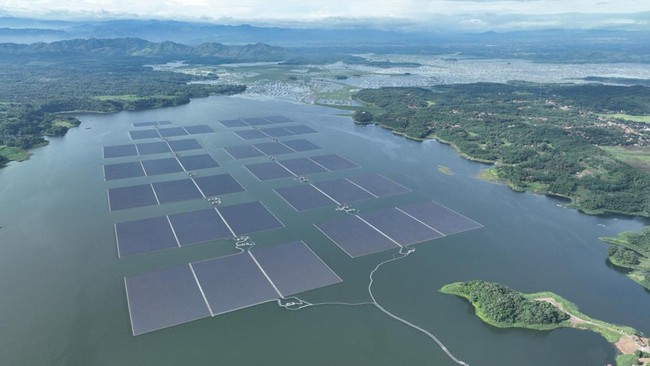
Strategies include the massive utilisation of state-owned land, the use of reservoirs, and the implementation of Battery Energy Storage Systems (BESS) to guarantee the reliability of the national system. Darmawan emphasised that the availability of land facilitated by the government is key to reducing the basic cost of electricity production, ensuring it remains competitive and affordable for the public.
“This is a fast-track programme where we are not only deploying solar plants but also solar plants integrated with Battery Energy Storage Systems (B ESS). Because the land is provided by the government and we are also utilising reservoirs, this naturally makes the solar programme very economically competitive,” Darmawan stated during a Hearing with Commission XII of the Indonesian House of Representatives (DPR RI) in Jakarta on Thursday.
In PLN’s mapping, solar development is highly sensitive to land prices; an increase in land costs from Rp 200,000 to Rp 600,000 per square metre could drive electricity tariffs up by 3 cents per kilowatt-hour (kWh). As an anticipatory measure, there is a proposal to utilise 28,000 hectares of land, with approximately 8.5 GWp ready for development on Java Island following alignment with existing transmission network maps.
“Additionally, there is the development of solar plants with BESS in reservoirs covering 10,000 hectares. This is for Java Island alone, which adds 10 Gigawatt peak. We are also building solar plus BESS specifically for Bali and Madura islands,” he explained.
For the first phase of this mega-project, PLN targets a capacity of 27.4 GWp combined with battery storage of 82.5 GWh. This capacity increase is planned to be realised gradually, with 4.6 GW in 2027, 4.4 GW in 2028, and a target to reach an accumulated addition of 19.1 GW by 2030. By 2028, the company plans to build BESS + floating solar projects using state reservoirs up to 3.1 GW.
In PLN’s presentation, the company will utilise BESS from excess energy in the system amounting to 1.3 GW in 2027. Furthermore, the BESS + solar programme under the Electricity Supply Business Plan (RUPTL) for the Java system is set at 2.8 GW. There is also a B2ESS + solar programme to eliminate fuel usage in the Bali system (0.3 GW) and the Madura system (0.2 GW).
Additionally, the ‘Fuel Burning’ reduction programme launched in Bali aims to reduce dependence on fuel oil (BBM) for power generation by 586,000 kilolitres. This is achievable through the installation of 3,000 MWh of BESS and 1,400 MWp of solar power, requiring up to 1,400 hectares of land.
“This strategy will facilitate not only the strengthening of power capacity on Java island but also increase its reliability and reduce the consumption of imported-based fuels, replacing them with domestic-based energy,” he noted.
The company is also initiating the development of a ‘green corridor’ by installing solar panels along 802 km of Jasa Marga toll roads and mapping energy conversion at 741 diesel power plant locations across Indonesia. This upstream-to-downstream integration is projected to strengthen national energy sovereignty and accelerate the achievement of net-zero emission targets.
“The development of 100 Gigawatts of solar power, as directed by President Prabowo Subianto, is a flagship programme to ensure energy self-sufficiency and to effectively lower the basic cost of electricity production,” he concluded.
Source: jawawa.id (https://jawawa.id/newsitem/pln-boss-reveals-strategy-to-build-100-gw-of-solar-power-plants-1783079521)
Originally published by CNBC Indonesia (https://www.cnbcindonesia.com/news/20260703161602-4-747904/bos-pln-beberkan-strategi-bangun-100-gw-plts), translated from Indonesian