
PLN and Pelindo Inaugurate 1 MVA Onshore Power Supply at Tanjung Priok
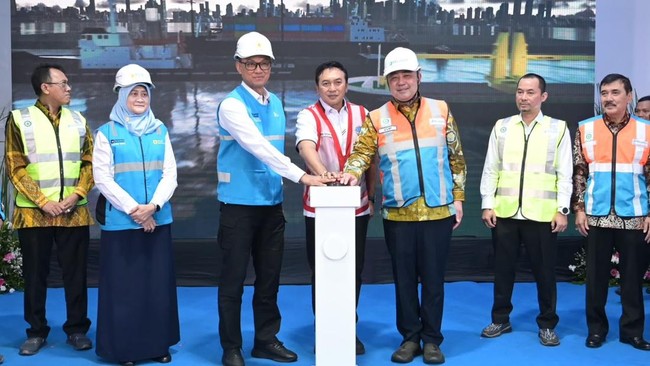
PT PLN (Persero) together with PT Pelabuhan Indonesia (Pelindo) have inaugurated two Onshore Power Supply (OPS) units with a total capacity of 1 megavolt ampere (MVA) at the Nusantara Multipurpose Pier (DSN), Tanjung Priok Port, North Jakarta. This facility serves as the first unit of a development programme involving 24 OPS units in Tanjung Priok, as part of a synergy between both parties to support efficiency and decarbonisation in the maritime sector.
The two OPS units, built and operated by PT Energi Pelabability Indonesia (EPI)—a joint venture between PT PLN Electricity Services and PT Pelindo Jasa Maritim—each have a capacity of 500 kilovolt ampere (kVA). This facility enables ships while berthed to switch off their diesel engines and transition to a more efficient and cleaner electricity supply from the shore.
The President Director of PLN, Darmawan Prasodjo, stated that the provision of electricity for the Onshore Power Supply (OPS) facilities aligns with President Prabowo Subianto’s ‘Asta Cita’ vision, particularly in driving industrial decarbonisation as part of the transformation towards sustainable development in the maritime sector through the development of a Green Port. This effort is crucial, given that the maritime sector contributes to global greenhouse gas emissions, while a significant portion of ship emissions in ports stems from the use of diesel engines during the berthing process.
“The presence of OPS facilities in Tanjung Priok provides a solution to reduce emissions from ships while berthed in the port. Through OPS, the electrical needs of ships can be met from land-based power sources, thereby suppressing the use of diesel engines. This step is part of PLN’s efforts to support the decarbonisation of the maritime sector while encouraging the realisation of a greener and more sustainable port ecosystem,” Darmawan said in an official statement on Thursday.
He added that the provision of electricity for OPS facilities demonstrates the readiness of PLN’s electrical infrastructure to support energy needs in the port area. This support also strengthens the electrification of the maritime sector, which requires a reliable power supply to support vessel operational activities while in port.
“Reliable electrical support is one of PLN’s commitments to accommodate clean energy needs in both port areas and large-scale industries. This is a form of State-Owned Enterprise (BUMN) synergy in supporting the transformation of the port sector through the utilisation of domestic energy, while simultaneously driving productivity through savings for maritime business actors and optimising port activities,” said Darmawan.
The President Director of PT Pelindo (Persero), Achmad Muchtasyar, stated that the operation of OPS is a vital part of driving the transformation of port areas towards greener and more efficient operations. According to him, the use of electricity from the shore also supports the creation of a more productive and sustainable port ecosystem.
“OPS is not merely replacing a ship’s power source from a generator to land-based electricity. It is a concrete step in the transformation of Tanjung Priok Port towards a green port, by providing energy that is more efficient, cleaner, and more reliable. We want to build a port ecosystem that is not only increasingly productive but also increasingly sustainable,” said Achlamd.
The OPS facility at DSN, Tanjung Priok, is the first in Indonesia to pass the international standard test IEC/IEEE 80005-3:2025. Its reliability was proven through a series of full connection trials last July, which allowed all ship generators to be turned off while berthed. Through this OPS system, electricity from the PLN grid is distributed to ships via conversion facilities that support both 50 hertz (Hz) and 60 Hz frequencies, enabling the service of two to four ships simultaneously.
Meanwhile, the President Director of PT Energi Pelabuhan Indonesia, Andriyuda Siahaan, stated that the development of OPS is planned to be carried out gradually, starting with 24 units in the Tanjung Priok Port area in 2027, with the potential to be replicated in multipurpose terminals, general piers, and other ports, reaching a total of 123 OPS units by 2050.
Following the results of the OPS trials in Tanjung Priok, Andriyuda continued, there was a significant efficiency in fuel oil (BBM) usage per berthing period.
“We conducted trials, and in less than 24 hours, the efficiency reached approximately 700 litres (equivalent to 50 to 60 per cent per berthing day). It took less than 24 hours,” said Andriyuda.
He added that the benefits of this efficiency would grow even larger if OPS implementation were expanded. With full implementation across 24 units with a total capacity of 12 MVA planned for construction, the potential fuel savings are estimated to reach approximately 4-5 million litres per year, with a potential reduction in emissions of up to around 8-10 thousand tonnes of CO2 per year.
In addition to reducing carbon emissions, the use of land-based electricity also reduces air pollution, noise, and vibrations caused by ships while berthed. Regarding the quality of the supply, trial results showed that the voltage remained at a stable level.
“The results of the OPS trials in Tanjung Priok prove that port electrification provides a measurable impact, ranging from fuel savings of up to 60 per cent per berthing day, a reduction in carbon emissions of about 1.5 tonnes of CO2 per berthing day, the elimination of generator smoke and noise, to a much more stable power quality for ships,” concluded Andriyuda.
Source: jawawa.id (https://jawawa.id/newsitem/pln-and-pelindo-inaugurate-1-mva-onshore-power-supply-at-tanjung-priok-1789661511)
Originally published by CNBC Indonesia (https://www.cnbcindonesia.com/news/20260917202825-4-768855/pln-pelindo-resmikan-onshore-power-supply-1-mva-di-tanjung-priok), translated from Indonesian