
PLN and GGGI Sign One of the World’s Largest Carbon Agreements
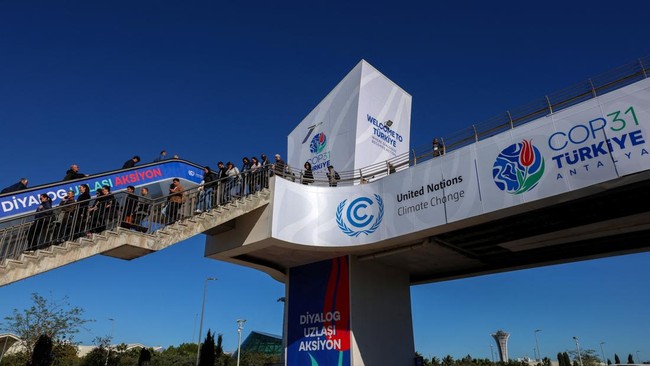
Jakarta, CNBC Indonesia — State-owned electricity company PT PLN (Persero) has made history for Indonesia through one of the world’s largest carbon-trading partnerships. The achievement was marked by the signing of Indonesia’s first Mitigation Outcome Purchase Agreement (MOPA) between PLN and the Global Green Growth Institute (GGGI), under the Indonesia–Norway bilateral partnership, at the 31st Conference of the Parties (COP31) in Antalya, Türkiye, on Wednesday, 11 November 2026.
The agreement is a concrete step towards linking climate-change mitigation in Indonesia with international carbon-financing mechanisms. Under the scheme, carbon finance from the Indonesia–Norway partnership will be mobilised to support clean-energy projects, particularly solar power plants, which will contribute to reducing greenhouse-gas emissions and strengthening national energy security.
Environment Minister and Head of the Environmental Control Agency Mohammad Jumhur Hidayat said the MOPA signing showed that international cooperation could be translated into mitigation action that benefits Indonesia.
“Through the Indonesian Climate and Carbon Partnership (ICCP), we connect Indonesia’s climate priorities with the expertise, technology and funding of our partners. This agreement is a practical step in implementing bilateral cooperation under Article 6.2 of the Paris Agreement between Indonesia and Norway. We will ensure that every emissions reduction is measurable, credible and accountable,” Jumhur said in a written statement on Saturday, 14 November 2026.
He added that the government was continuing to develop carbon-trading governance, including a registry system, authorisation, and reporting and accounting mechanisms to prevent emissions reductions from being counted twice.
Norwegian Climate and Environment Minister Sigrun Aasland said the partnership was one of the world’s largest carbon-trading programmes, designed to drive emissions reductions of up to 12 million tonnes of CO₂.
“Norway and Indonesia are marking the signing of one of the world’s largest carbon programmes. Through this agreement, Norway will help build solar power plants in Indonesia. This will provide cleaner electricity, strengthen energy security and cut emissions on a large scale. That is the main purpose of this collaboration, and today we are demonstrating how the mechanism can work in practice,” Sigrun said.
Through the partnership, Indonesia will implement a Generation-Based Incentive (GBI) programme, a results-based incentive scheme that supports renewable power projects connected to the electricity grid. The initial focus will be on solar power development, including projects equipped with Battery Energy Storage Systems (BESS).
She added that carbon finance would be directed towards clean-energy projects facing viability challenges, including projects requiring transmission infrastructure and energy-storage facilities.
PLN President Director Suroso Isnandar said the partnership was an important part of the company’s efforts to turn Indonesia’s energy-transition agenda into investment and tangible projects. International carbon-financing mechanisms, he said, could accelerate renewable-energy development while creating economic value from emissions reductions.
“PLN’s message at COP31 is about turning Indonesia’s energy-transition ambitions into investment and concrete action. Through the 2025–2034 Electricity Supply Business Plan (RUPTL), PLN has a clear roadmap to add 69.5 GW of generating capacity, around 76% of which will come from renewables, BESS and other clean-energy sources. This Article 6.2 partnership is an important instrument for connecting the national energy-transition agenda with international financing support,” Suroso said.
He added that since COP30, PLN had secured US$2.94 billion in energy-transition financing from development partners and export-finance institutions. A further US$300 million in potential project financing is also nearing financial close.
“Through the Indonesia–Norway partnership, PLN and GGGI are helping to operationalise the Article 6.2 mechanism as a new channel for financing the energy transition. This shows how international collaboration can link climate-mitigation outcomes with the development of clean-energy infrastructure at home,” Suroso added.
Suroso further stressed that renewable-energy development required sustained collaboration among the government, development partners, investors, project developers, financial institutions and technology providers. PLN, he said, remained open to partnerships to accelerate the delivery of clean-energy projects across Indonesia.
“Through this cooperation, Indonesia and Norway are expected to strengthen the implementation of international carbon markets while encouraging investment in clean-energy projects. For Indonesia, this will not only contribute to national climate targets, but also bring wider benefits in the form of energy security, economic growth, job creation and greater access to cleaner energy for the public,” he concluded.
Source: jawawa.id (https://jawawa.id/newsitem/pln-and-gggi-sign-one-of-the-worlds-largest-carbon-agreements-1794639030)
Originally published by CNBC Indonesia (https://www.cnbcindonesia.com/news/20261114130012-4-785226/pln-dan-gggi-teken-salah-satu-perjanjian-karbon-terbesar-di-dunia), translated from Indonesian