
PLN Accelerates 1,102-Tower Network and 920 MW Power Plant Construction to Prevent Electricity Deficit
PT PLN (Persero) projects that the peak electricity load in South Sulawesi will surge to 2,895 Megawatts (MW) by 2034, growing at an average of 6.2% per year. To anticipate this spike and meet the needs of industrial downstreaming, PLN is accelerating massive electricity infrastructure development through an additional 920 MW of generation capacity and an 876-kilometre circuit (kms) transmission network reaching remote areas. Amid this ambitious project, PLN has also asserted that issues regarding electricity tariff increases and coal scarcity are untrue.
PT PLN (Persero), through its Development Unit (UIP) Sulawesi, has officially commenced implementation of the Electricity Supply Business Plan (RUPTL) for the 2025-2034 period in the South Sulawesi region. This strategic step follows predictions that the number of customers will reach 4.1 million by the end of the next decade, with average electricity consumption growth of 3.7% per year.
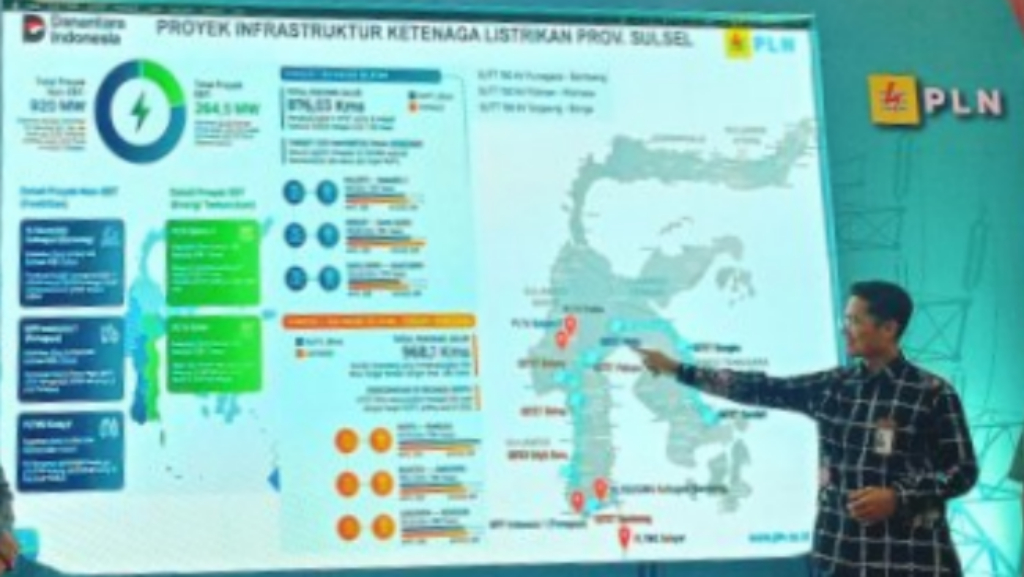
Senior Manager of Planning at PLN UIP Sulawesi, Misdjan Endang Subrata, explained that the company has prepared an energy mix from both non-New Renewable Energy (EBT) and EBT plants to maintain supply stability. From the non-EBT sector, PLN is building generation capacity predominantly totalling 920 MW sourced from gas, steam, and gas engine technologies to secure the base load of the South Sulawesi (Sulbagsel) electricity system. Concrete projects underway include the Subangsel Gas and Steam Power Plant (PLTGU) in the Bantaeng industrial area, and the Mobile Power Plant (MPP) Indonesia 1 in Punagaya, Jeneponto, focused on strengthening the region’s electricity system. “We are also ensuring energy justice for communities in the Selayar Islands by building the Selayar Gas Engine Power Plant (PLTMG),” said Misdjan.
Meanwhile, to support the green energy transition, PLN is developing water-based EBT plants by utilising river basins. These projects include adding capacity to the existing Bakaru Hydroelectric Plant to become Bakaru 2, and constructing the Pokko Hydroelectric Plant on the same river system. On the transmission side, PLN is building large-scale infrastructure dubbed the Southern Backbone Corridor 1. This project consists of a 275 kV Extra High Voltage Overhead Line (SUTET) connecting five main Extra High Voltage Substations (GITET) in South Sulawesi, with a total route length of 876.03 kms and 1,102 towers. The details include the Palopo–Bakaru 2 line spanning 210 kms (263 towers), the Sidrap–Daya Baru line spanning 312.99 kms (394 towers), and the Daya Baru–Bantaeng line spanning 222.50 kms (279 towers).
To reach remote areas, PLN is also constructing High Voltage Overhead Lines (SUTT) at several strategic points, such as the Punagaya-Bantaeng SUTT to connect generation reinforcement, and the Polman-Mamasa SUTT specifically targeted to supply electricity to the Mamasa area, which has so far relied on diesel power plants. Additionally, the Soppeng-Bengo SUTT is being built to strengthen electricity resilience in the southern part of South Sulawesi. Misdjan acknowledged that a project of this scale is not without challenges, particularly in the pre-construction phase covering permits, land acquisition, and compensation. “We understand there will be friction with communities, especially regarding land. But we are doing all this for the common good, not solely for PLN’s interests. This is an effort towards energy self-sufficiency felt by all people,” he stressed.
General Manager of UIP Sulawesi, I Gusti Made Aditya San Adinatha, added that reliable electricity supply is the main foundation for attracting investment and boosting downstream industries in Sulawesi, particularly South Sulawesi. “The realisation of reliable electricity supply is an important factor in driving sustainable economic growth,” he said. Amid the intensive development, rumours have circulated in the community regarding planned electricity tariff increases and dwindling coal stocks. Responding to this, Manager of Communications and TJSL at PLN’s South, Southeast, and West Sulawesi Distribution Unit (UID Sulselrabar), Ahmad Amirul Syarif, firmly denied the information. “To date, there has been no increase in electricity tariffs, either for prepaid or postpaid customers. God willing, the coal supply for the Sulbagsel system remains in a safe condition,” Amirul stated briefly.