
Plastic Bottles Turned into Puppets: How Much Difference Does It Make to Waste Reduction?
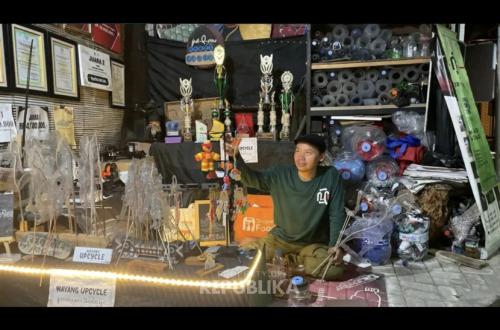
YOGYAKARTA — Yogyakarta City generates around 306.6 tonnes of waste a day. Amid this challenge, waste processing at source is one of the approaches being encouraged. Many types of waste still have the potential to be reused, including plastic bottles, which can be made into craft products such as puppets.
One such initiative is run by Paqone Waste Bank in Gedongkiwo, Mantrijeron, Yogyakarta City. By processing polyethylene terephthalate (PET) plastic bottles, the community is seeking to increase the value of waste that was previously sold mainly by weight. However, turning it into crafts still presents challenges, from selecting suitable raw materials to the shortage of skilled workers.
According to data from Yogyakarta City’s Environmental Agency (DLH), presented on 26 October 2026, 209.97 tonnes of waste a day had undergone processing. A further 51.4 tonnes a day was reduced directly at source. Yogyakarta City Government data from July 2026 also recorded upstream waste management at 47.68 tonnes a day, up from 21.20 tonnes a day in 2025. This upstream figure covers various methods, including waste banks, organic waste processing and other waste-reduction activities.
From collected waste to craft materials
Paqone Waste Bank grew out of a non-profit arts centre run by the local community. Budi Anggoro, a manager at Paqone, said that in 2017 children attending the centre began bringing in waste that could be sold. The proceeds helped cover the centre’s operating costs.
“The centre is non-profit, so the children who attend bring in waste that we can sell. The proceeds then help fund its operations. Over time, we thought: why not set up a waste bank as well?” Budi said when met at Paqone Waste Bank in Gedongkiwo, Mantrijeron, Yogyakarta City, on Friday (30 October 2026).
As waste collection continued, the managers began developing ways to use plastic waste. In 2021, they started turning PET bottles into puppets through a product line called Wayang Upcycle. The initiative was prompted by the low value of bottles sold only by weight. Budi said that at the time PET bottles fetched around Rp3,500 per kilogram, with roughly 40 bottles to a kilogram.
By turning them into crafts, the bottles are treated not merely as waste to be sold to collectors, but as raw materials that can be shaped into new products. One such product is a puppet made from the body of a plastic bottle.
The process begins by sorting bottles according to their condition and material quality. Not every bottle found or collected can be used in production. Budi said bottles must meet specific criteria to withstand the shaping process.
Bottles that do not meet those criteria are not used for crafts, making the quality of bottles deposited by members important.
A puppet about 50 centimetres tall requires roughly eight 1.5-litre mineral-water bottles. The bottles are shaped using a heat gun. Production times vary according to the character’s form and complexity. Budi said a Wolverine character can be completed in less than an hour and a half, while Petruk takes around two and a half hours or more.
Paqone’s plastic processing is not limited to using bottle bodies for puppets. Other parts of the packaging are used for different products. Bottle caps, for example, can be made into accessories or key rings, while plastic labels are used to make ecobricks. The materials are used according to their characteristics and how they can be processed, so not every part of a package is made into the same type of product.
Budi estimates that Paqone uses at least 200 plastic bottles a month for its various products. This is the minimum number used across all its crafts, not the number of bottles made into puppets alone.
The puppets also have a cultural dimension. Some combine traditional wayang figures, such as the Punakawan characters, with popular figures from films, superhero franchises and anime. Budi said this approach was intended to encourage young people familiar with popular characters to learn about traditional wayang.
“Many young people are unfamiliar with wayang, especially shadow puppetry. Young people in particular often do not know what wayang is or where it comes from. We would be sad to see this culture disappear,” he said.
The process also requires particular equipment and skills. Alongside a heat gun, production uses supporting tools such as a laser machine and a 3D printer. These technologies help make some parts of the products, although artisans still need skills, particularly to shape and finish the puppet characters.
The waste bank’s system also changes the value assigned to the raw materials. Budi said good-quality bottles can be bought for around Rp300 to Rp500 each, depending on their condition. This differs from selling bottles to collectors by weight.
“A kilogram would normally fetch Rp3,500, but we pay Rp500 per bottle, or at least Rp300. We also take the bottle’s quality into account,” Budi said.
He said paying according to quality encourages members to pay more attention to the condition of bottles before depositing them. Good bottles are separated and kept in suitable condition for use as craft materials.
Paqone Waste Bank currently has around 50 members and eight managers. Members do more than deposit waste: they can also help find and prepare materials when production requires them. For some orders, they may help with the work and earn additional income. Their involvement is on a partnership basis, according to need, rather than as permanent employees.
Budi said Paqone had once received an order for 216 puppets from a hotel in the Malioboro area, to be placed in 108 rooms. A large order requires extra labour and preparation of materials. In such cases, managers involve members and other partners to meet production needs. They also have a partner in East Java who can help when an order requires greater capacity and must be completed to a tight deadline.
Benefits for members and processing challenges
The waste bank’s work is not only about turning materials into crafts; it also encourages households to sort their waste. Heni, one of its members, said she had been with Paqone since September 2017. She sorts household waste before taking it to the waste bank, where it is weighed and recorded as savings.
“Household waste is reduced. The benefit is that the house is cleaner, and the feedback is that we also get money,” Heni said when met at Paqone Waste Bank in Gedongkiwo, Mantrijeron, Yogyakarta City, on Monday (2 November 2026).
Heni usually leaves the proceeds in her account and withdraws them about once a year, particularly before Eid. She uses the money for household needs such as syrup, bread and cooking ingredients.
“I save the money first. I usually withdraw it after about a year, around Eid,” she said.
Heni’s experience shows that sorting waste can bring direct benefits to households. As well as reducing the waste accumulating at home, the proceeds can be used for everyday needs. However, she said participation in her neighbourhood was not yet widespread.
“Across the whole neighbourhood unit, participation is still somewhat limited, although quite a lot of residents are already sorting waste or saving through the waste bank,” Heni said.
This suggests that setting up a waste bank does not automatically lead everyone to sort their waste. Household sorting needs to become more widespread so that reusable waste is not mixed with other rubbish. Residents’ participation is also important to the continued collection and processing effort.
At the same time, turning waste into crafts has its own limitations. Budi said one of the main challenges was finding people with the skills to make puppets. The work cannot be done by everyone, as it requires precision and specialised ability.
“Thankfully, our biggest challenge so far has been finding people. Not everyone can make wayang,” he said.
The shortage of skilled workers affects the ability to fulfil large orders. When demand rises, managers need to bring in additional partners to meet deadlines. The raw materials must also be sorted by quality, so not all collected plastic bottles can be used immediately.
Paqone plans to expand its use of discarded plastic to a wider range of products, including accessories and fashion items. Budi hopes the output will be useful in everyday life rather than merely decorative. However, product development still depends on skills, access to suitable materials and production capacity.
“Waste is a shared problem that affects many people. We hope people will also take part in processing it. We would be very happy if more people joined in,” he said.
Turning plastic bottles into puppets and other crafts shows that waste can be reused when it is sorted and processed according to the material’s characteristics. However, the initiative remains limited by the volume and quality of materials it can use and by the availability of skilled workers. Craft production also cannot address every type of waste generated by the community.
For that reason, making useful products from waste needs to go hand in hand with household sorting and broader waste management. Community initiatives such as Paqone Waste Bank can contribute to waste reduction, but their impact will be greater if more residents take part and systems are available to process different types and volumes of waste.