
Planting Green, Harvesting the Sea
Environmental crises don’t always require expensive mega-projects; sometimes solutions emerge from restoring lost ecological balance.
Surabaya - The coastal winds of Surabaya, East Java, no longer carry just the salt of the sea and mud from fish ponds. In the Wonorejo to Gunung Anyar areas, they also bring new hope for how the coastal city can withstand erosion, climate crises, and shrinking habitats for fish farmers.
This hope springs from mangrove roots, now seen not as obstacles to productivity but as part of the coastal economic system itself.
Amid urban development pressures, Surabaya’s coastline faces challenges common to many Indonesian coastal cities: relentless erosion, deteriorating water quality, rising temperatures, and a weakening coastal ecosystem. Meanwhile, fish farmers must remain productive to sustain their livelihoods.
This is where silvofishery or wanamina becomes relevant. The concept of combining fish farming with mangrove planting is now being seriously developed by Surabaya City Government through the Regional Research and Innovation Agency (BRIDA) and the Department of Food Security and Agriculture.
The core idea is simple but impactful: fish ponds are no longer separated from mangrove forests. Mangrove trees are planted and maintained within farming areas to create a natural ecosystem that supports fish, shrimp, and crab growth while preserving coastal environmental quality.
Notably, this approach isn’t born from conservationist romance alone. Surabaya is proving that environmental protection doesn’t have to conflict with residents’ economic interests.
For years, many mangrove areas in Indonesia were cleared to expand conventional fish ponds. Mangroves were seen as reducing production space and narrowing farming areas, leaving coastlines vulnerable to erosion and saltwater intrusion.
However, research shows mangroves have far more complex ecological functions: their roots stabilise sediment, absorb carbon, serve as fish breeding grounds, and maintain water quality. This ecosystem creates a life cycle that actually boosts fishery productivity.
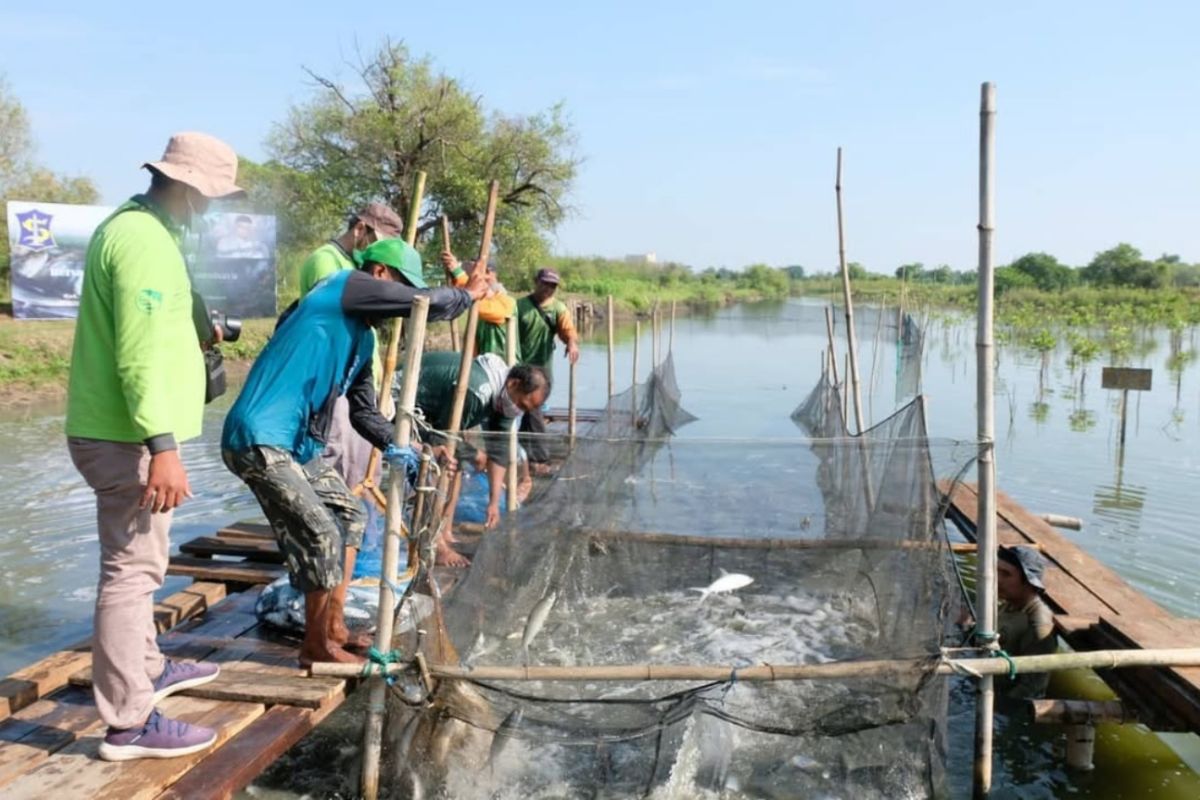
Surabaya is re-evaluating this relationship. The 2021 harvest of mullet in the Wonorejo mangrove area serves as an early example. From a one-hectare silvofishery pond, the area produced around 1.25 tonnes of mullet and vannamei shrimp. The figures demonstrate that mangrove integration does not automatically reduce farming yields.