
Plan to Establish Territorial Development Battalions Urged to Prioritise Dialogue
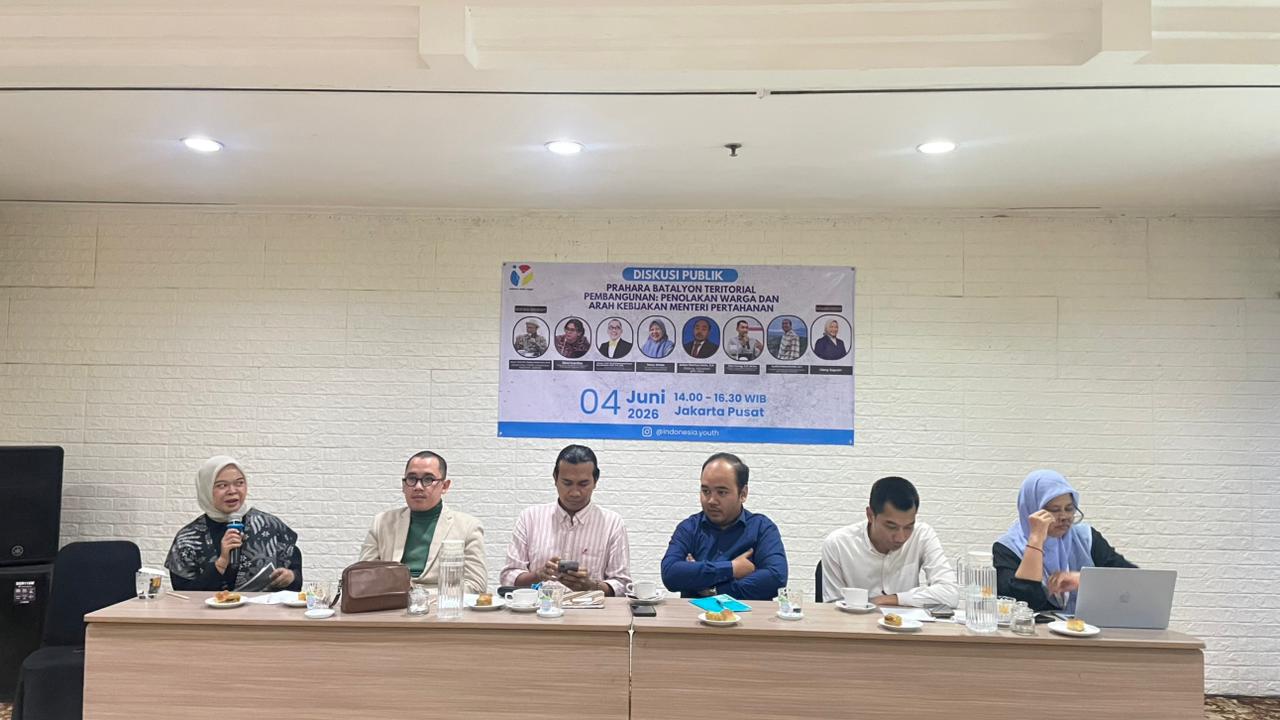
The government’s plan to establish 750 Territorial Development Battalions (BTP) over the next five years has come under the spotlight of various public policy researchers, legal experts, and academics. This policy is considered to require in-depth evaluation and a dialogical approach to harmonise the national development programme with the aspirations of communities in the regions. This issue surfaced during a public discussion entitled ‘The Territorial Development Battalion Storm: Citizens’ Rejection and the Defence Minister’s Policy Direction’ held in Central Jakarta on Thursday (4/6/2026). The territorial resilience structuring plan was previously presented by Defence Minister Sjafrie Sjamsoeddin during a working meeting with Commission I of the Indonesian House of Representatives on 19 May 2026, targeting the formation of 150 battalions annually to meet the needs of 514 districts/cities.
Public Policy and Governance Researcher Gian Kasogi explained that the government positions the BTP as an instrument to support regional development, strengthen food security, and address crime issues. However, he stressed the importance of maintaining clear boundaries between state defence functions and civilian administrative functions. ‘The TNI Law explicitly places the Indonesian National Armed Forces (TNI) as a state defence instrument. Involvement in civilian affairs through the Military Operations Other Than War (OMSP) scheme still has boundaries regulated by law,’ Gian stated. Based on media monitoring data from January to May 2026, dynamics and aspirations in the form of rejection from some community groups have emerged in several regions, such as Aceh, Papua, East Java, Central Java, and South Sulawesi.
The dynamics on the ground generally relate to issues such as the settlement of land ownership and designation status (agrarian), the need for more inclusive and transparent public consultation spaces, and adjustments to the living spaces of indigenous communities, farmers, and local residents. ‘Field facts show that the establishment of these new headquarters often intersects with local residents’ activity areas. Therefore, it is crucial for the government to prioritise a dialogical approach in resolving these social dynamics,’ Gian added. Meanwhile, Legal and Strategic Litigation Researcher Syaiful Hidayatullah underlined that the fulfilment of legal and human rights aspects in every public policy must prioritise meaningful public participation. This step is crucial to mitigate the risk of social tensions and potential horizontal conflicts in affected areas.
‘Every policy concerning residents’ living spaces should be carried out transparently, participatively, and with respect for the constitutional rights of the community. We hope the government opens balanced communication channels with local residents before this programme is implemented,’ said Syaiful.