
PKS MPR Faction Dissects Sharia Economy as Solution to National Economic Problems
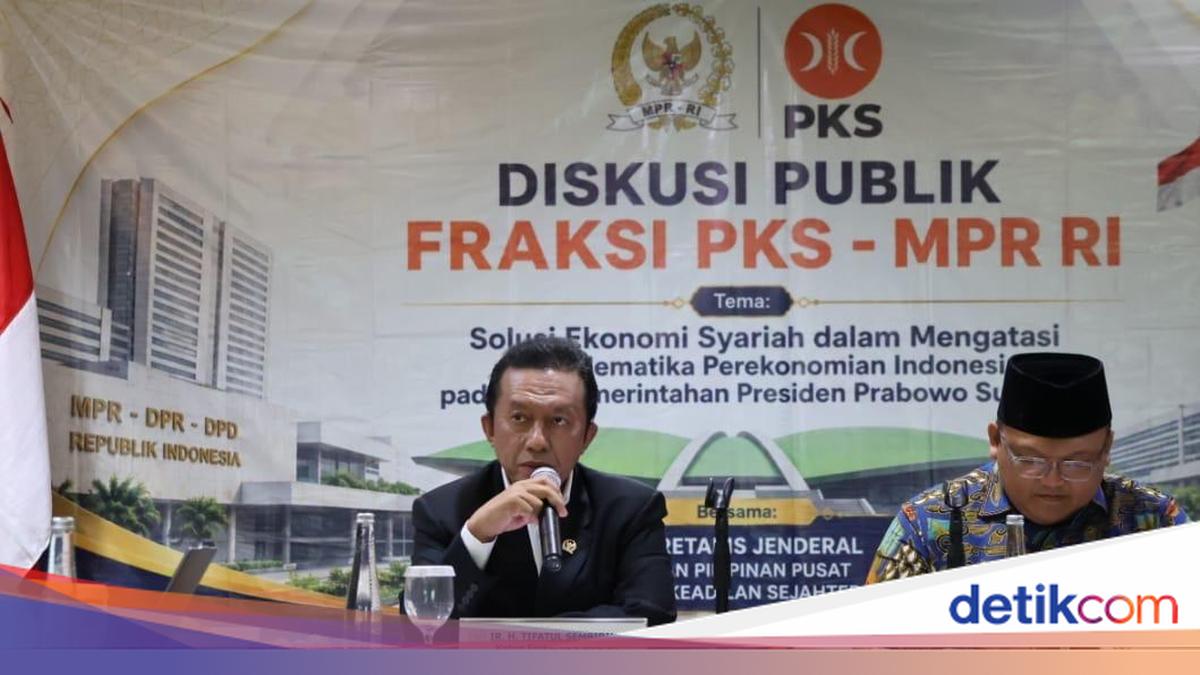
The Prosperous Justice Party (PKS) faction in the People’s Consultative Assembly of the Republic of Indonesia (MPR RI) held a national public discussion titled ‘Sharia Economic Solutions in Overcoming Indonesia’s Economic Problems in the Era of President Prabowo Subianto’s Administration’. The discussion brought together policy practitioners, academics, and regulators to address economic challenges from an Islamic perspective. PKS MPR faction chairman Tifatul Sembiring asserted that the sharia economic system, derived from the Qur’an and Sunnah, embodies the principles of balance (tawazun) and justice. He criticised the current dominance of the global capitalist system, which he said often disrupts the natural chain of sustenance through monopolies and resource exploitation. ‘Islam views wealth as a trust for the common good, not to be monopolised. The potential of the global halal industry, from food to tourism, is massive. However, Indonesia faces a major challenge because the level of Qur’anic literacy and public understanding of sharia still needs to be continuously improved. The sharia economy must be built structurally, not just as a seasonal response, so that it can become a positive challenge to the global economic system,’ Tifatul stated. The event was held in Depok, West Java, to formulate the real contribution of the sharia economy to national economic stability and growth under the new leadership. Meanwhile, PKS Secretary General M. Kholid explained that Indonesia is currently facing a vulnerable global economic situation, marked by a ‘triple deficit’ phenomenon, namely fiscal deficit, trade balance deficit, and balance of payments deficit. ‘As part of a constructive, productive, and solution-oriented governing coalition, PKS not only corrects but also offers alternative solutions. PKS, which makes Islam its ideological principle and justice its working ideology, wants to offer the sharia economy not merely as an add-on, but as a concrete non-conventional breakthrough to strengthen the national fiscal and monetary system,’ said M. Kholid. Dr. Handi Risza, Vice Rector of Paramadina University and moderator of the discussion, emphasised the momentum, noting that the halal industry and Islamic finance have been included in the national planning documents, the RPJPN and RPJMN 2025-2029. He stressed that amidst stagnant national economic growth at around 5 percent, the sharia economy must be pushed to become a new engine of growth. Responding to this, Dr. Banu Muhammad, Head of the Islamic Social Fund Cluster at PEBS FEB University of Indonesia, highlighted the massive gap between the potential and realisation of Islamic social funds. The national zakat potential reaches Rp 327 trillion, but actual collection is only around Rp 41 trillion. Similarly, the potential for cash waqf is Rp 180 trillion, with realisation still below 2 percent. ‘If optimised, the total potential of zakat, infaq, alms, and waqf (Ziswaf) reaches Rp 500 trillion, equivalent to 14 percent of the state budget. Looking back at the glory days of Islam, waqf acted as a second state budget, providing public goods such as free education and health facilities without burdening the state finances. The government needs serious political will, including transforming waqf management digitally and training professional, progressive nazir human resources,’ said Dr. Banu. Dr. Setiawan Budi Utomo, Director of Specialist Research and Widyaiswara at the OJK Institute, stressed that Islamic finance must transform from mere sharia compliance to sharia competence. This step is considered crucial to boost the sector’s market share, which is still stuck in single digits. He further elaborated on the Economic Sovereignty Framework, which integrates sovereignty in the financial, commodity, energy, digital, halal industry, and human resource quality sectors. He also floated a visionary idea to transform the Hajj Financial Management Agency (BPKH) into a ‘Sovereign Ummah Wealth Fund’, which, with accountable governance, could fund large-scale productive strategic projects. Meanwhile, Prof. Irfan Syauqi Beik, Dean of the Faculty of Economics and Management at IPB University, noted that Indonesia’s position in the State of the Global Islamic Economy (SGIE) Report recently dropped to fourth place, overtaken by the United Arab Emirates. Yet, the contribution of the Halal Value Chain (HVC) sector to the national Gross Domestic Product (GDP) continues to increase, reaching 27.34 percent. ‘We must not only be a consumer market but must seize the role of a global producer. The main strategy that must be executed is diversification into non-traditional markets such as Africa and South Asia, as well as accelerating the development of Halal Industrial Estates (KIH). Currently, we only have three official KIHs, far behind Malaysia which has 22 estates,’ Prof. Irfan revealed. Dr. Ferry Syarifuddin, Deputy Director of Bank Indonesia, provided a perspective on monetary policy from an Islamic economic viewpoint. In sharia economics, the ideal is to implement a full reserve banking system so that money supply growth aligns with real sector growth. He also warned of the risks of unproductive money printing or fiscal expansion, which could trigger high inflation, especially in volatile food prices. He also welcomed the Financial Sector Omnibus Law (UU P2SK).