
PKB Honours Five Kiai for Upholding Islamic Values and Nationalism
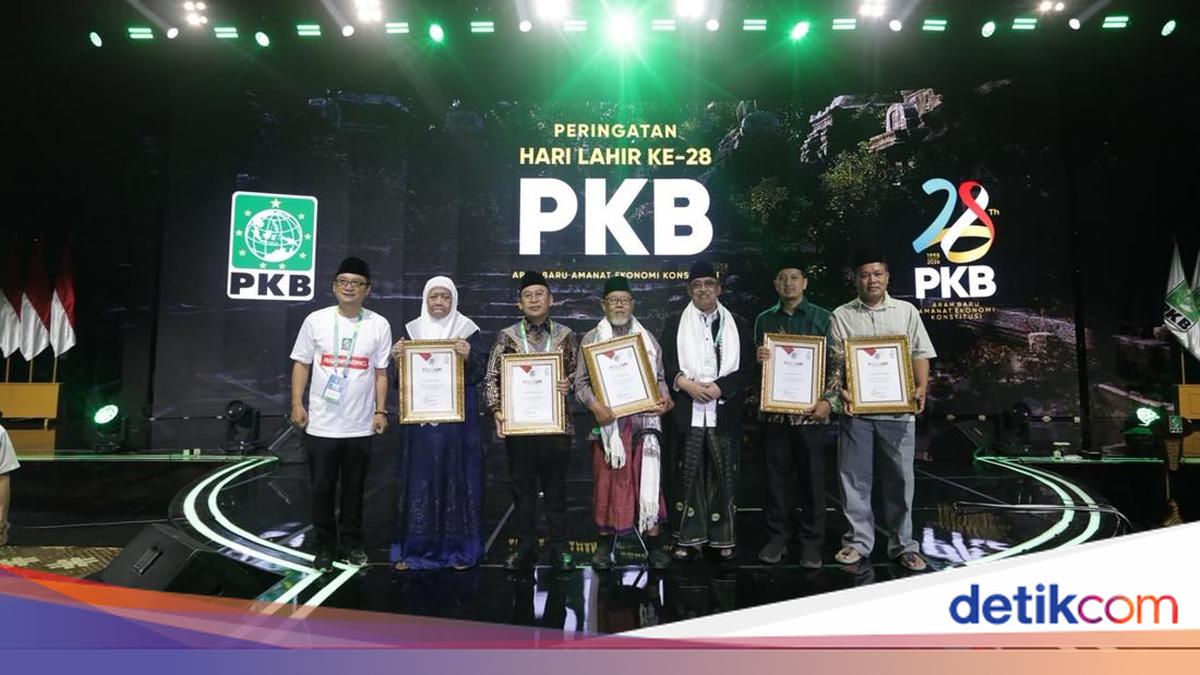
The National Awakening Party (PKB) has presented awards to five Islamic scholars (kiai) deemed to have made significant contributions to spreading Islamic teachings while instilling national values, Pancasila, and love for the homeland. The awards were presented by the Acting Chairman of the PKB Syuro Council, KH Manarul Hidayah, and PKB Secretary-General M Hasanuddin Wahid at the peak of the party’s 28th anniversary celebration at the Jakarta Convention Center (JCC), Senayan, Jakarta.
PKB Deputy Chairman Cucun Ahmad Syamsurijal stated that the five recipients are ulama who have dedicated their lives to pesantren education, Islamic propagation, and strengthening national unity. Cucun emphasised that the award is a form of respect from PKB for the kiai who consistently teach Islamic values integrated with the spirit of nationalism.
“We dedicate this PKB award to the kiai who preach and instil Islamic values in one breath with nationalism, Pancasila, and love for the homeland, using the people’s language that is easily understood by the ummah,” Cucun said in a written statement on Friday (24/7/2026).
According to Cucun, these kiai have demonstrated that love for Indonesia is an inseparable part of practising Islamic teachings. “Throughout their lives, they dedicated themselves to educating the ummah and the people that loving Indonesia is as important as loving their religion. Implementing Pancasila in daily life is as noble as carrying out the pillars of Islam,” Cucun said.
The five recipients of the award are:
- KH Sahal Mahfudh (represented by his son, Gus Abdul Ghoffar Rozin)
KH Sahal Mahfudh was the caretaker of the Maslakul Huda Islamic Boarding School in Kajen, Pati, Central Java, and served as the Rais Aam of the Nahdlatul Ulama Executive Board (PBNU) from 1999 to 2014. The charismatic ulama was known as a pious figure who not only taught students but also actively preached across various regions in Indonesia, carrying messages of Islam, morality, nationalism, Pancasila, and love for the homeland.
- KH Hasyim Muzadi (represented by his son, Gus Yusron Hasyim Muzadi)
The caretaker of the Al Hikam Islamic Boarding School and Chairman of PBNU from 2000 to 2010 was known as an ulama and intellectual who consistently spread the values of moderate Islam, nationalism, and Pancasila. His preaching reached various circles, from village study groups and academic forums at universities to international inter-civilisation dialogues.
- KH Imron Hamzah (represented by his wife)
KH Imron Hamzah was known as a charismatic preacher and orator with a firm, authoritative, yet easily understood preaching style. In addition to being active in preaching, he served as Chairman of the East Java Regional Board of Nahdlatul Ulama (PWNU) and was a member of the People’s Consultative Assembly (MPR) from 1987 to 1997.
- KH Ahmad Faqih (represented by his son, KH Mali Murtadlo, Lc)
The caretaker of the Al-Musri Islamic Boarding School in Cianjur was known as a warrior kiai who dedicated his life to religion and the struggle for Indonesian independence. KH Ahmad was once detained by the Japanese army for his involvement in the struggle alongside KH Zainal Mustofa against colonial rule. The boarding school he founded was also burned down by the Dutch army as part of the struggle to defend independence.
- KH Bukhori Masruri (represented by his son, Gus Farham Fuad)
KH Bukhori Masruri was known as an ulama, artist, and cultural figure who used art as a medium for preaching. He taught Islamic values, nationalism, Pancasila, and national unity through his works. KH Bukhori wrote the song ‘Perdamaian’ (Peace), popularised by the legendary group Bimbo, and was also known by the pen name Abu Ali Haidar. He served as Chairman of the Central Java Regional Board of Nahdlatul Ulama (PWNU) from 1985 to 1995.
Through this award, PKB reaffirmed its efforts to preserve the legacy of the ulama and pesantren who laid a strong foundation for religious, national, and state life. The exemplary conduct of these kiai is expected to inspire future generations to maintain harmony between Islamic values, nationalism, and the integrity of the Unitary State of the Republic of Indonesia (NKRI).