
PJT I Optimises Water Governance to Strengthen National Resilience Towards Golden Indonesia 2045
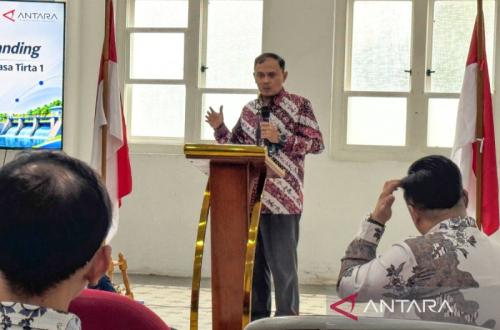
Perum Jasa Tirta (PJT) I is optimising the sustainable management of water resources from upstream to downstream. The move is intended to strengthen national water security in support of development towards Golden Indonesia 2045.
PJT I President Director Fahmi Hidayat stressed that the development targets set out in the National Medium-Term Development Plan (RPJMN) and National Long-Term Development Plan (RPJPN) through 2045 require strong water security. He said the threat of floods and droughts could hinder the achievement of the Golden Indonesia 2045 vision.
“If water security is not maintained, we will have floods in the rainy season and drought in the dry season. If this is not addressed, the Golden Indonesia 2045 target certainly will not be achieved,” Fahmi said in Jakarta on Monday.
Fahmi emphasised that water is a vital resource determining the continuity of agriculture, energy, industry, irrigation and various community needs across Indonesia. PJT I has been mandated to manage water resources under Government Regulation No. 46 of 2010.
Collaboration and preparation for climate threats
According to Fahmi, managing water from upstream to downstream is necessary to ensure supplies meet public needs while supporting food and energy security and economic activity. He underscored the importance of working with various stakeholders, as water-resource management cannot be carried out by one party alone.
Drought caused by prolonged dry seasons and El Niño anomalies poses a serious challenge. To address it, PJT I conducts weather-modification operations by cloud seeding in upstream areas such as Toba, Brantas and Bengawan Solo to increase water supplies during the dry season.
As the rainy season approaches, PJT I is strengthening the readiness of water-management infrastructure. Its focus is to maintain reservoirs’ flood-control functions while ensuring water availability for agriculture, energy, industry and communities. PJT I is also preparing flood-response guidelines to ensure water-resource management remains effective.
Water as the foundation of national self-sufficiency
Earlier, Coordinating Minister for Infrastructure and Regional Development Agus Harimurti Yudhoyono (AHY) stressed that water self-sufficiency is one of the main foundations of national development. Sustainable water availability is considered crucial for food and energy self-sufficiency, as well as industrial growth and digital transformation.
“Without water, it is difficult for us to achieve food self-sufficiency, because rice fields must be properly irrigated, especially when facing a long dry season and the El Niño phenomenon. The same applies to energy security: we want to continue optimising clean and renewable water-based energy resources,” AHY said in Jakarta on Thursday (15 October).
AHY made the remarks while chairing the National Water Self-Sufficiency Coordination Meeting at the Coordinating Ministry for Infrastructure’s office. The meeting also served as a forum for the National Water Resources Council. AHY explained that water self-sufficiency is an important part of President Prabowo Subianto’s Asta Cita priorities, ensuring adequate water supplies for communities, agriculture, livestock, industry and energy.
Source: jawawa.id (https://jawawa.id/newsitem/pjt-i-optimises-water-governance-to-strengthen-national-resilience-towards-golden-indonesia-2045-1795472448)
Originally published by Republika (https://news.republika.co.id/berita/toz3oj4430000/pjt-i-optimalkan-tata-kelola-air-demi-ketahanan-nasional-menuju-indonesia-emas-2045), translated from Indonesian