
Pioneer Ships: A Bridge of Hope for Sabutung Island Residents
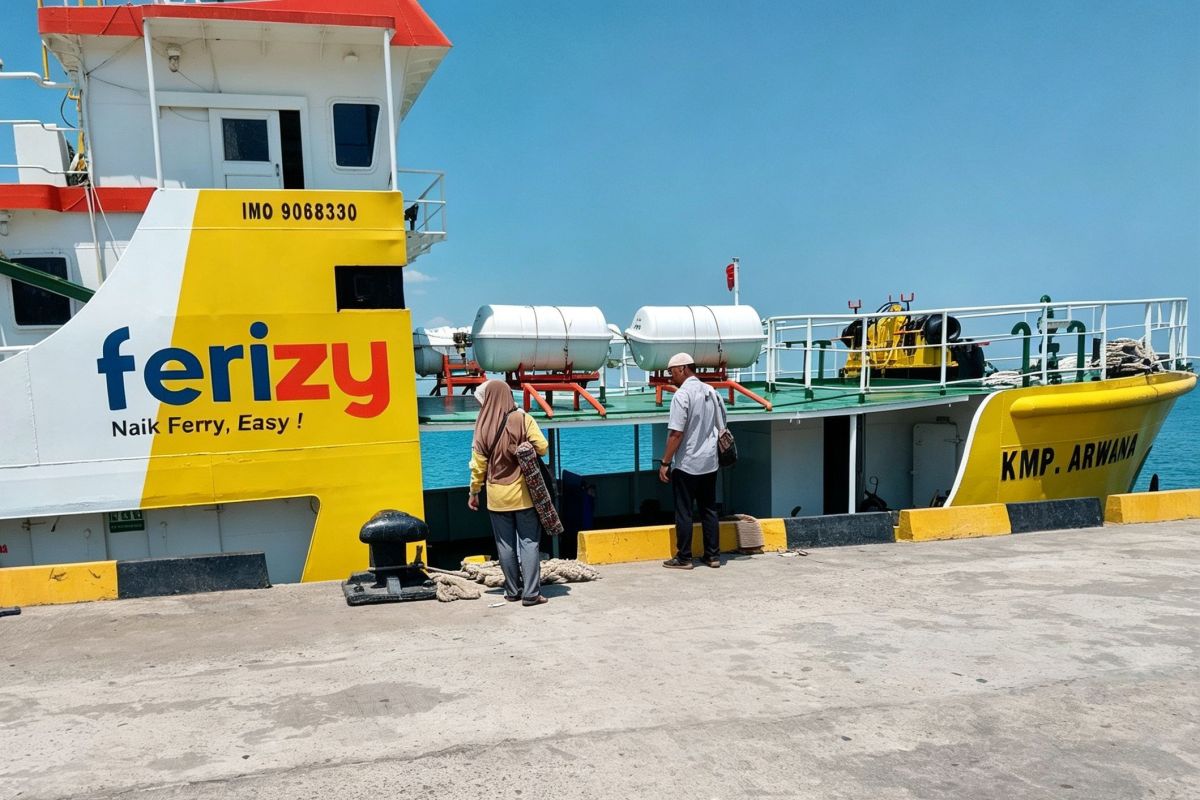
Makassar (ANTARA) - The golden rays of dawn in the eastern horizon accompany the daily activities of the residents of Sabutung Island, Pangkajene and Islands Regency, South Sulawesi, as they rush to the pier to board the pioneer ship.
Out of the total population of 1,453 people on Sabutung Island, many travel to the mainland for trading, administrative matters, daily necessities, or to carry out duties as civil servants (ASN).
Among them is Haedar, a teacher at the Perak Marine Boarding School on Sabutung Island. For him, the sea is not merely a stretch of water separating his teaching post from the administrative centre on the mainland; the sea is a routine part of his journey between the island and the Pangkep Regency mainland.
The presence of the pioneer ship, operated by PT ASDcal ASDP Indonesia Ferry Regional 4 since 23 January 2023, has made travel much easier for residents. For Haedar, the ship is not just a mode of transport, but a bridge connecting his teaching duties with mainland life.
“The fare on the pioneer ship is very affordable, around Rp21,000 per person. If you bring a motorcycle, it only adds an extra Rp5,000. This greatly assists those of us who frequently travel to the Pangkep Regency town,” said Haedar.
This fare is significantly lighter than renting wooden boats or fishing vessels, which can cost residents between Rp50,000 to Rp100,000 per trip. For island communities, this cost difference is substantial, as transportation is a recurring necessity, especially for those whose livelihoods require mobility between the island and the mainland.
Consequently, the pioneer ship provides much-needed breathing space for residents. Teachers can perform their duties, civil servants can manage government work, traders can transport goods, and the general public can more easily meet various needs.
However, for Haedar, the fare is not the only reason the pioneer ship is vital; safety is a much more pressing concern. Living in an archipelago means the people of Sabutung are intimately familiar with changing weather. When winds strengthen and waves rise, travelling via wooden boats or fishing vessels becomes a significant challenge.
In such conditions, Haedar feels much safer using the pioneer ship. He believes that during extreme weather, the pioneer ship is far more secure than traditional wooden vessels. This sense of security is crucial for residents who cannot afford to halt their mobility for long periods, as teachers must teach, traders must sell, and government services must continue.
Since the arrival of the pioneer ship, the activities of Sabutung residents have become smoother. Haedar’s story illustrates another facet of inter-island connectivity. On a map, a ferry route might appear as a mere line connecting two points, but for islanders, that line represents access to schools, government offices, markets, hospitals, and economic centres.
Connectivity is a key focus for PT ASDP Indonesia Ferry Regional 4 in strengthening connectivity across Eastern Indonesia. Executive Director of ASDP Regional 4, Imran Kuru, stated that connectivity is a primary focus because the Regional 4 operational area is vast, spanning Sulawesi, Maluku, and Papua.
Regional 4 comprises 10 branches: five in Sulawesi, two in Maluku, and three in Papua. Therefore, the state-owned enterprise is focused on strengthening routes that can enhance connectivity in these regions. In South Sulawesi, key examples of this connectivity include the Maccini Baji–Pulau Sabutung (Pangkep) route and the Demaga Bajoe (South Sulawesi)–Dermaga Kolaka (South Sulawesi) route.
Pioneer ships on these routes have become the preferred choice for island communities to link their activities with the mainland, ensuring mobility no longer relies solely on wooden boats or fishing vessels.
This connectivity also plays a role in maintaining public services in archipelago regions. Teachers, like Haedar, can fulfil their teaching roles, while civil servants can continue government work that requires inter-island travel. For traders, the ships serve as a pathway to transport goods, helping the economic engine keep running, while for families, the ships provide access to daily necessities.
The role of ferry transportation in connecting island communities is also evident at Bajoe Port, Bone Regency, South Sulawesi, to the neighbouring Kolaka Port, South Sulawesi. ASDP records that from January 2025 to February 2026, Bajoe Port served over 28,000 passengers and approximately 56,000 vehicles, demonstrating the high level of mobility dependent on ferry transport between the two provinces.
For ASDP, connectivity is not just about moving passengers from one port to another; it involves the movement of goods, economic activity, public service delivery, and regional development opportunities. ASDP Regional 4 is also exploring business expansion through the development of connectivity and logistics, including the possibility of opening connections to Surabaya, East Java.
This expansion into logistics is driven by both market demand and production data, aiming to grow the company’s business processes. Such connectivity development also opens opportunities for maritime transport to support the tourism sector in the archipelago and Eastern Indonesia.
Source: jawawa.id (https://jawawa.id/newsitem/pioneer-ships-a-bridge-of-hope-for-sabutung-island-residents-1790202119)
Originally published by Antara (Indonesian) (https://www.antaranews.com/berita/5755707/kapal-perintis-jembatan-asa-warga-pulau-sabutung-pangkep), translated from Indonesian