
PINTAR Series: Designing Financial Freedom Through Understanding Investing
By: Sultan
Asosiasi Penasehat Investasi Indonesia (APII) was founded in Jakarta on 29 October 2018 under Deed No. 92 by Notary Leolin Jayayanti, SH., M.Kn., as a forum for licensed Investment Advisers regulated by the Financial Services Authority (OJK). APII plays a role in assisting OJK in improving the performance of the capital market, particularly in terms of the number of investors, while also providing investors with valid, independent, and professional information. In addition, APII actively promotes financial literacy and financial inclusion through various educational activities such as workshops and investment classes that work with market participants and across industries, as well as becoming a partner of OJK in enforcing member conduct standards and codes of ethics.
[illustration image]
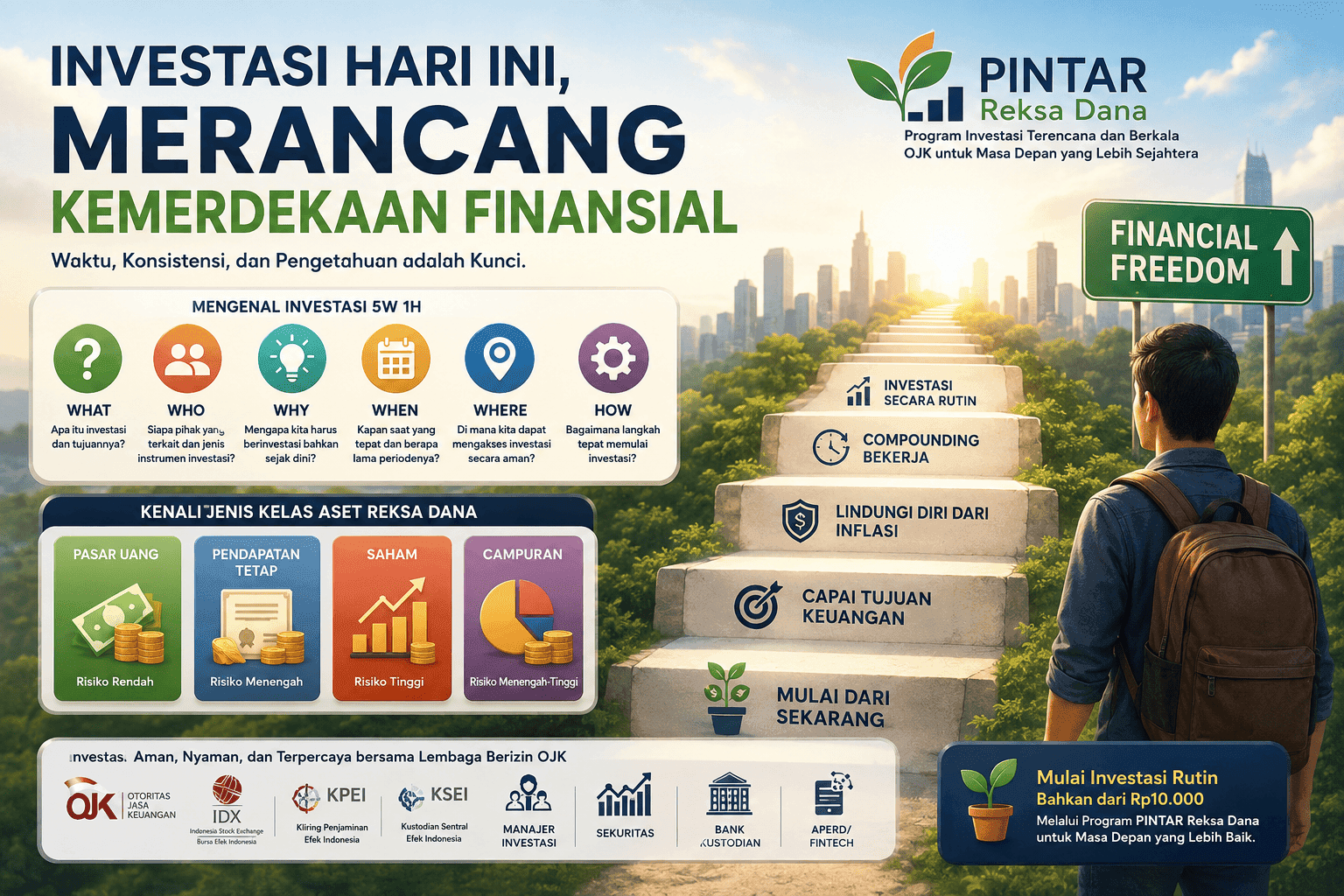
As a concrete step by OJK in supporting financial literacy, OJK presents the PINTAR (Program Investasi Terencana dan Berkala) Reksa Dana programme. A programme initiative launched in April 2026 to encourage regular and planned investing, focusing on beginner investors via mutual funds. Reksa Dana is a vehicle that pools funds from the investing public to be invested in a range of Portfolio of Securities (stocks, bonds, and money markets) led professionally by Investment Managers.
The modern financial architecture today rests on a fundamental principle known as Time Value of Money (TVM), or what is interpreted as the value of money over time. In general, TVM is the basic principle that the nominal value of money you hold today is much more valuable than the same nominal amount in the future.
Why is that? Money has a “capacity” to be rotated and generate returns. If you leave Rp100,000 under a pillow today, its purchasing power five years later will not be the same because its purchasing power has eroded due to inflation. The TVM concept is the logical reason why leaving money idle is a loss, and why investing becomes a necessity to protect wealth.
Before diving directly into the world of investing, it is advisable to take note of the following information to learn more about investing through the 5W 1H approach.
What - What Is Investing and What Is Its Purpose? Fundamentally, investing is the activity of placing a portion of funds into an asset or financial instrument with the expectation that the asset will yield a return (imbalance) or an increase in value over time. If saving is purely meant to maintain liquidity or short-term emergency funds, investing focuses on value growth like wealth multiplication that can be harvested in the future. The aims of this step are not a get-rich-quick scheme. For the general public, the aims of investing include the following:
Protecting the value of money from the threats of inflation
Accumulating funds for future obligations, such as costs of education for children or buying a home
Creating financial independence through passive income that will eventually be able to cover living costs without having to work actively
Who - Who Are the Parties Involved in Investing and the Types of Investment Instruments?
In Indonesia, the governance of the capital market is regulated and supervised by the Financial Services Authority (OJK) to ensure consumer protection. In this ecosystem, there are several main institutions that play important roles in managing and facilitating your investment activities:
Indonesia Stock Exchange (BEI): Market operator that facilitates buy-sell transactions of securities (stocks, bonds) and monitors issuer compliance.
Indonesia Clearing and Guarantee Corporation for Securities (KPEI): The body responsible for clearing and guaranteeing settlement of bourse transactions.
Indonesia Central Securities Depository (KSEI): The central depository and settlement institution that provides securities administration services.
Investment Managers: Professionals tasked with managing collective funds raised from the public investors, especially through mutual fund products.
Securities Companies: Intermediaries that facilitate buy-sell transactions of investment assets, such as stocks and bonds.
Custodian Banks: Institutions that provide safekeeping and administration services for the assets (Portfolio of Securities) of Mutual Funds and investors. Custodian Banks are responsible for the security and administration of assets.
Selling Agent of Mutual Fund Securities (APERD)/Fintech Companies: all institutions or digital platforms licensed by OJK to sell mutual fund products, making investment access easier and more affordable for the general public.
Understanding the Different Asset Classes of Mutual Funds
Before investing, it is important to understand the fundamental differences between asset classes based on the risk-return trade-off, namely, the higher the potential return, the higher the risk. Based on asset class, generally in Indonesia, mutual fund instruments are divided into four types:
Money Market Funds: Most investments in savings instruments, cash equivalents, deposits and bonds under 1 year (low risk)
Fixed Income Funds (RDPT): Most investments in bonds over 1 year (medium risk)
Equity Funds: Most investments in shares of public companies (high risk)
Mixed/Hybrid Funds: A blend of investment in bonds and equities (medium-high risk)
Why Should We Invest Even From an Early Age?
There is an economic phenomenon that makes someone increasingly optimal to invest as soon as possible:
Firstly, the inflation effect. The fundamental figure of the capital market Benjamin Graham argued that genuine investors should not merely view profits nominally, but in real terms (after inflation). Traditional savings that give very low interest rates are essentially unable to outpace the decline in value due to inflation.
Secondly