
Pinglu Canal officially begins operations, boosting China-ASEAN trade
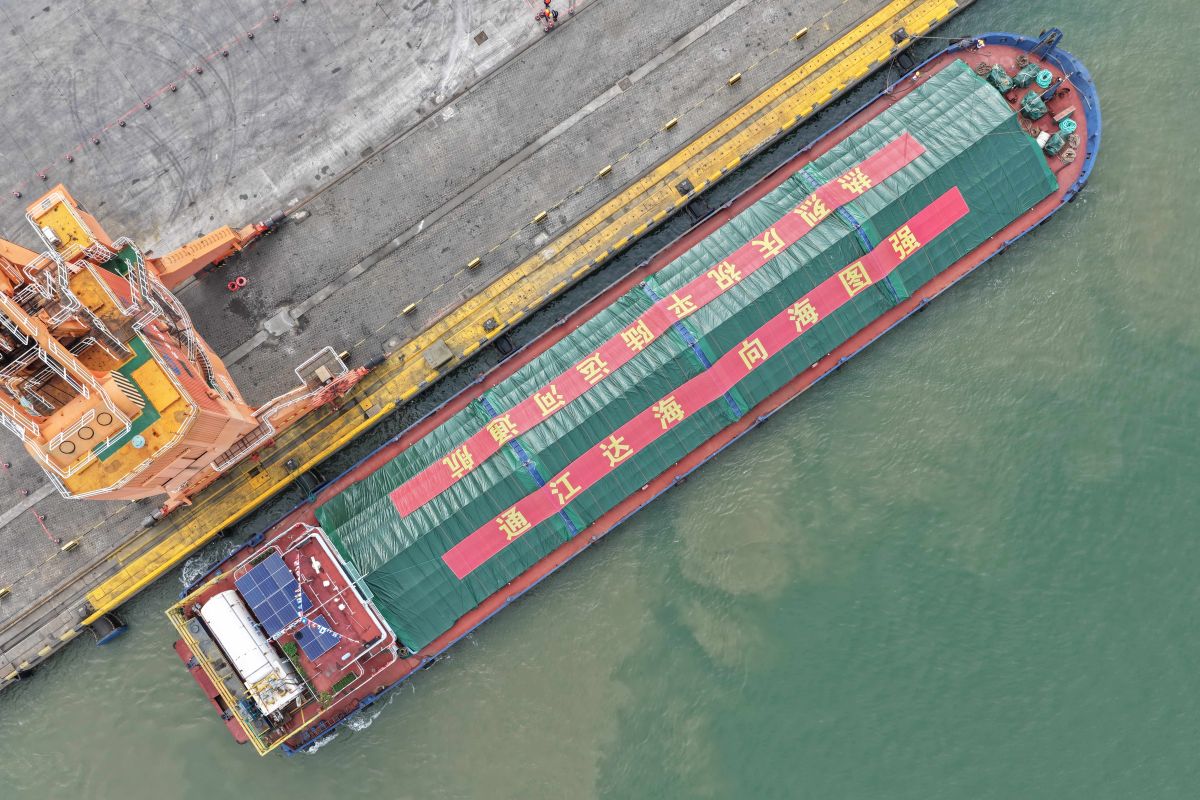
Nanning, China — The Pinglu Canal in the Guangxi Zhuang Autonomous Region, southern China, officially began operations on Wednesday (16/9), marked by the departure of a 5,000-tonne capacity cargo ship.
Completed after construction began in August 2022, the canal reduces shipping routes by more than 560 kilometres for cargo travelling from southwestern China to coastal ports, which previously had to detour to the Port of Guangzhou. Starting from the mouth of the Pingtang River in Hengzhou, Nanning, the capital of Guangxi, the Pinglu Canal flows south to the Beibu Gulf and enters the sea.
The project spans 13_4.2 kilometres with an investment value of 72.7 billion yuan (1 yuan = Rp2,634). It features a high navigation class, not only in China but globally, allowing it to be traversed by 5,000-tonne class cargo ships.
Industry analysts suggest the Pinglu Canal will serve as a vital arterial corridor for cargo shipments between western China and ASEAN. Bulk commodities imported from Indonesia, such as coal, aluminium ore, rubber, and palm oil, can now enter inland China directly via the canal. Conversely, Chinese steel, fertiliser, mechanical equipment, and electronics can be exported to Indonesia and other ASEAN markets more punctually and cost-effectively.
Guangxi Jingui Pulp & Paper Co., Ltd., a paper manufacturer in Qinzhou, Guangxi, is an investment from Indonesia’s Sinar Mas. It currently has a production capacity of 1 million tonnes of chemical-mechanical pulp and 1.9 million tonnes of high-quality white cardboard per year. The company noted that with the completion of the canal, raw materials such as wood and calcite along the route can be shipped directly to the factory via water transport, with finished products then exported through the Port of Qinzhou to ASEAN and other international markets.
Data from Qinzhou Customs shows that in 2025, total bulk commodities imported from Indonesia through the Port of Qinzhou reached 11.521 million tonnes, with a trade value of 8.26 billion yuan. The Beibu Gulf Port serves as both a maritime gateway and a hub for the river-sea intermodal transport of the Pinglu Canal. In 2025, the port handled a total cargo throughput of 358 million tonnes, a 9.1 per cent year-on-year increase, while container throughput reached 10.0626 million TEU, up 11.6 per cent.
Following the opening of the Pinglu Canal for navigation, the Beibu Gulf Port will achieve closer integration between inland waterways and the seaport system. This will enhance the efficiency of cargo collection and distribution, perfect the multi-modal river, rail, and sea transport system along the New International Land-Sea Trade Corridor, and further strengthen economic and trade exchanges between China and ASEAN.
Wang Zhongyue, chairman of Guangxi Xinlong Logistics Group Co., Ltd., stated that the opening of the Pinglu Canal will improve logistics quality, reduce costs, and increase efficiency regarding bulk goods. Wang noted that his company stands to benefit directly in areas including bulk cargo distribution, cross-border supply chains with ASEAN, and cross-border e-commerce industrial zones.
According to official data, the Pinglu Canal is expected to reduce logistics costs by 18 to 30 per cent. This is set to provide a new boost to China-ASEAN trade, which has demonstrated strong momentum in recent years.