
Pilot Bioethanol Facility Launched with Production Capacity of 60 Kilolitres per Year
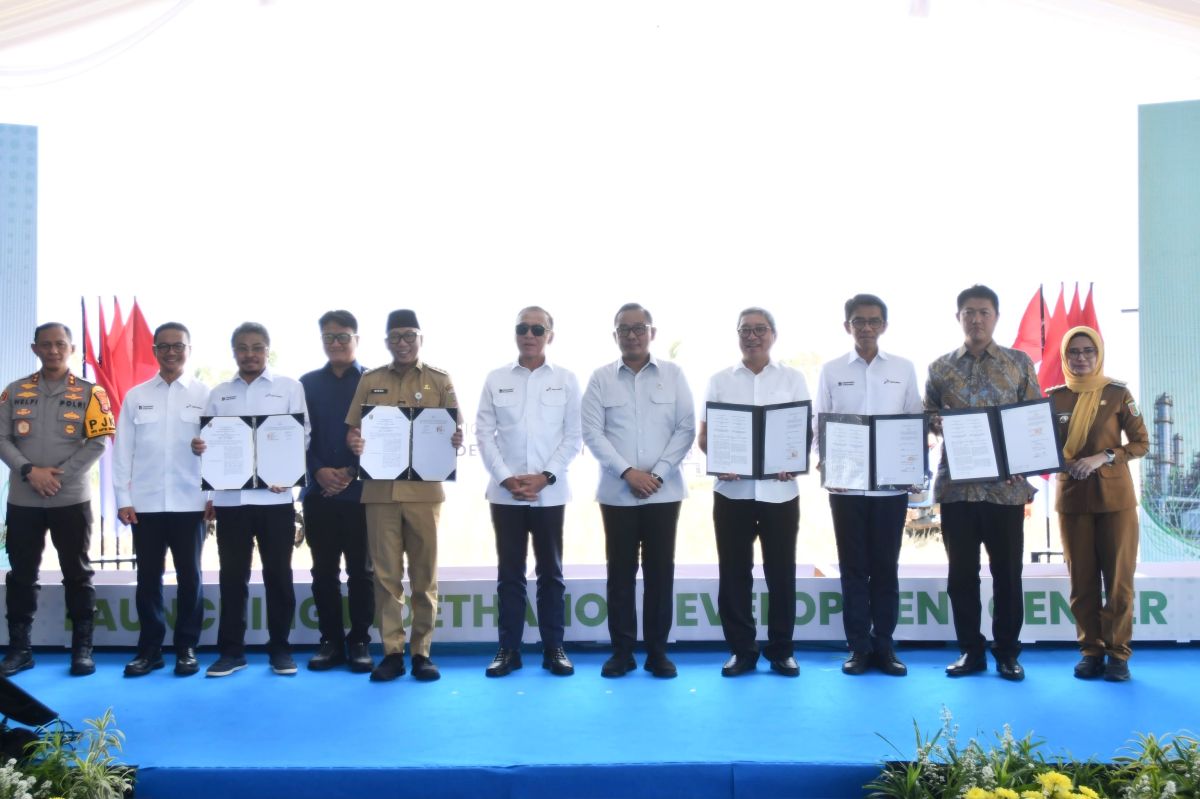
The development of bioethanol as one of the sources of renewable energy continues to be strengthened. One example is the construction of the Bioethanol Development Center in Tegineneng, Pesawaran Regency, Lampung, launched by Pertamina New & Renewable Energy (Pertamina NRE) on Monday (14 September).
The facility has been developed as a platform for developing and testing bioethanol on a pilot scale. Its development covers a number of stages, ranging from the development of raw materials (feedstock), cultivation, technology testing, through to the validation of the bioethanol production process.
Pertamina NRE Chief Executive Officer John Anis said the facility prioritises a multi-feedstock and multi-generation technology approach. This approach allows the use of various types of raw materials as well as the development of first-generation (1G) and second-generation (2G) bioethanol production technologies.
According to John, the approach is expected to optimise the potential of local resources whilst supporting the formation of a national bioethanol ecosystem.
The launch of the Bioethanol Development Center was also marked by the signing of two memoranda of understanding. First, a Joint Agreement between Pertamina NRE and the Lampung Provincial Government concerning the development of agribusiness, energy resilience and food security in Lampung Province. Second, a Memorandum of Understanding between Pertamina NRE, TMMIN, TTI and the Research Association of Biomass Innovation for Next Generation Automobile Fuels (raBit).
The cooperation covers the exploration of the technical and commercial potential of production and the utilisation of sustainable bioethanol in Indonesia. Its scope includes feasibility studies, the development and use of technology, and the exchange of knowledge and experience.
Deputy Minister of Investment and Downstreaming/Deputy Head of the Investment Coordinating Board (BKPM), Todotua Pasaribu, said the development of bioethanol can bring together the agricultural, industrial, technological, investment and community sectors within a single renewable energy-based economic chain.
“Lampung has 430 thousand KL, with the main strategy being reactivation, synergy with PTPN, the development of integrated first-generation (1G) and second-generation (2G) sorghum, the Bioethanol Development Center pilot or biomass demonstration development centre, cassava downstreaming, maize downstreaming and factory conversion, so that it can support energy resilience,” said Todotua on Monday (14 September).
Meanwhile, President Commissioner of PT Pertamina (Persero), Mochammad Iriawan, also expressed his support for the launch of the facility. He also conveyed his appreciation to the Deputy Minister of Investment and Downstreaming/Deputy Head of BKPM and the Governor of Lampung for their support of the construction of the Bioethanol Development Center.
In terms of raw material development, sorghum is considered one of the commodities with potential for development. John explained that sorghum has competitive productivity and harvest cycles.
“What is interesting about sorghum, apart from its productivity, is that it can be harvested three times a year,” John explained.
Sorghum development in Lampung is directed towards a multi-generation approach. The plant’s sap can be used as a raw material for first-generation (1G) bioethanol. Meanwhile, the stalks or biomass remaining after the sap extraction process can be developed as a raw material for second-generation (2G) bioethanol. This approach allows a single source of raw material to be utilised through production technologies across different generations, so that the biomass potential can be optimised.
John explained that the Bioethanol Development Center in Lampung is designed as a pilot facility with a bioethanol production capacity of up to 60 kilolitres per year. The facility will be used to test various combinations of raw materials and technologies in the bioethanol production process.
The stages being tested include pre-treatment, hydrolysis, fermentation, distillation and dehydration. The facility also includes pre-treatment stages for processing second-generation (2G) raw materials.
“Pertamina NRE is deeply committed to supporting the President’s programme and the great ambition of achieving 1 million kilolitres of bioethanol production per year using a multi-generation system,” said John.
The launch of the facility also marks the beginning of Lampung’s development as one of the centres for end-to-end bioethanol development. This development covers the entire process, from the development and cultivation of raw materials, processing, through to the testing and validation of production technologies.
Going forward, the results of pilot-scale testing will form the basis for technical, economic and commercial assessments. The results of these studies will subsequently be used to determine opportunities for technology development towards a demonstration scale and, eventually, the commercial stage.
Source: jawawa.id (https://jawawa.id/newsitem/pilot-bioethanol-facility-launched-with-production-capacity-of-60-kilolitres-per-year-1789437080)
Originally published by Media Indonesia (https://mediaindonesia.com/ekonomi/933455/fasilitas-pilot-bioetanol-diluncurkan-kapasitas-produksi-capai-60-kiloliter-per-tahun), translated from Indonesian