
Pilkada Debates and Welfare Feature in 20 Regional Recommendations to the Minister of Home Affairs
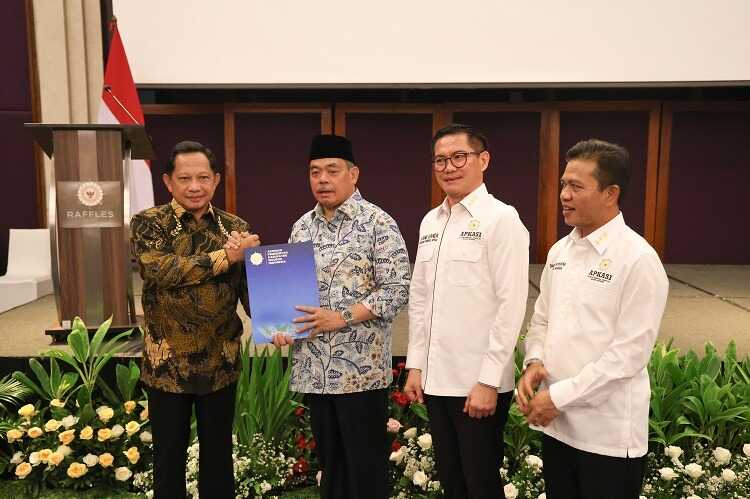
Jakarta, 5 March 2026 – The Association of Regional Governments of Indonesia (Apkasi) has officially finalised and handed over 20 recommendations arising from Rakernas XVII to the central government. The handover of the strategic documents was conducted directly by Apkasi’s Chairman Bursah Zarnubi to Minister of Home Affairs Tito Karnavian on the sidelines of the 2026 First Meeting of the Board of Directors and the joint iftar in Jakarta.
The 20 recommendations crystallise a range of local government challenges in recent years. Key points highlighted include the tangled web of regional financial transfers (TKD), fiscal pressures facing districts, the wage burden of Pegawai Pemerintah dengan Perjanjian Kerja (P3K) staff that strains the regional budgets, the authority and management of civil servants in the regions, and the proposal for Pilkada to be conducted via the DPRD.
“These recommendations reflect the full portrait of the aspirations of fellow regional leaders on the ground. We hope these points will receive serious attention and become the principal considerations of the central government in shaping policies touching regional interests,” said Bursah during the handover.
Sekretaris Jenderal Apkasi Joune Ganda stressed that the 20 points would not be kept as mere administrative documents. Apkasi has instructed each internal department to guard the recommendations closely until they are accommodated by decision-makers at the central level.
“We will guard each point seriously in line with the remit of the management. We will move to ensure these aspirations reach the policy tables that matter,” Joune asserted.
Through the finalisation of these recommendations, Apkasi positions itself as a strategic partner of the government in stitching back together the harmony between centre and region for national economic equity.
In response, Minister of Home Affairs Tito Karnavian reminded that restoring central trust in the regions is the key. He highlighted the tug-of-war dynamics between decentralisation and centralising impulses triggered by concerns over budget leaks in the regions.
“Central trust depends on regional performance. If the image of the regions is tainted by budget leaks—whether subtle leaks in operating expenditure or in projects—loss of trust will follow. The consequence is that powers and funding could be pulled back to the centre,” he said.
Tito also noted discussions on term lengths. He stated that extending the term of regional heads until the swearing-in of new officials could be achieved via a revision of the law without touching the 1945 Constitution. On welfare, the minister supported the idea of transforming operating costs into a lump-sum scheme to curb corrupt behaviour arising from a system that is too rigid.
In step with the Minister of Villages, Development of Disadvantaged Regions, Yandri Susanto, he urged regional heads to focus on downstreaming village potential through the Kopdes Merah Putih cooperative. He aims to create 5,000 export villages to strengthen regional economic structures. “We grant full latitude through Permendes No 16 of 2025 so that village funds are used to meet real community needs, without percentage-based restrictions. Villages must be drivers of development, not merely spectators,” he said.
As a sign of social responsibility during Ramadan, the event included symbolic charitable donations to six orphans from Yayasan Yatim Piatu Masjid Al Ikhwan, Lenteng Agung Timur, South Jakarta. (Two days before).
The Directorate General for Politics and General Administration (Polpum) of the Ministry of Home Affairs collaborated with schools in the city of Cirebon to strengthen the education ecosystem and prevent violence-based extremism among students.
Andra Soni opened the briefing by noting the province’s proximity to Jakarta, which is advantageous for development in the Province of Banten.
During Ramadan, all staff could observe the fast devoutly and in good health. The minister also urged staff to engage in contemplation.
Tito also noted that of 52 disaster-affected districts/cities, 38 have returned to normal conditions.
The Ministry, through the Directorate General for Regional Finance (Bina Keuangan Daerah), emphasised the importance of rapid procurement and orderly administration for the BLUD (Badan Layanan Umum Daerah).