
Pigai: How Can There Be a Human Rights Revolution Without a Legal Basis?
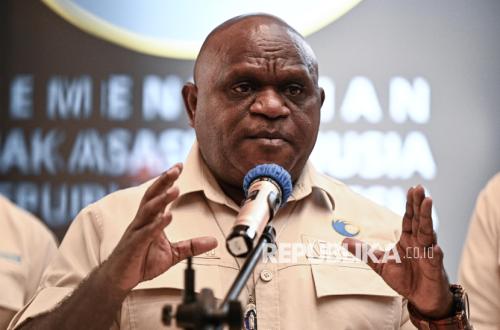
Human Rights Minister Natalius Pigai has urged the acceleration of discussions on a number of regulations that will strengthen the authority of the Ministry of Human Rights. Pigai admitted that he has not been able to take concrete action freely, including against companies suspected of committing human rights violations, because he is constrained by the legal basis.
Pigai said that various draft regulations have been submitted to the Ministry of Law, the Ministry of State Secretariat, and the House of Representatives. The proposals include laws, presidential regulations, and presidential instructions.
“The important thing is that all proposed regulations, whether laws, presidential regulations, or presidential instructions that we have submitted to the institutions, are processed quickly. How can I carry out a human rights revolution if there is no legal basis,” Pigai said during his visit to Sumedang, West Java, on Friday (21/8/2026).
Pigai cited the handling of alleged human rights violations by corporations as an example. He wants the Ministry of Human Rights to be able to issue warnings and even push for the revocation of permits for companies proven to have committed violations, but he considers that such authority must have a firm legal foundation.
“Companies in Indonesia have many violations. I want to issue warnings. I want to revoke the permits of those that violate human rights. But where is the legal basis?” Pigai said.
The issue of the legal basis is important because the Ministry of Human Rights is a separate ministry established after the restructuring of the Ministry of Law and Human Rights in 2024. Presidential Regulation Number 156 of 2024 gives the Ministry of Human Rights the task of administering government affairs in the field of human rights to assist the president.
In the new structure, the duties and functions of the Directorate General of Human Rights, which were previously under the Ministry of Law and Human Rights, were transferred to the Ministry of Human Rights. The ministry, among other things, carries out the functions of formulating and implementing policies in the fields of human rights instruments, strengthening, services, and compliance.
However, the institutional mandate does not automatically provide all the enforcement instruments desired by Pigai. According to him, authority that has a direct impact on society and the business world still requires more specific regulations so that every ministry decision has legal legitimacy.
One of the regulations being prepared touches the business world. President Prabowo Subianto has previously granted a permit for the initiative to draft a Presidential Regulation on the Implementation of Business and Human Rights Compliance Assessment for Business Actors. The approval is a follow-up to the Ministry of Human Rights’ proposal submitted in 2025.
The draft is important because the Ministry of Human Rights wants to build a human rights compliance assessment mechanism for business actors. The ministry has long had functions related to human rights services and compliance, including assessment of business actors, but regulatory strengthening is needed to clarify the mechanism and consequences of the assessment.
Source: jawawa.id (https://jawawa.id/newsitem/pigai-how-can-there-be-a-human-rights-revolution-without-a-legal-basis-1787370654)
Originally published by Republika (https://news.republika.co.id/berita/tk5b9l451/pigai-bagaimana-mau-revolusi-ham-kalau-tak-ada-dasar-hukum), translated from Indonesian