
Pigai highlights narrative warfare regarding Papua conflict on social media
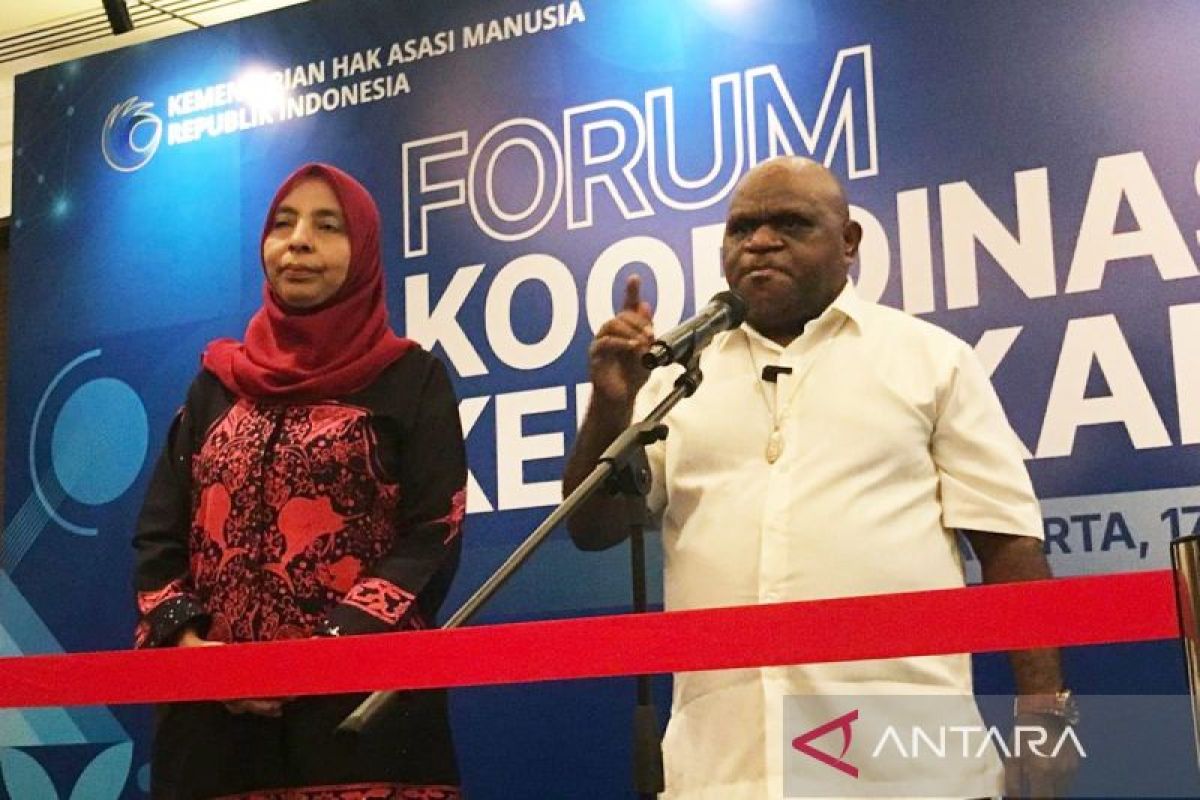
Jakarta (ANTARA) - Human Rights Minister Natalius Pigai has urged the strengthening of the credibility and quality of information regarding the conflict in Papua, ensuring that information concerning the parties involved and the status of civilians can be accurately verified.
Speaking in Jakarta on Tuesday, Pigai stated that information regarding individuals within conflict zones needs thorough verification, particularly when discrepancies arise concerning a person’s status.
“Therefore, we must ensure that misleading information does not spread among the public. Consequently, the aspects of credibility and information quality must be measurable,” said Pigai.
He noted that an individual’s history and status can become part of the verification process when information emerges regarding casualties in conflict-related incidents.
Pigai cited the possibility of security personnel operating in the field without official insignia, which may lead them to be perceived as civilians.
“There are claims that intelligence officers in the field remove their official attributes and are subsequently identified as civilians. Once an incident occurs and investigations are conducted, their history is revealed, showing they were indeed security personnel,” he said.
According to Pigai, this situation demonstrates the importance of caution when disseminating information to prevent the public from drawing conclusions based on unverified data.
He also highlighted the spread of information regarding the Papua conflict via social media. According to him, the West Papua National Liberation Army-Free Papua Movement (TPNPB-OPM) is more adept at shaping opinion through information and visual evidence shared on social platforms.
“I observe that the TPNPB-OPM consistently wins the battle of opinion. We are constantly in a losing position. Why? Because they state ‘A’, then present evidence that suddenly appears on social media, uploaded by various parties, leaving us at a disadvantage,” said Pigai.
He assessed that the government needs to strengthen the delivery of verifiable information to the public, especially concerning incidents related to the safety of civilians.
Beyond the issue of information, Pigai requested that the public treat conflict victims equally, without discriminating between indigenous Papuans and non-Papuans.
“If ten Papuans are killed or shot daily, we must share that suffering and concern. We should not only express concern when non-Papuans are killed or shot,” he stated.
According to Pigai, all residents of Papua are Indonesian citizens; therefore, protection and empathy for victims should not be differentiated based on identity.
“We want to act justly, yet we are practicing injustice. We say there should be no discrimination or racism, yet we practice racism against others. That is also unfair,” he said.
Under international humanitarian law, the principle of distinction requires parties in a conflict to distinguish between civilians and those involved in hostilities.
Civilians are, in principle, protected from direct attacks, unless they take a direct part in hostilities. In cases of doubt, various precautionary measures must be taken to ensure an individual’s status and to prevent mistaken attacks on civilians.