
PHE's Efficiency Strategy Yields High Oil and Gas Production in West Java
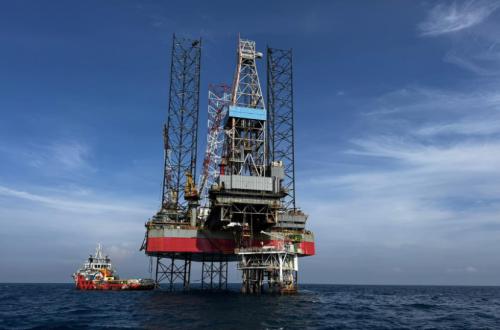
PT Pertamina Hulu Energi Offshore North West Java (PHE ONWJ) has recorded operational performance in the northern waters of West Java. Through the LLA-6 development well at the LLA Platform, the company recorded initial production of 1,321 barrels of oil per day (BOPD) and gas of two million standard cubic feet per day (MMSCFD).
The hydrocarbon flow from this well features a zero per cent water content (Basic Sediment and Water/BSW). Adang Sukmatiawan, Senior Manager of Subsurface Development & Planning at PHE ONWJ, revealed that this achievement involved mature calculation and evaluation processes from previous drilling campaigns applied to this well.
“The success of the LLA-6 well was derived from lessons learned from the LLE-5ST well which we drilled last year. Given that the target layers are the same, we refined the formulation and strategy. The results proved that we could achieve excellent production with much more mature execution,” Adang stated in a press release on Monday (18/5/2026).
Adang explained that the LLA-6 well began directional drilling on 24 March 2026 using the PVD-II Rig. The drill bit reached a final depth of 5,407 feet measured depth (ftMD), equivalent to 3,561 feet true vertical depth (ftTVD). The entire sequence, from the drilling phase to the production flow test on 2 May 2026, was completed rapidly in just 33 days.
This speed was supported by smooth offshore operations. The entire process, from equipment mobilisation to the unloading of supporting materials from ships to the rig facilities, proceeded precisely without significant weather or logistical constraints.
The LLA-6 well is the first drilling well at the LLA Platform after more than 24 years of inactivity. In preparing this well, the Subsurface Team coordinated intensively with various parties to face numerous challenges at the LLA Platform, such as seabed bubble issues, shallow gas hazards, and the risk of drilling fluid loss in the Parigi and pre-Parigi layers.
The well penetrated the LL-30 layer 60 feet more updip than the LLE-5ST well. The Subsurface Team prepared drilling equipment ranging from pressure gradient measurements to comprehensive analyses, proving that the LL-30 layer still holds potential and has proven to produce oil. Data from the LLA-6 well indicates even greater potential within the LL-30 layer in the new southern area, which can be further developed through subsequent drilling.
The short duration of the work had an immediate positive impact on budget efficiency. Based on current field estimates, the total cost absorbed for the LLA-6 well was only 61.5 per cent of the Authorization for Expenditure (AFE) approved by SKK Migas. This saving of nearly 40 per cent represents a significant achievement.
The General Manager of PHE ONWJ, Muzwir Wiratama, expressed full appreciation for the hard work of the entire team. For him, achieving maximum results with cost-effective methods is a tangible manifestation of efforts towards sustainable domestic energy security.
“Executing the work plan safely, completely, and faster, with much better results, is proof of the PHE ONWJ spirit, namely ‘Safer, Faster, Better’. This success is particularly special because we are not only considering the volume of lifting achieved, but also how efficiently the costs are spent,” Muzwir emphasised.
Currently, all PHE ONWJ fleets and teams have shifted their operational focus. The drill bits are being prepared to hit the next targets at the LLA-5 and LLA-7 wells. “There are still several drilling work plans with the same target layers ahead,” Muzwir said optimistically.