
PHE Targets Indonesia as Asia’s CCS Hub, Seeks Cross-Border Investment
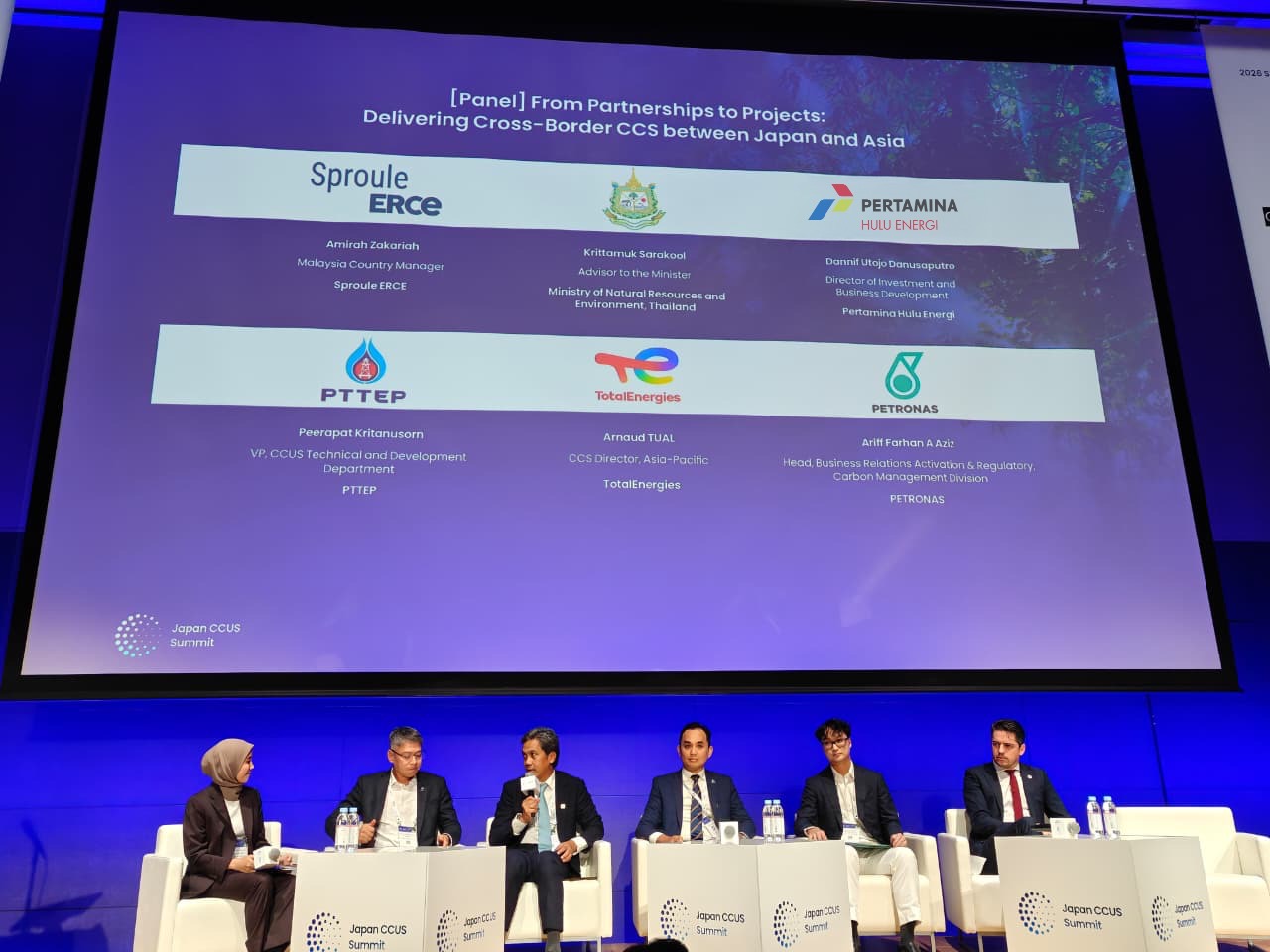
Tokyo, Japan — Indonesia has an opportunity to play a strategic role in Asia’s decarbonisation. PT Pertamina Hulu Energi (PHE) is stepping up efforts to make the country a regional carbon capture and storage (CCS) hub, targeting long-term partnerships with emissions-intensive industries in Japan and other Asian countries.
The ambition is not simply to make use of Indonesia’s significant carbon storage potential. PHE says the key to establishing a regional CCS hub lies in regulatory certainty, investor confidence and a business model capable of ensuring projects remain viable for decades.
PHE Investment and Business Development Director Dannif Utojo Danusaputro made the remarks while speaking on a panel at the Japan CCUS Summit 2026 in Tokyo on 19 October. The panel was entitled “From Partnerships to Projects: Delivering Cross-Border CCS between Japan and Asia”.
According to Dannif, cross-border CCS cooperation requires a strong foundation. Storage capacity alone is not enough to persuade investors to proceed with large-scale projects.
“For investors and emissions-intensive industries in Japan, confidence rests on three main pillars: regulatory certainty to manage long-term risks; clear institutional arrangements, coordinated and transparent in handling permits and cross-border oversight; and long-term financial viability, or bankability,” Dannif said.
Major investment requires certainty over carbon supply
PHE sees cross-border CCS development as a strategic partnership that must benefit all parties. Indonesia has the opportunity to provide carbon storage facilities, while industrialised countries such as Japan need long-term solutions for managing carbon emissions.
However, seizing that opportunity requires both sides to be ready.
For storage providers such as Pertamina, certainty over carbon dioxide (CO₂) volumes, the readiness of industries’ carbon capture facilities and long-term commercial contracts are essential before investment can go ahead.
Building a CCS hub requires substantial capital expenditure. This includes geological characterisation studies, drilling injection wells, constructing storage facilities and developing carbon transport infrastructure.
“Cross-border CCS projects are not merely commercial transactions for carbon storage, but long-term strategic partnerships. For a company such as Pertamina, building a CCS hub requires very substantial upfront investment. We therefore need certainty over emissions volumes, readiness of capture facilities on the industrial side, and long-term cooperation agreements,” he said.
The challenge in developing CCS, therefore, is not just technological; it is also about building a business ecosystem that provides certainty for all parties involved.
Targeting the first commercial CCS project in Asia-Pacific
To accelerate project delivery, PHE is urging CCS developers to build trust through transparency, develop hub-scale infrastructure, strengthen collaboration with governments and consolidate long-term partnerships.
PHE is also targeting a major milestone within the next two to three years: a final investment decision (FID) on what it hopes will be the Asia-Pacific’s first commercial cross-border CCS project, followed by progress towards carbon injection.
For PHE, the success of this pioneering project would demonstrate that a cross-border CCS value chain can operate commercially and sustainably.
That chain would encompass capturing CO₂ in its country of origin, transporting it safely across borders and permanently storing it in suitable geological formations under a reliable regulatory framework.
“If this first project proves that CO₂ can be captured in one country, transported safely across national borders and permanently stored under a reliable regulatory framework, the market will move quickly from discussion to replication,” Dannif said.
He said success with the first project would provide a reference for future developments, while validating the regulatory framework, business model, technical solutions and partnership structures required.
New opportunities for Indonesia’s low-carbon industries
PHE’s initiative is aligned with the vision of the Asia Zero Emission Community (AZEC), which promotes cooperation among Asian countries to accelerate the transition to lower emissions.
Under this model, Japan could gain access to long-term emissions storage solutions, while Indonesia could develop a new value-added industry by using its carbon storage potential.
With sufficient regulatory certainty, infrastructure and commercial contracts, a CCS hub could also attract new investment in energy, engineering services, carbon transport and the management of underground storage facilities.
However, realising these opportunities will depend on project readiness, economic viability, operational safety and clear allocation of responsibility for long-term carbon storage.
“Together with the government, we are committed to making Indonesia a reliable and trusted regional CCS hub to support Asia’s decarbonisation journey,” Dannif said.
PHE reaffirmed its commitment to continued investment in sustainable upstream oil and gas operations and business, in line with Environmental, Social and Governance (ESG) principles.
The commitment also includes strengthening integrity and a culture of compliance, applying good corporate governance and working to prevent fraud.
For Indonesia, cross-border CCS development offers an opportunity to move beyond being merely a carbon storage location. The next challenge is to build market confidence and ensure the country’s geological potential can be turned into safe, competitive and sustainable commercial projects.
Source: jawawa.id (https://jawawa.id/newsitem/phe-targets-indonesia-as-asias-ccs-hub-seeks-cross-border-investment-1792835432)
Originally published by ruangenergi.com (https://www.ruangenergi.com/phe-bidik-indonesia-jadi-hub-ccs-asia-incar-investasi-lintas-negara/), translated from Indonesian