
Phapros mitigates impact of rupiah weakening on raw material costs
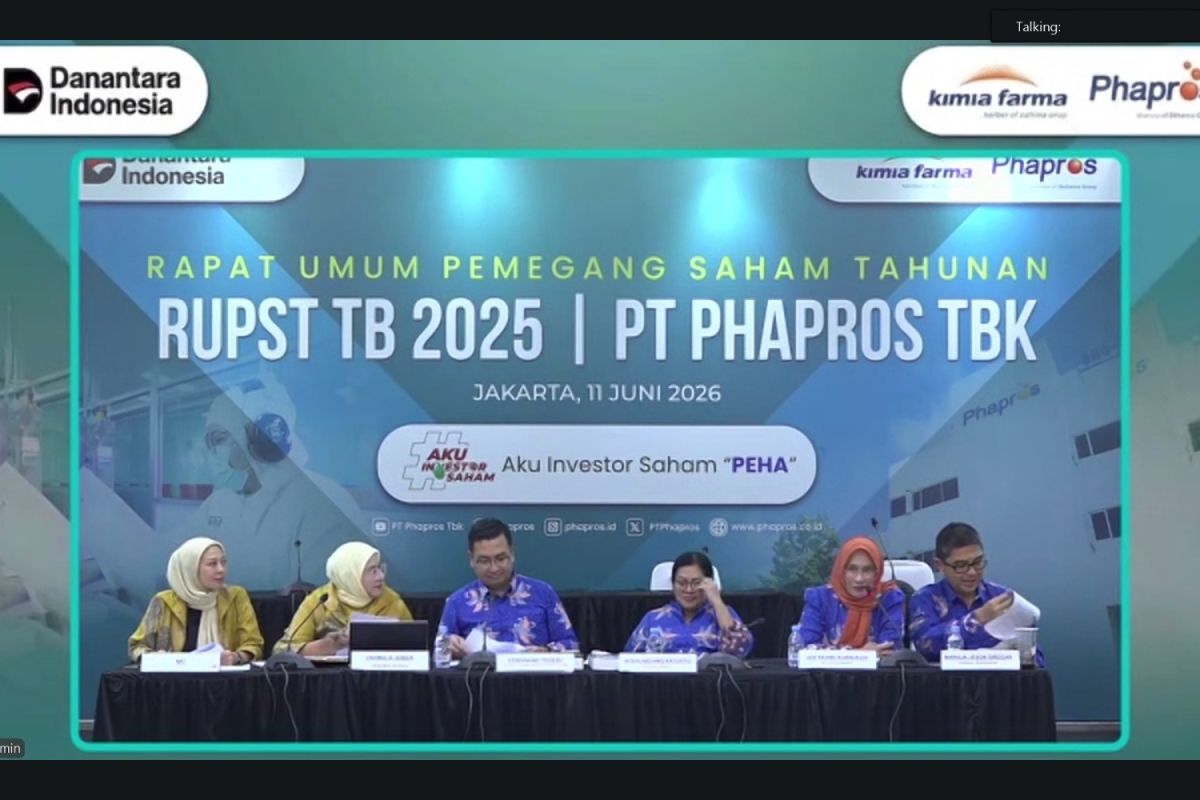
State-owned pharmaceutical company PT Phapros Tbk, a subsidiary of PT Kimia Farma Tbk, is taking several mitigation steps to curb the impact of the rupiah’s weakening trend against the US dollar on imported raw material costs and company operations. “Given that the rupiah exchange rate fluctuation is an external factor, Phapros will focus more on internal aspects because we cannot control that. So what we are trying to control is mitigation to minimise the negative impact,” said Phapros Production Director Ida Rahmi Kurniasih during the company’s Public Expose after the Annual General Meeting of Shareholders for the 2025 Fiscal Year in Jakarta on Thursday. The rupiah exchange rate at Thursday’s close weakened by 45 points, or 0.25 percent, to Rp17,989 per US dollar from the previous Rp17,944 per US dollar. Ida stated that the rupiah’s weakening trend has impacted the rising costs of raw materials and shipping for the pharmaceutical industry, which remains reliant on imports. According to her, the company has prepared several mitigation steps, including developing scenarios for the rupiah’s depreciation against the US dollar, renegotiating prices with foreign suppliers, and diversifying sources of raw materials. Furthermore, the company is also considering the use of currencies other than the US dollar in raw material import transactions. “We continue to seek alternative raw materials to obtain better prices, including the possibility of conducting transactions in currencies other than the US dollar. For example, some purchases are now made in renminbi (Chinese yuan) and euros,” Ida said. She mentioned that the company is also preparing earlier procurement contracts for raw materials with longer terms to maintain price stability and supply continuity. In addition to implementing cross-divisional efficiency, Phapros is also preparing hedging measures to minimise the impact of exchange rate fluctuations on company operations. Phapros President Director Intan Abdams Katoppo stated that the national pharmaceutical industry still faces the challenge of high dependence on imported raw materials, which reaches over 90 percent. However, according to him, the growth in healthcare service needs and the National Health Insurance programme still open growth opportunities for the domestic pharmaceutical industry. In 2026, the company is also preparing export market expansion to Timor-Leste, Cambodia, the Philippines, Myanmar, Papua New Guinea, and Peru to widen its international market. Intan said the overseas market expansion is being carried out to broaden the market while capitalising on the strengthening of the US dollar against the rupiah. “To take advantage of this dollar strengthening momentum, we are pushing sales to overseas markets such as Timor-Leste, Cambodia, the Philippines, Myanmar, Papua New Guinea, and Peru,” Intan revealed. In addition to expanding export markets, the company is also preparing four new products in 2026, including the children’s multivitamins Vicom Grow and Vicom Star, as well as the antibiotic Pehafosh. The children’s multivitamin products are also being prepared to support the government’s stunting reduction programme.