
PGN Strengthens North Coast Ecosystem with 269,000 Mangroves and Biosaline Rice
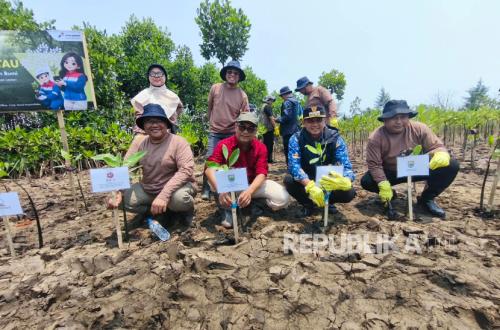
PT Perusahaan Gas Negara (Persero) Tbk (PGN) and its group, Pertamina’s Gas Subholding, through its Corporate Social Responsibility (CSR) programme ‘Tanam Pantau’, has planted more than 26 and 9,000 mangrove seedlings across various coastal regions of the North Coast of Java since 2024. The planting has taken place in Semarang, Kendal, Batang, Indramayu, Gresik, and Bekasi. This effort aims to strengthen the ecosystem and increase the resilience of coastal areas in facing the impacts of climate change.
Strengthening coastal resilience is part of the PGN group’s efforts to respond to environmental change challenges. Mangrove planting is conducted to maintain the ecological functions of the coast while supporting the capacity of the region and its communities to face environmental shifts.
A similar approach is being applied through innovation in the food sector, notably the development of Biosaline Rice in collaboration with the National Research and Innovation Agency (BRIN) and local governments. This programme has expanded to cover 550 hectares, growing from an initial 5 hectares at the end of 2024.
From previously unproductive land, this development has resulted in harvests of 5 to 7 tons of dry grain per hectare per planting season.
Pujiharini, Head of the Watershed Management, Rehabilitation, and Natural Resource Conservation Division at the Central Java Provincial Environmental, Forestry, and Land Division (DLHK), stated that mangrove planting plays a vital role in ecosystem rehabilitation and strengthening coastal resilience against climate change.
“Coastal areas face increasing challenges due to environmental and climate change. These efforts (mangrove planting) must be carried out sustainably and synergised with management from upstream to downstream, particularly in Watershed Areas, so that the ecological benefits of mangroves can be felt in the long term,” she said.
Rusmanto, Head of the Batang Regency Environmental Office, noted that the management and restoration of coastal environments require synergy between local governments, the business world, research institutions, and the community. Such collaboration is necessary to ensure mangrove planting is integrated with coastal area management at the regional level.
“Coastal area management cannot be undertaken by the government alone. Collaboration with various parties is required so that coastal areas remain preserved and provide sustainable benefits to the community. Socialisation and the involvement of coastal communities, as well as understanding the importance of natural sea abrasion walls, are initial mitigation steps to make them aware of the danger of losing livelihoods in the future if mangrove planting is not implemented,” he explained.
Meanwhile, PGN’s CSR Division Head, Krisdyan Widagdo Adhi, stated that ‘Tanam Pantau’ was developed with an approach that does not only focus on mangrove planting but also connects environmental aspects with food security, disaster mitigation, appropriate technology, and community empowerment.
“For PGN, sustainability is not just about planting trees, but about how to build an ecosystem that continues to provide benefits,” said Krisdyan.
This approach is realised through, among other things, the development of saline-tolerant rice-fish farming (minapadi salin) to support food security, disaster mitigation in the North Coast of Java, and the application of appropriate technology to improve community welfare.
Through this approach, mangrove rehabilitation becomes part of a broader effort to strengthen coastal resilience while developing the productive potential of communities in areas affected by environmental changes.
Krisdyan added that the sustainability of ‘Tanam Pantau’ requires the involvement of various parties. Local governments support the direction of development and environmental management, BRIN provides research and innovation, while the community plays a role in maintaining and utilising the ecosystem sustainably.
“Moving forward, we want to ensure that what is planted today can grow into an ecosystem that provides real benefits. The sustainability of the programme requires collective work, monitoring, education, and consistent community involvement,” he concluded.
Source: jawawa.id (https://jawawa.id/newsitem/pgn-strengthens-north-coast-ecosystem-with-269-000-mangroves-and-biosaline-rice-1790244109)
Originally published by Republika (https://esgnow.republika.co.id/berita/tlv33h370/pgn-perkuat-ekosistem-pantura-dengan-269-ribu-mangrove-dan-padi-biosalin), translated from Indonesian