
PGN and BRIN Develop Saline Minapadi to Boost Economic Value of Batang Coastal Land
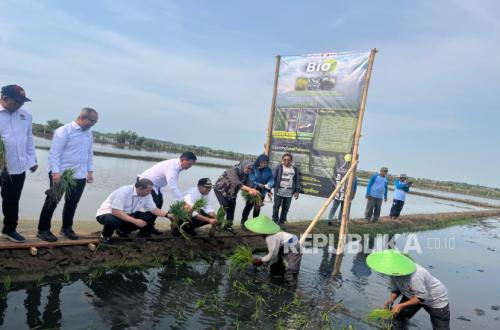
Coastal land previously affected by salinity is now being utilised as a source of food production and income. PT Perusahaan Gas Negara (PGN), the National Research and Innovation Agency (BRIN), and the Batang Regency Government have launched a ‘minapadi salin’ programme that combines rice cultivation, saline tilapia farming, and seaweed aquaculture in a single area.
The programme, implemented at Sicepit Beach in Kasepuhan Village, Batang Regency, Central Java, is an expansion of the biosaline rice programme previously applied in Semarang and Jepara. In Semarang, biosaline rice land development grew from 20 hectares to over 115 hectares. Meanwhile, in Jepara, the harvest realisation reached 22 hectares from a target of 20 hectares, with an economic value of approximately Rp 1.23 billion. Overall, the economic value of the biosaline rice programme that has been running has reached around Rp 7.66 billion.
The minapadi salin programme in Batang is being developed on 32.26 hectares of land managed by the Sido Barokah Mulyo Farmers’ Group Association (Gapoktan), the Intani Farmers’ Group, and the Dewi Sri VI Farmers’ Group. The launch was marked by the release of 10,000 saline tilapia fingerlings and the planting of biosaline rice seedlings with farmers. Additionally, the community has begun cultivating Gracilaria verrucosa seaweed, a species with high economic value that is adaptive to coastal water conditions. In the initial phase, seaweed cultivation uses around 30 kilogrammes of seed, with the first harvest targeted within three months and potential productivity of five kilogrammes of harvest for every one kilogramme of seed sown.
Batang Regent M Faiz Kurniawan said the programme opens up opportunities to utilise saline land, which has been less productive, into agricultural and fishery areas that generate economic value. “We appreciate the collaboration between PGN, BRIN, and various parties in presenting the Minapadi Salin Programme in Batang Regency. This programme not only supports national food security but also opens opportunities to improve the welfare of farmers and coastal communities through more productive use of saline land,” he said.
BRIN Deputy for Regional Research and Innovation Yopi said the minapadi salin programme is an example of applying research results to address the challenges of coastal land with high salinity levels. “BRIN does not want research results to just stop in the laboratory, but to be present in the community and become a real solution for regional problems,” Yopi said.
PGN Corporate Secretary Fajriyah Usman said the programme combines biosaline rice cultivation, saline tilapia farming, and seaweed cultivation to increase land productivity while adding sources of income for coastal communities. “This Minapadi Salin programme is a tangible manifestation of that commitment, by integrating agricultural and fishery innovations, including the development of seaweed commodities, to improve farmers’ welfare while strengthening national food security,” she said.
With agricultural technology support developed by BRIN, rice productivity is targeted to reach 6-7 tonnes per hectare. Meanwhile, saline tilapia is expected to be harvested with an average weight of around 300 grammes per fish. Going forward, the programme will be strengthened through mangrove planting in coastal areas around the cultivation site to help reduce abrasion while maintaining the sustainability of the coastal ecosystem.