
Petrokimia Gresik presents decarbonisation innovations at COP31
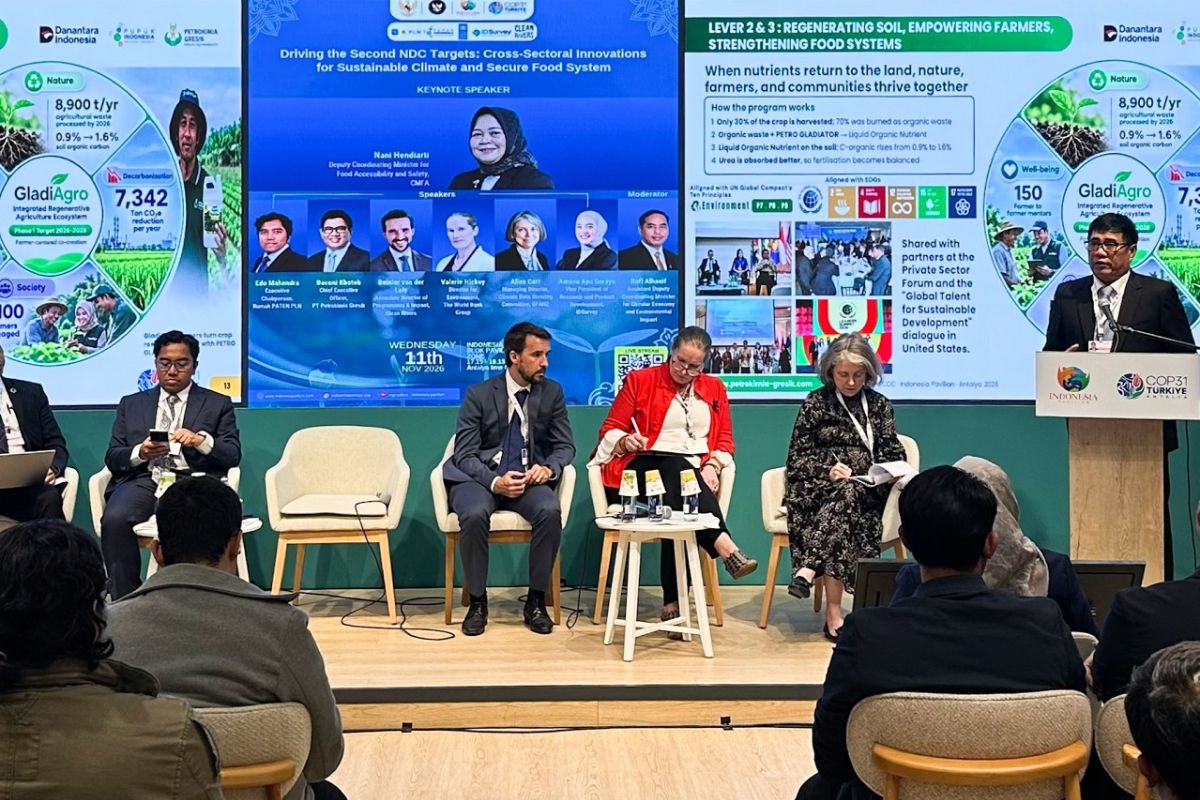
Jakarta (ANTARA) – PT Petrokimia Gresik (Persero), an agro-industrial solutions company within the PT Pupuk Indonesia (Persero) holding, has introduced a range of decarbonisation innovations, from its factories to farmland, to support more efficient and sustainable agricultural productivity.
Petrokimia Gresik President Director Daconi Khotob said in a statement issued in Jakarta on Saturday that by reducing emissions from production, developing innovative fertilisers and assisting farmers, the company was seeking to strengthen national food security while supporting the transition to a low-carbon industry.
Speaking at the global climate forum, the Conference of the Parties (COP31) in Antalya, Türkiye, Daconi emphasised that food security, industrial growth and environmental responsibility must go hand in hand.
For this reason, decarbonisation efforts are not confined to factories, but are also being extended to fertiliser use on farmland.
“We do not want to stop at production activities within the factory. That means we do not want only to manage emissions from production; we also want to cover the entire value chain that generates carbon emissions,” he said.
At its factories, Petrokimia Gresik has implemented various decarbonisation programmes through energy efficiency, upgrades to production technology, and carbon capture and utilisation.
The programmes are estimated to contribute to emissions reductions of around 529,000 tonnes of CO₂ equivalent a year. One example is ZA II, which uses CO₂ from the ammonia production process to make ammonium sulphate fertiliser, as well as calcium carbonate as a by-product that can help neutralise soil acidity.
In 2025, ZA II captured and utilised around 58,000 tonnes of CO₂, bringing the cumulative total to 1.13 million tonnes over 2010–2025. Petrokimia Gresik is also developing a pilot Carbon Capture and Utilisation (CCU) project with the Ministry of Industry and a technology partner from Taiwan, processing CO₂ into soda ash, or sodium carbonate.
The technology could capture around 6,500 tonnes of CO₂ a year under a production scenario of 16,000 tonnes of soda ash annually, while creating opportunities to develop higher-value downstream products.
“This programme shows that we are not only carrying out decarbonisation, but can also produce fertilisers and other downstream products. In this way, it brings a wide range of benefits to the company,” Daconi said.
In agriculture, Petrokimia Gresik is promoting balanced fertiliser application through farmer education and assistance.
According to the company’s calculations, using balanced fertiliser in a ratio of Petroganik, NPK and urea of 5:3:2 could cut emissions associated with fertiliser use by around 70 per cent compared with using urea alone at the same total weight. This would be equivalent to 181 kilograms of CO₂ equivalent per hectare per growing season.
Assuming the practice is applied across 1.2 million hectares with two growing seasons a year, the potential emissions reduction is estimated at 433,000 tonnes of CO₂ equivalent annually. More precise fertiliser application is also intended to improve nutrient-use efficiency, maintain soil condition and support crop productivity.
The benefits of more efficient farming are also reflected in the company’s Agro Solution and Makmur farmer-support programmes. In one sugar-cane cultivation example, productivity rose by 12 per cent with the same amount of fertiliser, while farmers’ additional income increased by Rp8.1 million per hectare. The results point to opportunities to raise yields and improve farmers’ economic returns through more effective cultivation support.
“We are working to train and educate farmers to apply balanced fertilisation. By using the right dosage, farmers can reduce the amount of fertiliser they use, making application more efficient and lowering the carbon emissions produced,” Daconi said.
Petrokimia Gresik is also developing zeolite-based NPK fertiliser. The natural mineral can retain nutrients and water around plant roots, potentially improving fertiliser efficiency and reducing emissions.
Daconi said that through its participation in COP31 Türkiye, the company was supporting Indonesia’s national emissions-reduction targets and its goal of achieving net-zero emissions (NZE) by 2060 or earlier.
The transformation from factories to farmland forms part of the company’s efforts to build a sustainable fertiliser industry, improve farmers’ welfare and safeguard national food security.
“Together, I invite everyone to seize this opportunity, not only to provide food for the world, but also to support industrial growth and protect the Earth for future generations,” he said.