
Petrodollar Shaken! Iran War Paves Way for Yuan to Dominate Energy
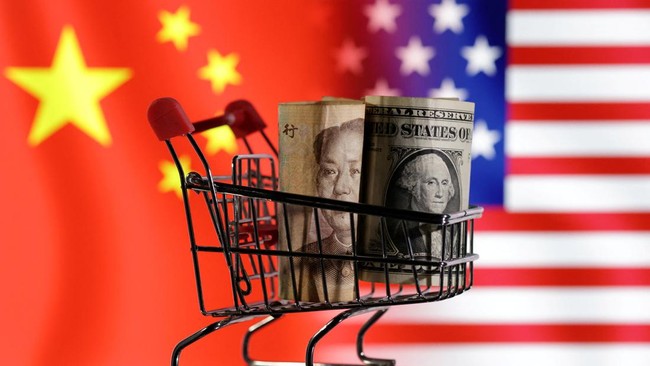
Jakarta, CNBC Indonesia - The petrodollar is beginning to waver due to the Iran war, while the yuan is steadily rising and the petroyuan is once again being discussed in global markets.
The war involving Iran is now raising concerns greater than mere short-term market volatility. This conflict is increasingly viewed as a threat to the old system that has supported US dollar dominance for decades, particularly in global energy trade.
At the same time, China’s yuan is increasingly entering market discussions. The reason is the emerging possibility that some future energy transactions will no longer fully rely on the US dollar. If this pattern spreads further, the Iran war will not only disrupt oil prices and market sentiment but also potentially accelerate changes in the global currency map.
The dollar’s strength has not only stemmed from the US’s vast economy or its deep financial markets. There is another equally important foundation: many global trades are conducted in dollars, and the surplus funds from those trades are reinvested in dollar assets. In this system, oil plays a crucial role.
When oil is sold and paid for in dollars, many countries are automatically compelled to hold dollars to meet their energy needs. This is how dollar dominance has taken deep root, not only in global trade but also in the world’s foreign exchange reserves.
Petroyuan Gains Traction Amid the War
Amid the escalating conflict, the yuan is attracting greater attention in international market discussions. This is particularly related to the potential shift in global energy trade patterns, as the war dragging in Iran once again spotlights the world’s oil distribution routes.
The yuan’s role becomes increasingly relevant when linked to energy trade. Iran is said to be opening opportunities for several countries to allow their ships to pass through the Strait of Hormuz, but on the condition that oil payments are made in yuan.
If this truly develops, the implications extend beyond shipping smoothness; it could also serve as an initial signal of change in the global energy trade system, which has long been heavily dependent on the US dollar.
This is where the term petroyuan is once again buzzing. If access to energy trade routes begins to be tied to the use of currencies other than the dollar, then the dollar’s dominance in oil transactions could face new pressures.
This shift may not occur in the near term. However, the ongoing war is seen as a trigger that could accelerate pressure on the petrodollar, while opening greater space for the emergence of the petroyuan.
In the worst-case scenario, Middle Eastern oil flowing to Asia via the Strait of Hormuz could increasingly be priced and traded in yuan, while Western oil sold to traditional US allies continues to use the dollar. If this truly happens, the global oil pricing system would no longer fully rely on the dollar as it has in the past.
This is where the yuan’s position becomes intriguing. China’s currency has not yet become a dollar replacement, but it is starting to be viewed as one of the currencies with potential for greater space if global energy trade patterns change.
This picture is also evident in the latest International Monetary Fund (IMF) data.
China’s yuan share in global foreign exchange reserves rose slightly to 1.95% in Q4 2025, from 1.92% in Q3 2025. The increase is still small and its portion far below the dollar or euro, but the direction of movement remains significant as it shows the yuan is slowly gaining space in the composition of central banks’ global foreign exchange reserves.
Petrodollar Fades But Dollar Remains Unrivalled
Nevertheless, pressure on the petrodollar has actually emerged even before the Iran war intensified. This means the conflict is not the start of change but a factor that could accelerate a shift already underway.
One of the main drivers is the changing direction of global oil trade. Now, most Middle Eastern oil is sold to Asia rather than the US. Saudi Arabia even sells oil to China about four times more than to the US. This indicates that the centre of global energy trade is shifting.
On the other hand, oil from Russia and Iran, hit by sanctions, is increasingly traded outside dollar channels, using local currencies like the rouble, yuan, and rupee, as well as non-dollar payment infrastructures. In other words, alternative routes outside the dollar have already begun to form, even before the latest conflict erupted.
The ongoing war then amplifies that pressure. Hitherto, the petrodollar system has endured partly due to US security guarantees in the Gulf region, one of the world’s key oil production centres. But in this conflict, those security guarantees are being tested.
If global energy route security begins to falter, the foundation of the old system supporting the petrodollar also weakens. Moreover, the Strait of Hormuz, one of the world’s most important oil trade routes, is now affected. If energy flows are disrupted at this point, the effects could ripple to oil prices, inflation, and global financial markets.
IMF data shows that this pressure is more than just geopolitical rhetoric. The share of global foreign exchange reserves denominated in US dollars fell to 56.77% in Q4 2025, lower than 56.93% in Q3 2025.
If traced throughout 2025, the direction is the same. In Q1 2025, the dollar’s portion was still around 57.79%, then dropped to 56.32% in Q2 2025, before hovering around 56.9% in the second half of the year and closing at 56.77%. At this level, the dollar’s share is at its lowest point since the mid-1990s. This means dollar dominance