
Petamburan Residents Convert Kitchen Waste into Biogas
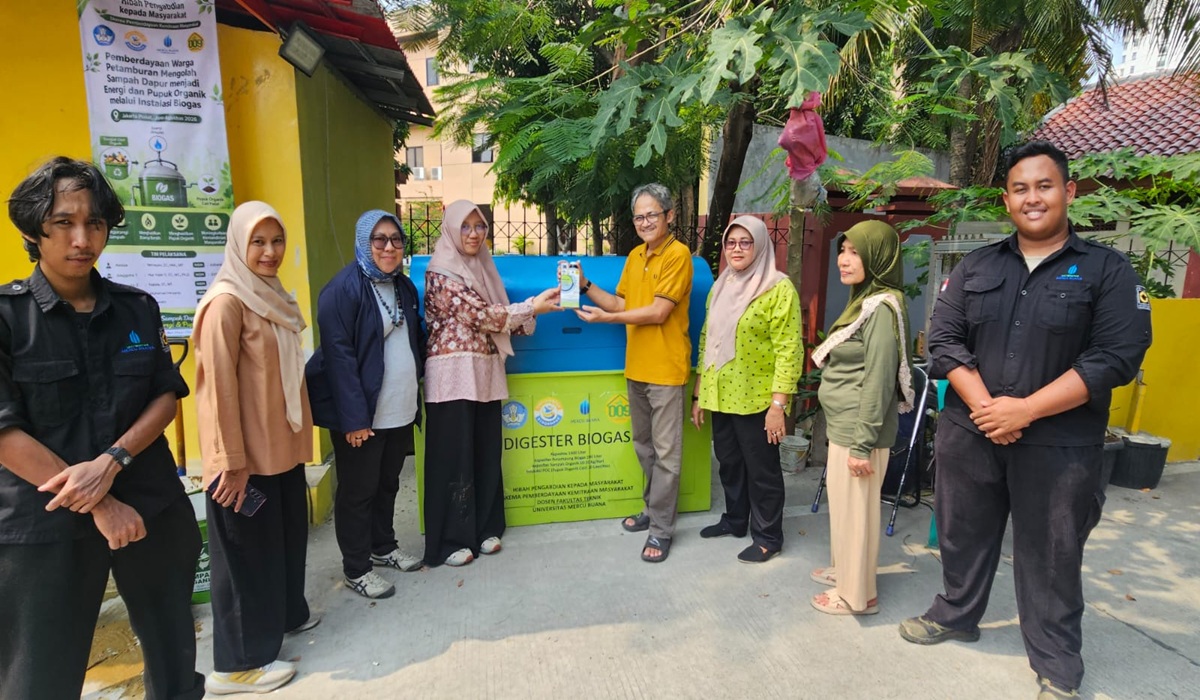
Amid the dense settlements of Petamburan, Central Jakarta, household kitchen waste is now finding an innovative solution. Leftover rice, fruit peels, and vegetable pulp, which usually pile up in disposal sites, are now being converted by residents into fuel for cooking. This transformation is the result of a community empowerment programme by the Community Service Team (PkM) from Mercu Buana University (UMB), which has introduced household biogas installations in the area.
This programme serves as an answer to a classic problem in densely populated urban areas: limited land that makes independent organic waste management difficult, despite the daily increase in kitchen waste volume. Through a Community Service grant scheme funded by the Directorate of Research and Community Service, Ministry of Higher Education, Science, and Technology (Kemdiktisaintek), the UMB team installed biogas digester units that can be operated directly by residents.
The head of the implementation team, Mirnayani, emphasised that this initiative is not merely about installing technical equipment, but about changing community habits from the root cause, namely waste sorting at the household level. “All this time, kitchen waste has been considered worthless, when in fact it is the most potential source to be converted into energy. The quality of the biogas produced depends heavily on how disciplined residents are in sorting their waste from home,” said Mirnayani.
The waste-to-energy process is carried out through a simple yet impactful mechanism. Organic waste is shredded and fermented to produce two main beneficial products for the residents. What sets this programme apart from typical equipment donations is its focus on sustainability through the preparation of local operators. Residents are not only taught how to turn on the installation, but are trained in-depth to handle the entire process chain. The training covers raw material collection, shredding techniques, digester loading, gas production monitoring, daily logbook entries, and risk management procedures such as handling gas leaks. With competent local operators, the installation is expected to remain optimally functional even after the university’s mentoring period ends.
The programme, which also involves Nur Indah and Nabila as team members, along with UMB students as field assistants, targets a larger vision: local food and energy self-sufficiency. If the model in Petamburan runs consistently, there is significant potential to replicate it in other dense settlements in Jakarta. This step is expected to address two challenges simultaneously: reducing the burden on increasingly full final disposal sites and lowering household energy costs for the community.