
Pestani Rawit Groo Festival Boosts Chilli Productivity by up to 15%
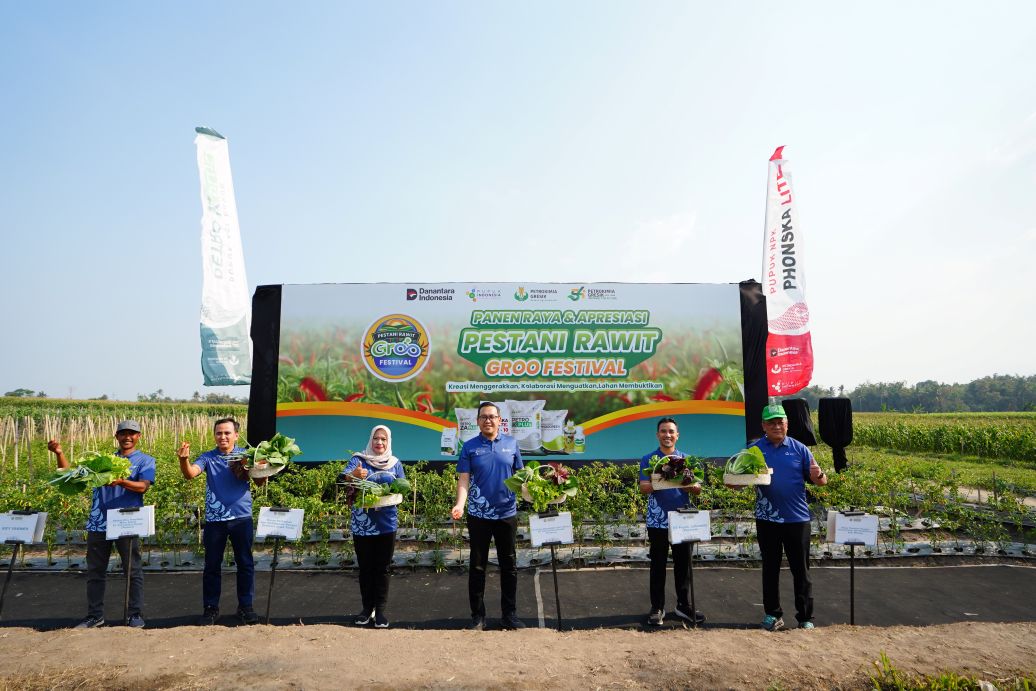
PT Petrokimia Gresik is driving an increase in bird’s eye chilli productivity in East Java through the Pestani Rawit Groo Festival. The programme involved 270 farmers from Malang, Kediri, Mojokerto, Blitar, and Probolinggo, applying balanced fertilisation and cultivation technology on their respective plots.
Director of Finance and General Affairs at Petrokimia Gresik, Adityo Wibowo, said the cultivation practices applied through the programme showed positive results. In demonstration plots, bird’s eye chilli productivity reached 11.5 tonnes per hectare, an increase of 13-15% compared with the previous yield of around 10 tonnes per hectare.
“We want to encourage bird’s eye chilli farmers in East Java to continue increasing harvests through balanced fertilisation, the use of technology, and appropriate cultivation practices,” Adityo said at the Pestani Rawit Groo Festival awarding event in Belung Village, Poncokusumo District, Malang Regency.
According to Adityo, productivity improvements are important because East Java contributes around 35% of national bird’s eye chilli production. Chilli production in the province is recorded at more than 600,000 tonnes. Therefore, productivity improvements at farmer level are considered to play a role in maintaining chilli supply while supporting food security.
In the Pestani Rawit Groo Festival, cultivation practices also formed part of a competition. In the Groo Field Creation category, participants applied a cultivation package prepared by Petrokimia Gresik from planting through to harvest. Assessment was based on the total weight of 54 bird’s eye chillies, with a weighting of 80%, while documentation of the cultivation process carried a weighting of 20%. The number 54 was chosen to coincide with the 54th anniversary of Petrokimia Gresik.
In addition to the field competition, the activity involved 270 urban farming practitioners from 27 provinces through the Groo Plant Creator programme. Participants shared their chilli cultivation experiences on social media, from planting through to harvest. The programme was strengthened by Groo Plant Partner, which involved 54 influencers, agricultural extension officers, and stakeholders. Overall, the Groo Festival involved 540 participants from various regions.
“This competition is not only looking for farmers with the best harvest results, but also encouraging participants to learn and directly prove the application of more focused cultivation practices on their own plots,” Adityo said.
Petrokimia Gresik also introduced a technology- and data-based agricultural approach. Through the AgrooFertile application, farmers obtain services that integrate artificial intelligence, agronomy services, and databases. In addition, the Soil Fertility Book is used as a reference regarding soil conditions, soil testing, balanced fertilisation, and data-based agriculture.
“We want technology to be present not merely as a tool, but as a solution that genuinely helps farmers make decisions, manage their land better, and achieve higher productivity,” Adityo said.
Head of Horticultural Crops at the East Java Provincial Agriculture and Food Security Agency, Pudjiati Ningsih, said the programme provides benefits for farmers, particularly in improving the productivity and quality of bird’s eye chillies. “I hope this activity can be utilised as effectively as possible to maintain food security. Through this programme we can maintain the productivity and quality of bird’s eye chillies,” she said.
Pudjiati expressed hope that a similar approach could be applied to other agricultural commodities in East Java. According to her, East Java is one of the main national centres for bird’s eye chilli production, making productivity improvements important.
One participant, Sumarno from the Tresno Tani Gembongan farmer group in Ponggok District, Blitar Regency, said the fertiliser recommendations provided by Petrokimia Gresik had an impact on chilli plant growth. “I followed the fertiliser application recommendations provided by Petrokimia Gresik. The results were very optimal, and my fellow farmers and I were very enthusiastic about participating in this programme,” he said.
The Pestani Rawit Groo Festival is part of the Pestani Programme developed by Petrokimia Gresik for farmer empowerment and cultivation competitions in East Java. As of June 2026, the Pestani Programme has reached 782 farmers in 14 regencies across several commodities, including watermelon in the Tapal Kuda area, melon in the Pantura region, shallots through Pestani Bawang Merah Nyawiji, and bird’s eye chillies through the Pestani Rawit Groo Festival.
“We present Pestani to accompany farmers from the field, not just from discussion rooms, because we believe productivity must be proven through real practice,” Adityo concluded.