
Pesta Babi or Pig Feast: The Documentary That Shook Indonesia’s Food Empire in Papua
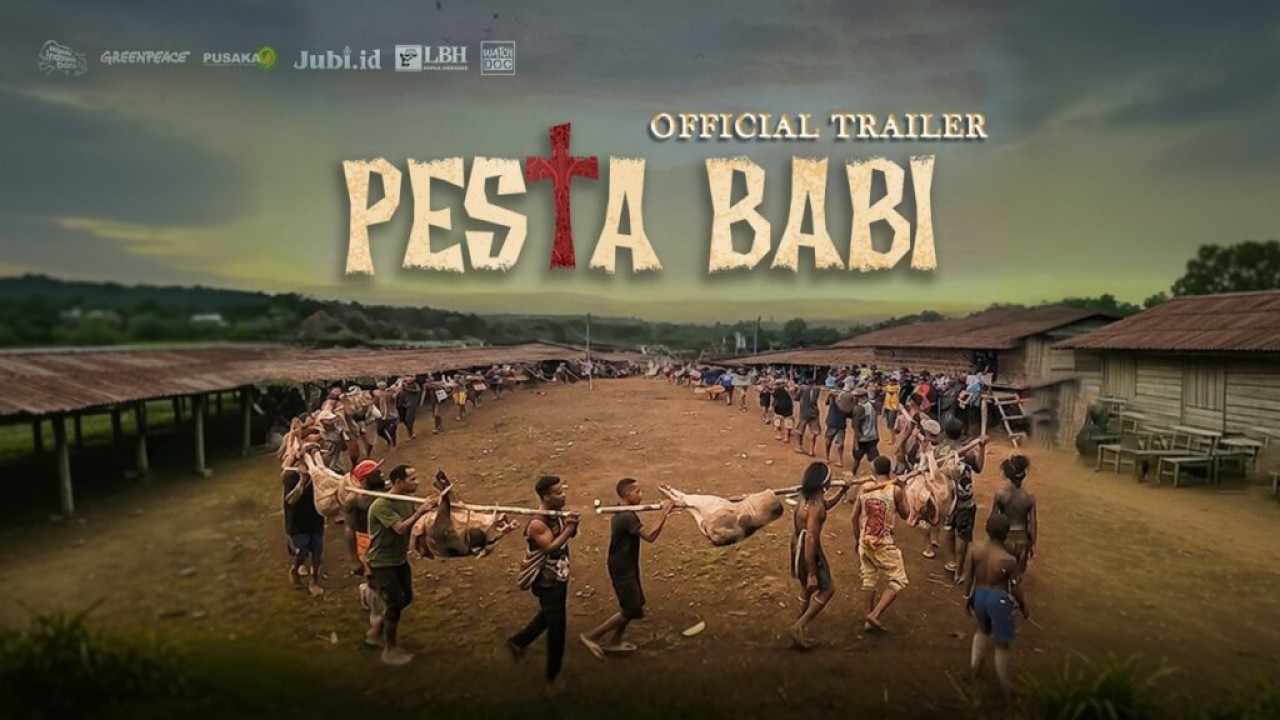
Pesta Babi, a 95-minute documentary is shaking Indonesia’s government, military, and corporate elite — and it’s about pigs.
A documentary about pigs, land, and power is doing what decades of diplomatic reports failed to achieve: forcing Indonesia to confront what is happening in its easternmost frontier. Pesta Babi: Kolonialisme di Zaman Kita — or Pig Feast: Colonialism in Our Time — is a 95-minute investigative film directed by Cypri Paju Dale and Dandhy Dwi Laksono, released in April 2026. It is now one of the most talked-about and suppressed documentaries in Southeast Asian history. Since its limited release, it has been screened in over 2,000 registered locations. Yet it has also been forcibly shut down at universities, disrupted by military personnel, and dismissed by government officials as “unbalanced.” The film, produced by WatchDoc alongside environmental and legal advocacy groups, does not simply document deforestation. It maps a power structure — one that connects national strategic projects, oligarchs, palm oil conglomerates, and the Indonesian military into a single, self-reinforcing machine.
Papua is Indonesia’s largest and most resource-rich province, long at the center of territorial disputes, human rights concerns, and underdevelopment. Under President Prabowo Subianto’s administration, the government designated large-scale agricultural and energy projects in South Papua as National Strategic Projects (PSN). These include food estates for rice and cassava, sugarcane plantations for bioethanol, and palm oil expansion — all positioned under the slogans of “food security” and “energy transition.” The affected areas, primarily around Merauke, Boven Digoel, and Mappi, are home to indigenous communities including the Marind, Awyu, Yei, and Muyu peoples, whose ancestral forests and rivers are directly in the path of these projects. It is within this context that Pesta Babi was made — and why it hit so hard.
The Ships, the Excavators, and the Signs on the Land
The film opens with a striking scene. Yasinta Moiwend, a Marind Anim woman from Merauke, describes the morning a massive ship docked at her village pier. It carried hundreds of excavators, escorted by military forces, heading inland for a National Strategic Project. Not far away, Vincen Kwipalo from the Yei community found his clan’s land had been marked with a sign reading: “Property of the Indonesian Army.” He had not been consulted. He had not been compensated. He simply woke up one day and his ancestral forest had been designated military territory — at the same moment a sugarcane company was encroaching on the same land.
These are not isolated anecdotes. The film argues they are symptoms of a coordinated system in which state power and corporate interest converge in Papua’s forests without meaningful consent from the people who have lived there for generations.
2.5 Million Hectares and the Oligarchs Behind Them
The scale of what Pesta Babi documents is staggering. According to the film, up to 2.5 million hectares of Papua’s forests could be converted into industrial plantations under projects promoted in the name of food and energy security.
Satellite imagery cited by Mongabay in November 2025 showed that roughly 17,000 hectares — approximately half of the first sugarcane concession alone — had already been cleared. The documentary traces the corporate ownership networks behind these projects, linking elite business circles and palm oil conglomerates to the national program.
One of the key figures identified in related reporting is Andi Syamsuddin Arsyad, a businessman who has expanded welfare and infrastructure assistance in villages surrounding the food estate areas — a practice critics describe as co-opting local consent.
Meanwhile, PT Agrinas Pangan Nusantara, a state-connected entity, has been pursuing targets of 425,000 hectares of food estates across Papua, Kalimantan, and South Sumatra. The financial architecture behind it, according to Indonesia analyst Kevin O’Rourke speaking to Mongabay, may already be straining under the weight of competing national budget demands.
The Military in the Screening Room
What gave Pesta Babi its political charge was not just its content, but how the state responded to it. Since its April 2026 release, at least 21 incidents of disrupted screenings were documented by a coalition of 10 civil society organizations. Screenings were shut down at Mataram University in Lombok, reportedly by university authorities themselves. A public event in Fort Oranje, North Moluccas, was broken up by local security forces.
A Jesuit priest in Yogyakarta confirmed that a planned screening was cancelled under pressure from authorities. The Indonesian Army (TNI) issued public warnings that the film contained “unbalanced narratives” about Papua, and Colonel Tri Purwanto, spokesperson for the XVII/Cenderawasih Military District Command, stated that films screened publicly must comply with Indonesian censorship laws. Despite this, Law and Human Rights Minister Yusril Ihza Mahendra denied that the government had issued any formal ban, attributing the disruptions to “administrative procedures” at individual campuses. For many observers, this explanation did not hold.
A Witness Walks Back, a Nation Debates
The controversy deepened in May 2026 when Yasinta Moiwend — the Marind Anim woman whose story opens the film — publicly distanced herself from Pesta Babi. In videos widely circulated on social media between May 20 and May 23, she said she felt “misled” during filming and that her words had not been presented as she intended. “I support development in Merauke,” she said. “We want our children to have a better future.” Her statements were quickly amplified by media outlets and government-aligned voices as evidence of the documentary’s alleged bias. But the retraction itself deepened the debate.
Was Mama Sinta’s change of position a genuine clarification — or the result of social and institutional pressure in
Source: jawawa.id (https://jawawa.id/newsitem/pesta-babi-or-pig-feast-the-documentary-that-shook-indonesias-food-empire-in-papua-1780304000)
Originally published by Batam News Asia (https://batamnewsasia.com/2026/05/29/pesta-babi-or-pig-feast-the-documentary-that-shook-indonesias-food-empire-in-papua/)