
Pesantrens Encouraged to Become Hubs for Community Empowerment and Self-Sufficiency
Islamic boarding schools (pesantran) are considered to have a much broader potential than mere religious educational institutions, with the capacity to serve as hubs for community empowerment. An education model that integrates character building, life skills, local potential development, and environmental awareness can equip students (santri) to build both economic and social independence.
The Coordinating Minister for Community Empowerment, Muhaimin Iskandar, believes that pesantrens can fulfil this role by strengthening the capacity of students and the surrounding communities. He noted that the educational process must provide space for students to recognise potential, develop skills, and identify opportunities within their local environments.
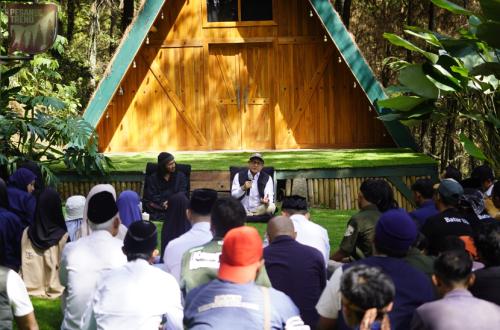
“Pesantrens should not only be places for learning. They can be spaces to build individuals who possess character, skills, the ability to spot opportunities, and ultimately, the ability to be self-sufficient,” Muhaimin stated during a visit to Pesan Trend (or Sekolah Rimba Indonesia), developed by the Pemuda Hijrah Foundation in Bandung Regency, West Java, on Tuesday.
This model is currently implemented at Pesan Trend through a curriculum that blends national standards, Quranic education, permaculture, and life-skills-based learning. Students do not only participate in classroom learning but are also involved in agriculture, livestock, waste management, coffee development, product manufacturing, and educational tourism.
“The key to empowerment is ensuring these children are not just prepared to seek jobs, but also possess the ability to create opportunities and develop the existing potential around them,” he said. The ability to create added value from local resources is a crucial aspect of building self-sufficiency.
One such potential being developed is coffee production, featuring an Arabica plantation spanning approximately 12.7 hectares, with an additional two hectares of new land. The management involves the Putra Manglayang Farmers Group, consisting of 31 members, with a projected production of around 50 tonnes in 2026.
Of that total, approximately 14 tonnes have already been absorbed for processing into various products, while the remaining 36 tonnes are still sold as raw materials. This situation presents an opportunity to increase added value through the strengthening of post-harvest capacity, processing, packaging, and market access.
“Here, we see how local potential can become a source of empowerment. It is not just about producing commodities, but about how the community has the ability to process them, increase added value, and reap greater benefits,” Muhaimin remarked. He added that developing local potential can expand the economic benefits received by the community.
Empowerment is also being implemented through sustainable agriculture, maggot cultivation, and converting waste into compost. These activities provide space for students to learn resource management while identifying productive opportunities arising from environmental challenges.
Muhaimin assessed that such community initiatives require strengthened access, mentoring, and collaboration to expand their impact. According to him, the government does not need to take over existing movements but should instead assist in scaling their benefits.
“Empowerment is not about making the community dependent, but about giving them the ability to stand on their own. Pesantrens have great potential to be a space where that independence grows,” Muhaimin said. He also encouraged pesantrens and communities in other regions to develop similar models tailored to their respective potentials.
Hanan Attaki, the founder of the Kampung Pemuda area, stated that the development of the area began with the Pemuda Hijrah movement in 2015. The next phase focuses on developing a model of youth empowerment that can be applied more widely.
“In our first period, we created a trend; thankfully, from 2015 to 2020, the ‘hijrah’ trend emerged in Indonesia. In the second period, we are creating models and locations. This area is one such collaborative space for youth. In a city, it would be called a ‘youth space’, but since we are in the mountains, we call it Kampung Pemuda,” Hanan explained.
Hanan hopes this approach can be implemented in various regions through Islamic centres, mosques, or village environments, according to local character. He noted that development does not need to follow a single template, as every region has different needs and potentials.
“Our hope is that this can scale up across Indonesia. This is not a franchise, but a movement. It can be imitated and developed freely according to the needs of each region,” he said. Such an approach opens opportunities for pesantrens to develop empowerment models aligned with local resources.
Strengthening skills, commodity processing, and the ability to identify opportunities can expand the function of pesantrens within the social and economic life of the community. The challenge remains to ensure that the educational process produces students who possess not only religious and academic knowledge but also the ability to develop the potential of their surrounding environment.
Source: jawawa.id (https://jawawa.id/newsitem/pesantrens-encouraged-to-become-hubs-for-community-empowerment-and-self-sufficiency-1791370702)
Originally published by Republika (https://rejabar.republika.co.id/berita/tmj8a0416/pesantren-didorong-jadi-pusat-pemberdayaan-dan-kemandirian-masyarakat), translated from Indonesian