
Pesantren, Pegon, and Artificial Intelligence: Welcoming National Literacy Day
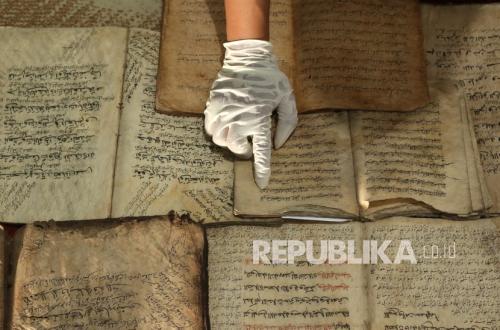
REPUBLIKA.CO.ID, JAKARTA – National Literacy Day, commemorated every 8 September, should not merely be a moment to remember script as a legacy of the past. It needs to become a space for thinking about the future of literacy. Amid the development of Artificial Intelligence, script cannot simply be saved from extinction. It must be given the opportunity to live, adapt, and become part of the knowledge ecosystem of the digital generation.
Pesantren have a long experience of making script a medium of knowledge. Pegon is not merely Arabic letters used to write regional languages. It is an intellectual creativity that brings together Islam and the culture of the Nusantara. Through Pegon, turats is translated, the kitab kuning are studied, dakwah is spread, and Islamic knowledge is implanted into community life.
For that reason, Pegon does not deserve to be placed solely as a cultural artefact. It is a knowledge technology. Santri read, write, take notes, and pass on knowledge through this medium. Within it lies ta’lim, ta’dib, tazkiyah, khidmah, and the continuity of sanad. What is inherited is not only letters, but a way for knowledge to live and move from generation to generation.
Now that medium is changing. Santri are not opposed to technology; learning no longer relies only on books and notebooks. The space of learning has also shifted from the pesantren veranda to the digital screen. This change need not become a threat. Indeed, it is here that pesantren can demonstrate the strength of their tradition, embracing new technology without losing adab, sanad, and their educational orientation.
Pegon Enters the Digital Space
The Pegon Virtual Keyboard is an important step in that journey. A script that has long been associated with pen and paper can now be used on a mobile phone. The change of tool appears simple, but its meaning is great. A script will remain alive if it is present in the everyday devices of the young generation, used for communication, documentation, and the production of knowledge.
Preserving Pegon therefore cannot stop at storing manuscripts or holding ceremonial activities. The script must be used, read, studied, and developed. Digitalisation opens the way for documenting Pegon works, gathering corpora, research, and developing technologies that will eventually be able to recognise and process text. Preservation thus becomes a strategy for the sustainability of knowledge.
Academic studies reinforce Pegon’s function in Islamic education. Mohammad ‘Ulyan, Nurti Budiyanti, and Shepta Adi Nugraha, in “Islamic Education Based on Arabic Pegon Letters in Madrasah Diniyah Al Barokah Watuagung Tambak Banyumas” (Jurnal Iqra’, 2020), demonstrate the relationship between Pegon and the transmission of education and the preservation of the Islamic heritage within educational settings.
The next step is Digital Tarkib. If the Pegon Virtual Keyboard brings pesantren script into the mobile phone, Digital Tarkib brings the tradition of studying the kitab kuning into the digital space. Its implementation is present in Rumah Kitab, showing that digitalisation can move beyond mere writing towards processing the structure of kitab kuning texts to support santri in their learning.
Rumah Kitab then presents a broader idea of the virtual pesantren. If the Pegon Virtual Keyboard is the layer of script and Digital Tarkib is the layer of the digital kitab kuning, Rumah Kitab is the layer of the learning ecosystem. The three indicate the direction of transformation: script, books, and the space of studying take on new forms in the digital environment without severing tradition.
From Pegon Towards Artificial Intelligence
It is here that Artificial Intelligence finds its relevance. AI needs data, language, knowledge structures, and context. The Pegon Virtual Keyboard provides a doorway for the production of Pegon texts. Digital Tarkib opens the way for structuring the knowledge of the kitab kuning. Rumah Kitab provides a digital learning environment. The three can become the foundation for developing AI rooted in the pesantren tradition.
Imagine santri writing Pegon on a mobile phone, accessing digital kitab kuning, understanding the structure of texts, then learning in a virtual pesantren space. AI can assist with transliteration, character recognition, search, translation, and learning recommendations. However, technology must remain a khadim, a servant. Kiai, teachers, sanad, talaqqi, and adab must not lose their authority.
Fengchun Miao and Wayne Holmes, in Guidance for Generative AI in Education and Research (UNESCO, 2023), emphasise a human-centred approach and attention to linguistic and cultural diversity. This principle is relevant for pesantren. AI should extend human capability, not replace the educational process that shapes knowledge, adab, and responsibility.
Pesantren need to build a Pegon AI Ecosystem. The steps begin with the inventory of works, standardised digitisation, corpus building, the development of character recognition, and language processing. Kiai safeguard context and authority. Santri become users as well as contributors. Campuses develop methodologies, technologists build the tools, and the government provides supportive policies and infrastructure, in khidmah, or service, to knowledge and the ummah.
National Literacy Day can ultimately become a moment that transcends the romanticism of preservation. Pegon is not merely a script of the past. From pen to keyboard, from keyboard to digital book, from book to virtual pesantren, and then towards Artificial Intelligence, this journey offers a future. Pesantren must become the fa’il (the subject), guarding sanad and adab whilst leading innovation.
Source: jawawa.id (https://jawawa.id/newsitem/pesantren-pegon-and-artificial-intelligence-welcoming-national-literacy-day-1788778455)
Originally published by Republika (https://analisis.republika.co.id/berita/tkzoza393/pesantren-pegon-dan-artificial-intelligence-menyambut-hari-aksara-nasional), translated from Indonesian