
Pertamina Strengthens Renewable Energy Programme, Transforming Its Partner Villages
Jakarta, CNBC Indonesia — Forests turning green again and electricity reaching homes have marked the beginning of change for communities in Tumpak Village, Central Lombok, West Nusa Tenggara, and Bondan Hamlet, Cilacap, Central Java. For residents, energy means more than lighting: it also creates business opportunities and improves livelihoods.
In Tumpak, Burhanudin and the community have restored a protected forest area that had been denuded by 2018. Around 30,000 trees are now growing there. The conservation effort has also opened up new economic opportunities for residents.
Livestock farming is growing, ecotourism attracts around 800 visitors a year, and coconut-based products such as cocopeat (coconut coir dust), virgin coconut oil (VCO) and briquettes provide income for the community. These activities employ 60 people and generate an economic turnover of around Rp60 million a year. Residents’ productive activities are supported by a 6.6 kWp solar power system.
“The more trees we plant, the more new sources of economic activity grow in this village,” Burhanudin said at the online DETalk event, ‘Empowered Villages, Sustained Energy: A Blueprint for the Energy Transition of the Future’, on Wednesday (3 November 2026).
Jamaludin, a community leader from Bondan Hamlet in Cilacap, has also seen change. Until 2017, the hamlet where he lived had no electricity. To obtain clean water, residents had to travel around seven kilometres by boat.
The arrival of a hybrid power plant has now transformed residents’ lives. Electricity not only lights homes but also powers pond aerators and desalination technology, which turns brackish water into clean water.
The benefits extend to local economic activity. Women have received training in processing aquaculture products, while the village cooperative helps sustain the hybrid plant’s operations through a monthly contribution of Rp25,000 per household. Bondan Hamlet has also become a learning laboratory for students from Cilacap State Polytechnic.
“This programme has proved that it works well and delivers tangible, wide-ranging benefits to the people of Bondan Hamlet,” said Jamaludin, recipient of the 2023 Pertamina Group TJSL Local Hero Award.
The stories of Burhanudin and Jamaludin show how renewable energy can drive change in villages. It does more than provide access to energy: it also helps communities develop local potential and create new livelihoods.
These efforts are in line with the Desa Energi Berdikari (DEB, or Independent Energy Village) programme, which state-owned energy company PT Pertamina (Persero) has been developing since 2018. Through its Social and Environmental Responsibility (TJSL) programme, Pertamina promotes the use of renewable energy alongside community economic development tailored to each village’s potential.
Pertamina Vice President for CSR and SMEPP Management Rudi Ariffianto said in the DETalk webinar that DEB is developed under three categories: Food Security, Modern Coastal Communities and Energy Tourism. Development takes place in stages, from DEB White, Green and Blue to Self-Reliant.
Pertamina has so far developed 310 Independent Energy Villages, with another 24 in development. Sixty per cent are outside Java. The number is targeted to reach 334 villages by the end of 2026 and to continue expanding to 732 by 2030.
“We are seeking to promote sustainable economic growth for communities, based on local resources,” Rudi said.
The programme’s impact can be seen in the use of various energy sources, including solar power, biogas, micro-hydro, biodiesel and hybrid power plants. Together, these have generated 1.595 million Wp of electricity capacity and 973,000 cubic metres of biogas.
In the food sector, DEB has produced more than 21,000 tonnes of rice and 5,000 tonnes of non-rice commodities across around 2,000 hectares. In fisheries, the Modern Coastal Communities programme contributes 390 tonnes of wild-caught fish a year.
The programme generates more than Rp26 billion a year in community-based economic value and benefits over 283,000 people. Some villages have developed tourism into a source of income. DEB Uma Palak ecotourism in Denpasar generates Rp540 million a year, while Kampung Kepiting in Cilacap earns Rp601 million annually.
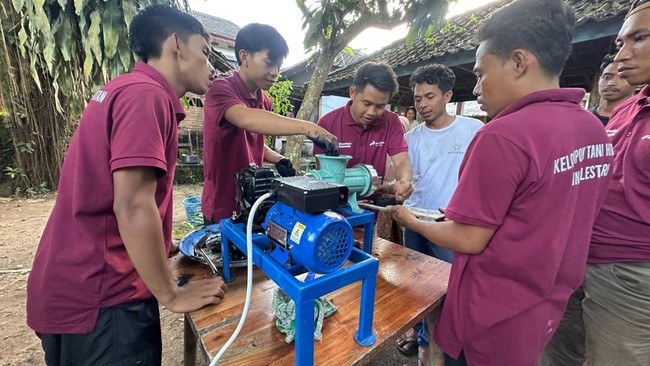
Alongside creating economic opportunities, the programme strengthens communities’ capacity to manage renewable energy. A total of 223 community leaders have been certified as renewable energy operators.
In Keliki Village, Ubud, for example, agricultural productivity has increased. Rice harvests, previously limited to once a year, now take place up to three times annually, while yields have risen from 3–4 tonnes to seven tonnes per hectare.
Renewable energy also benefits communities during emergencies. DEB Watumite in Ende has been able to maintain electricity and internet access during disasters.
Environmentally, the programme has contributed to reducing emissions by more than 1.1 million tonnes of CO2 equivalent and managing 145,000 tonnes of waste a year. Its expansion is also supported by a pentahelix collaboration. Together with 13 universities, Pertamina has introduced 40 types of appropriate technology in 134 villages.
For residents, the changes mean more than the arrival of power plants or new technology. Energy has created opportunities to develop businesses, raise productivity and protect the environment.
Through Desa Energi Berdikari, Pertamina is seeking to ensure that the energy transition goes hand in hand with community empowerment. Sustainable energy is not only about how electricity is generated, but also how its benefits can sustain local economies and improve the quality of life in rural communities.
Source: jawawa.id (https://jawawa.id/newsitem/pertamina-strengthens-renewable-energy-programme-transforming-its-partner-villages-1793767847)
Originally published by CNBC Indonesia (https://www.cnbcindonesia.com/news/20261104104418-4-782161/perkuat-program-ebt-begini-cerita-perubahan-desa-binaan-pertamina), translated from Indonesian