
Pertamina Patra Niaga Conducts First Lifting of B50 Biosolar
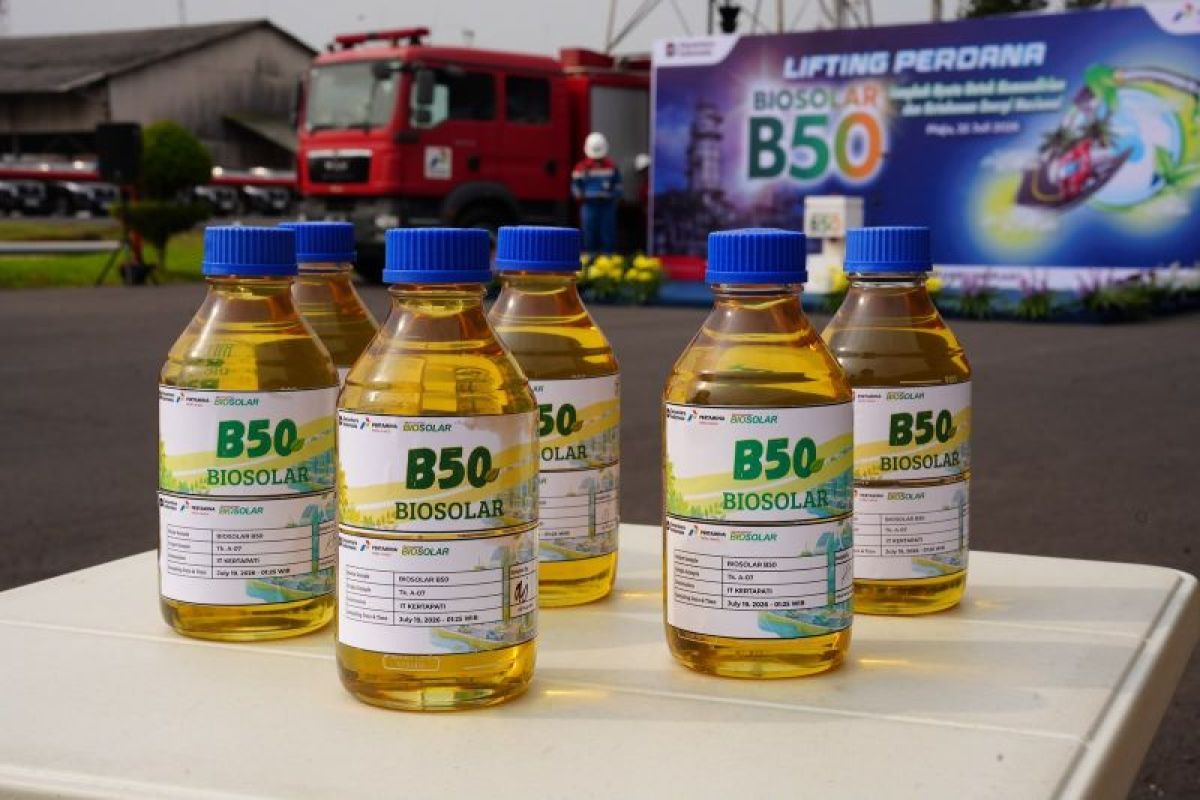
Jakarta (ANTARA) - PT Pertamina Patra Niaga has carried out the first delivery (lifting) of its B50 Biosolar product, containing a 50 per cent blend of biofuel.
Vice President of Corporate Communication at Pertamina Patra Niaga, Kitty Andhora, said in Jakarta on Thursday that the company is continuing to ramp up production of the environmentally friendly B50 Biosolar fuel.
The product is an innovation combining 50 per cent palm oil (fatty acid methyl ester/FAME) with 50 per cent diesel oil.
The national implementation of B50 was officially launched by President Prabowo Subianto on 9 July 2026.
According to Kitty, Pertamina Patra Niaga has recorded two B50 liftings by the company’s refineries.
The first was carried out by the Kasim refinery in Papua on 18 July 2026, followed by the Plaju refinery in South Sumatra on 22 July 2026.
Kitty said the first lifting is a concrete manifestation of the company’s commitment to supporting President Prabowo Subianto’s Astacita programme to achieve energy self-sufficiency in Indonesia.
“The first lifting of B50 by the Kasim and Plaju refineries is an important milestone marking Pertamina Patra Niaga’s concrete steps in strengthening national energy independence, resilience and sovereignty, particularly through the government’s B50 programme,” she said.
In this lifting, the Kasim refinery delivered 4,600 kilolitres (kl) of B50 to MT Krasak, while the Plaju refinery delivered 8,230 cl of B50 to the Integrated Terminal (IT) Palembang.
The lifted B50 Biosolar is now ready to be distributed to petrol stations across western and eastern Indonesia so that the benefits of the environmentally friendly fuel can be widely felt.
According to Kitty, before the lifting took place, Pertamina Patra Niaga made various preparations to ensure the B50 implementation met standards.
This included the readiness of facilities and infrastructure, product quality control and safety aspects to maintain reliable energy supplies for the public.
Starting from the blending process, all procedures must be standardised, with diesel and FAME mixed gradually until the correct composition and specification are achieved.
The blended B50 is tested in a laboratory to analyse whether it meets specifications and to check its quality in accordance with Ministry of Energy and Mineral Resources regulations, before being channelled to fuel terminals and subsequently distributed to petrol stations.
Furthermore, Kitty revealed that the presence of B50 will generate a multiplier effect on the national economy and contribute to foreign exchange savings through reduced diesel imports.
“This programme is also expected to contribute to reducing greenhouse gas emissions, as well as curbing dependence on imported fuel,” Kitty said.