
Pertamina Optimises Palm Oil Potential and Waste to Substitute Fuel Imports
PT Pertamina (Persero) has reaffirmed its commitment to supporting the government’s target of reducing imports of fuel oil (BBM) to strengthen national energy security. The strategic move is focused on optimising the use of palm oil and its derivative products.
Pertamina Deputy CEO Oki Muraza stated that palm-based bioenergy is a measurable solution to address the challenge of meeting domestic energy needs, which are currently still supported by imports of crude oil and fuel products. “The answer is right before our eyes. With the resources of CPO (Crude Palm Oil) and Empty Fruit Bunches, we must be able to convert them into energy,” Oki said, quoted from a written statement on Tuesday (21/7/2026).
Oki further outlined three main potentials of bioenergy in safeguarding national energy security. First, the very abundant availability of domestic biomass. Second, its crucial role in supporting energy security while accelerating decarbonisation in the transportation sector. Third, bioenergy can drive a circular economy that contributes to improving public welfare.
“Pertamina cannot walk alone in this energy transition. The scheme that must be built is to strengthen the entire biofuel ecosystem, from the supply of raw materials, technology development in refineries, to distribution to the public,” he explained.
This concrete step is realised through the implementation of the B50 biodiesel programme, which currently establishes Indonesia as the country with the largest biodiesel usage in the world. Its distribution network reaches 86 of Pertamina’s 121 fuel terminals across Indonesia.
On the other hand, to reduce petrol imports, Pertamina is also building a bioethanol development facility in Glenmore with a capacity of 30,000 kilolitres per year. This step is taken to pursue the E10 blending target according to the government’s roadmap.
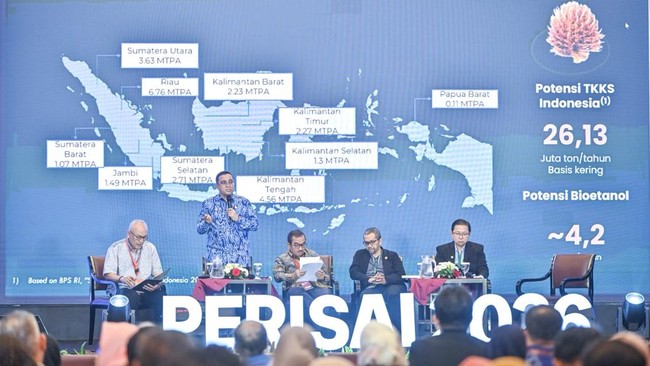
In addition to CPO, Pertamina is beginning to eye the vast, underutilised potential of Empty Fruit Bunches (EFB). With a potential volume reaching approximately 25 million tonnes per year, EFB is considered to have strategic added value for processing into bioethanol.
“Our challenge now is in downstream processing. How we can break down this EFB into glucose and then into bioethanol. If this initiative succeeds, there will be no more wasted waste,” Oki explained.
This development focus is also accompanied by an increase in green refinery infrastructure capacity. Pertamina is currently supporting the construction of a Dedicated Green Refinery in Cilacap. Previously, the company had also commercially applied coprocessing technology at the Cilacap Refinery and is currently conducting trial phases for the Balongan and Dumai Refineries.
Oki emphasised that the transition towards energy independence requires a solid ecosystem, from raw material supply and technology development in refineries to downstream distribution. “This all requires cooperation. We cannot just rely on industry. There must be synergy between the government, banking, academia, and the public. The goal is one: to realise energy independence and reduce the burden on the state’s foreign exchange reserves,” he concluded.
Source: jawawa.id (https://jawawa.id/newsitem/pertamina-optimises-palm-oil-potential-and-waste-to-substitute-fuel-imports-1784631207)
Originally published by CNBC Indonesia (https://www.cnbcindonesia.com/news/20260721163704-4-752663/pertamina-optimalkan-potensi-limbah-sawit-untuk-substitusi-impor-bbm), translated from Indonesian