
Pertamina NRE Chief Unveils Three Strategies to Develop Green Fuels
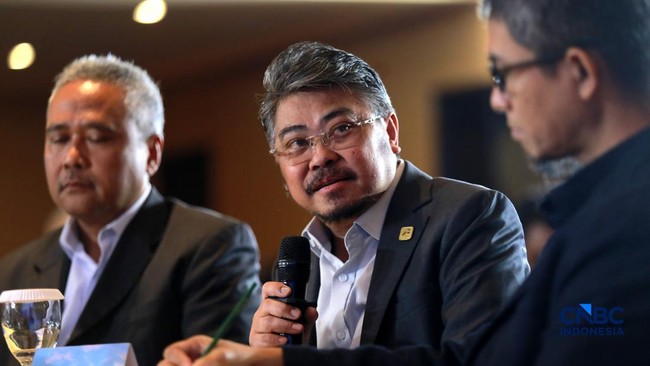
PT Pertamina New and Renewable Energy (NRE) has three strategies to drive the development of green fuels domestically. This approach is being pursued to help Indonesia achieve energy independence whilst making the cost of renewable energy more competitive for the public.
Pertamina NRE President Director John Anis explained that the company is seeking to diversify energy sources to strengthen national energy security amidst global geopolitical dynamics. According to him, energy development must not rely on a single method but must involve various integrated innovations from upstream to downstream.
‘We have three strategies here: one is multi-feedstock, the second is multi-generation, and the third is multi-region,’ he said at the CNBC Indonesia Energy Forum in Jakarta.
The first strategy, multi-feedstock, involves utilising various plant-based raw materials to avoid competition with national food needs. Pertamina is currently optimising molasses, a by-product of sugar production, as a feedstock for ethanol and is beginning to explore the use of cassava and sweet sorghum in the Lampung region.
‘Why multi-feedstock? Because the most mature option that does not compete much with food is sugarcane. Molasses is a side product that can no longer be turned into sugar, so it does not compete with sugar,’ he stated.
The second strategy is the development of cross-generational technology, or multi-generation, by venturing into the processing of waste into second-generation biofuels. This innovation targets the utilisation of leftover sorghum stalks and palm oil mill effluent (POME), which are abundantly available, to be converted into cheaper biomethanol.
‘Why are we moving to second generation? Because first-generation feedstock sometimes competes with food and is expensive, making it uneconomical. Meanwhile, second-generation uses waste, so the feedstock can be cheap,’ he explained.
The final strategy is a multi-region approach, focusing on building production facilities close to raw material sources. Pertamina plans to add at least five new processing plants spread across East Java, Central Java, Lampung, and Sulawesi to ensure supply chain and logistics efficiency.
‘Why multi-region? Because each region has different potential. Some have corn potential, others have sugarcane potential, so we will go there,’ he concluded.