
Pertamina NRE accelerates waste-to-value through Bandung DWM development
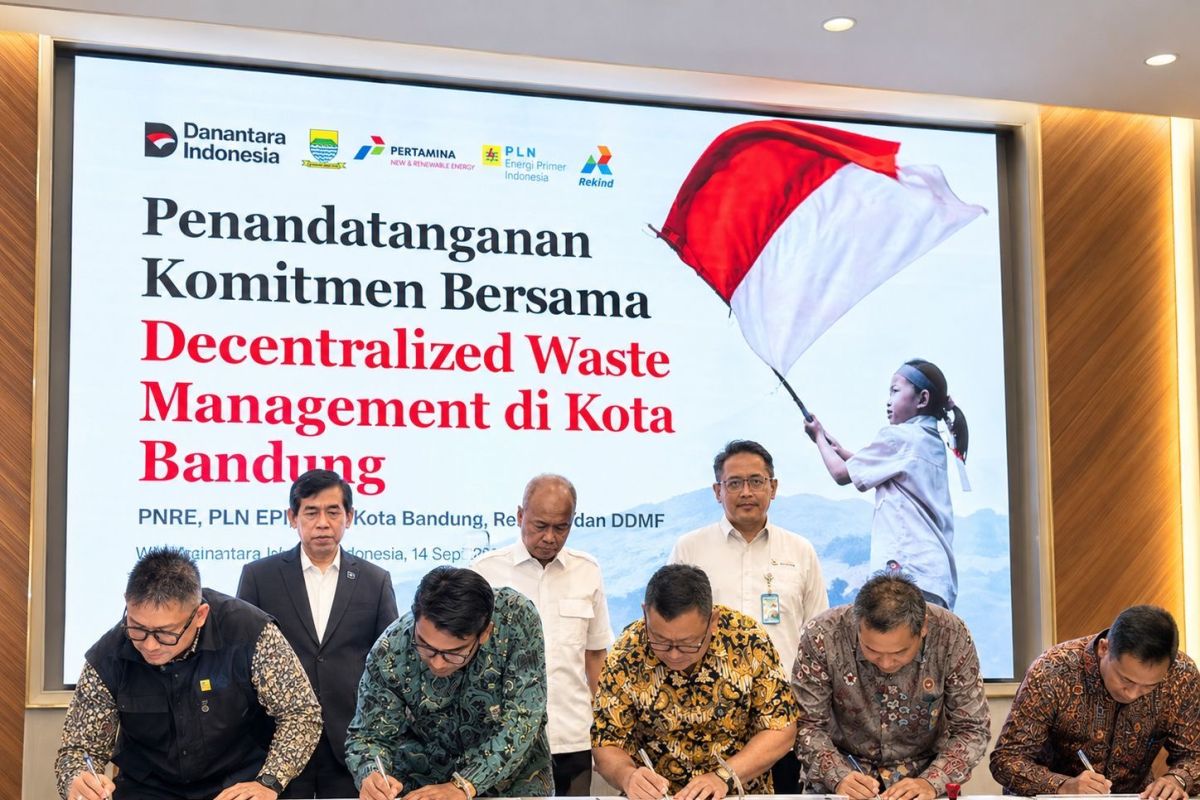
Jakarta (ANTARA) - Pertamina New & Renewable Energy (NRE) is driving innovation in waste management by prioritising a waste-to-value approach through the development of the Decentralised Waste Management (DWM) pilot project in Bandung.
Norman Ginting, Director of Projects & Operations at Pertamina NRE, stated in Jakarta on Wednesday that this project serves as an initial step towards developing integrated waste management capable of converting waste into value-added resources and energy.
“Through this project, we want to encourage the transformation from waste to resource, and subsequently from waste to value. Materials that still hold value can be recovered, while fractions with energy potential can be developed into alternative fuels with more controlled quality,” said Norman.
In its initial concept, the facility is designed to process approximately 300 tonnes of municipal solid waste (MSW) per day through a series of mechanical sorting and material recovery processes, including bag opening, screening, magnetic separation, ballistic separation, and eddy current separation.
This process will separate materials that still possess recycling value, organic fractions or fines, and combustible fractions that can be further processed.
From a technological perspective, the DWM integrates mechanical sorting, material recovery, and fuel preparation processes.
The separated combustible fraction can undergo shredding, drying, mixing, and quality control to produce Solid Recovered Fuel (SRF) with more consistent characteristics.
This SRF has the potential to be utilised as an alternative fuel to partially replace fossil fuel usage, either through co-firing in power plants or to meet energy needs in the industrial sector.
He explained that, under the concept currently being studied, the combustible fraction from MSW could also be combined with rice husks to produce blended SRF, which will subsequently be verified based on feedstock characteristics, product quality, supply chain sustainability, and the requirements of potential off-takers.
“The technological value of this project lies not just in the waste processing machinery. More importantly, it is about how we build a system capable of converting highly heterogeneous waste into more consistent, measurable materials and fuels that possess economic value. This is what distinguishes the waste-to-value approach from conventional waste management,” said Norman.
He continued that the success of this project will require integration throughout the entire value chain, ranging from ensuring waste supply and characteristics, land and infrastructure readiness, and the availability of supporting materials, to product quality and the certainty of off-takers.
In the initial project structure, PNRE is planned to act as both developer and operator, supported by local governments as well as engineering, procurement and construction (EPC) partners, technology providers, suppliers, and off-takers.