
Pertamina EP Rantau Spuds Five Wells Amid Post-Flood Recovery
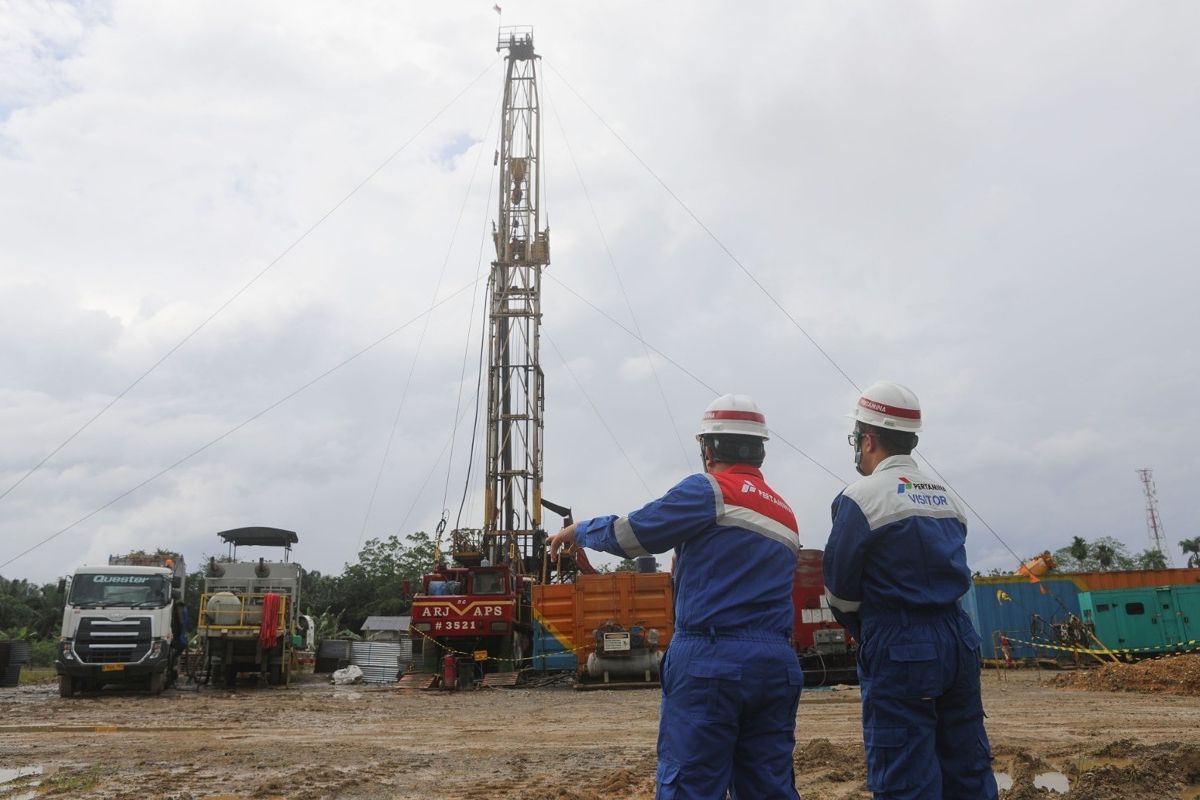
Jakarta (ANTARA) - PT Pertamina EP Rantau Field has spudded five new oil and gas wells while recovering from flooding in Aceh Tamiang, Aceh Province, demonstrating the resilience of energy workers.
Pertamina EP Rantau Field Manager Tomi Wahyu Alimsyah said in a statement in Jakarta on Saturday that the drilling supports the sustainability of national oil and gas production.
“After carrying out recovery programmes in stages and completing three new wells, oil production has returned to a stable level of 1,700 barrels per day,” he said.
Tomi said Pertamina EP Rantau Field, part of Pertamina Subholding Upstream Regional 1 Zona 1 (Pertamina Hulu Rokan/PHR Zona 1), was carrying out an ongoing post-flood recovery programme.
He said production had returned to its previous performance within four months. The company has also spudded five new wells in its working area.
“Although we are still recovering from the floods, the company is drilling wells to find new oil and gas reserves and maintain production. Spudding these new wells is vital to national energy supplies,” he said.
The five wells are RNT DZ-51 and RNT DZ-52, in Tanjung Seumantoh village, Karang Baru subdistrict, Aceh Tamiang.
They are being drilled using the APS-752 rig, with a capacity of 550 horsepower (HP). Their planned total depths are 1,145 metres measured depth (MMD) for RNT DZ-51 and 1,037 MMD for RNT DZ-52.
The other three wells—RNT DZ-11, RNT DZ-23A and RNT DZ-33—are in Paya Meta village, Karang Baru subdistrict, Aceh Tamiang.
RNT DZ-11 is being drilled using the TMMJ-12 rig, also with a capacity of 550 HP, and has a planned total depth of 1,132 MMD. Drilling is under way on the other two wells.
Tomi said spudding the five new wells would also help maintain production at PEP Rantau Field. The work forms part of a national strategy to strengthen energy security and explore Aceh Tamiang’s oil and gas reserves.
“Collaboration with rig-service contractors, together with full support from SKK Migas, is part of our shared commitment to maintaining national energy security and sustainability,” he said.
Before spudding the five new wells, Pertamina EP Rantau Field carried out a phased recovery from the floods that hit its working area. It applied four recovery phases: emergency, reactivation, recovery and sustainability.
These phases covered safety measures, repairs to facilities and the strengthening of long-term operational systems.
“The initial stage focused on basic needs such as food, clean water, healthcare and electricity. Once conditions improved, the team began reactivating facilities and production wells,” he said.
Tomi said the Pertamina EP Rantau Field team had taken various steps to speed up recovery. One was bringing back online the power plant, which is central to the field’s operations.
When the electricity failed, the clean-water supply was also lost because the water treatment plant (WTP) had been flooded and its pumps could not operate. Oil production also came to a complete halt.
“The power plant here uses gas from reactivated wells. The floods severely damaged our High Pressure Compressor Station (HPCS), so we came up with various innovations to restore electricity,” he said.
After careful analysis, the team decided not to reactivate the HPCS, previously the gas compressor station and the sole source of gas for the power plant.
Instead, it sought an alternative and found that SP-5 could take over the HPCS’s function with a few modifications, restoring electricity. The HPCS remains inactive, while gas is now supplied by both SP-5 and SP-1.
“Every challenge brings a lesson. One benefit was that we simplified some facilities. Once the electricity problem was resolved, production, which had previously been at zero barrels, gradually began to rise,” he said.
Tomi said the post-flood recovery had been relatively rapid, taking only four months.
The major floods at the end of last year, with water levels of about 4–4.5 metres and mud deposits of 30–80 centimetres, damaged production facilities, offices and housing for Pertamina EP Rantau workers.