
Pertamina Builds New Jetty in Bali to Prevent Fuel Distribution Disruptions
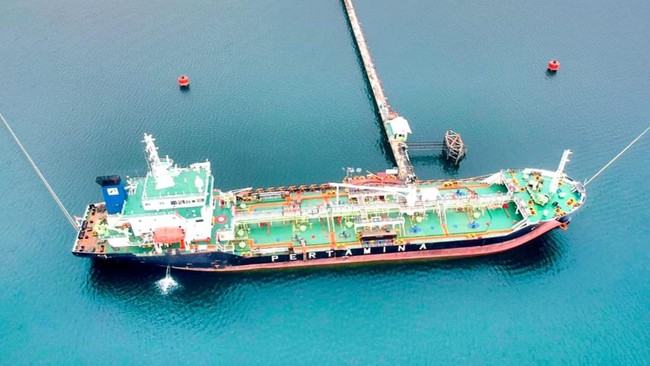
Jakarta, CNBC Indonesia — PT Pertamina Patra Niaga (PPN) is building a new jetty at the Manggis Terminal complex in Bali to mitigate the risk of fuel distribution disruptions caused by high waves.
Pertamina Patra Niaga president director Mars Ega Legowo Putra said the construction followed berthing problems that had temporarily disrupted fuel deliveries to several petrol stations in Bali in October 2026.
He explained that the infrastructure is being designed so its approach channel does not run in the same direction as the sea swell, which is expected to reduce the risk of vessels being struck when waves become large.
“At Manggis Terminal, the waves are indeed very large. One of the measures we are taking is to build a new jetty whose approach channel is not aligned with the direction of the waves. We hope this can reduce the risk of vessels being struck when the waves are high,” Mars Ega said at a hearing with Commission VI of the House of Representatives on Thursday (12 November 2026).
“We hope to accelerate the process and complete construction soon,” he added.
Pertamina is also exploring the use of Benoa Port with state-owned port operator PT Pelabuhan Indonesia (Persero), or Pelindo, to strengthen fuel supplies to Bali, particularly Denpasar.
Bali’s largest fuel storage capacity is at Manggis Terminal, while the greatest demand is in Denpasar, which has so far been served by Pesanggaran Terminal.
Mars Ega said Pesanggaran Terminal’s storage capacity and jetty facilities are relatively limited, restricting its ability to receive large vessels.
By exploring the use of Benoa Port, Pertamina hopes to bring in larger vessels and increase fuel supplies to Pesanggaran and Denpasar.
“If Benoa Port can be used, Pesanggaran could receive supplies from larger vessels, increasing supplies to Bali overall. It would also give us an alternative port if waves cause problems at Manggis,” Mars Ega said.
How fuel distribution in Bali was disrupted
Mars Ega said the disruption began when the vessel MT Prima XP arrived at Manggis Terminal at 6.40 am Central Indonesia Time on 11 October 2026.
The vessel was scheduled to berth and unload fuel, allowing Pertalite deliveries to petrol stations to begin at about 11 am that day.
However, berthing was delayed by anchor-handling work that took around 18–19 hours. As a result, no fuel was delivered to petrol stations on Sunday (11 October 2026). Distribution resumed at about 4 am on Monday (12 October 2026).
Mars Ega said the day-long interruption depleted petrol stations’ buffer stocks, prompting vehicle queues and creating a public perception of a fuel shortage.
He said fuel stocks at Manggis Terminal had returned to normal by 12 October 2026. Pertamina nevertheless needed time to restore deliveries from the terminal to petrol stations, whose stocks had already fallen.
With support from several Bali provincial government policies, distribution returned to normal the following Saturday.
“By 13 October, fuel stocks were indeed available at the terminal. However, we were still recovering deliveries from the terminal to petrol stations because queues had already formed. With the support of the governor’s policies during the recovery, distribution was back to normal by Saturday,” he said.
Source: jawawa.id (https://jawawa.id/newsitem/pertamina-builds-new-jetty-in-bali-to-prevent-fuel-distribution-disruptions-1794495067)
Originally published by CNBC Indonesia (https://www.cnbcindonesia.com/news/20261112174044-4-784757/pertamina-bangun-dermaga-baru-di-bali-cegah-distribusi-bbm-terganggu), translated from Indonesian