
Pertamax Price Hike Makes User Shift to Pertalite Unavoidable, Economists Warn
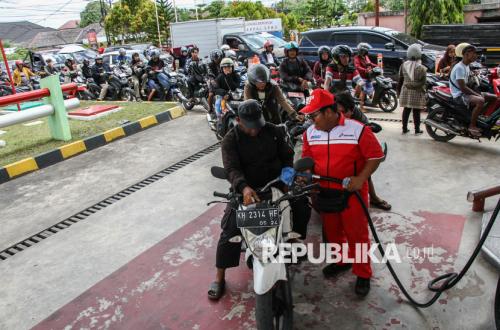
The increase in the price of Pertamax from Rp12,300 to Rp16,250 per litre is expected to drive some users to switch to Pertalite. Economists assess that the widening price gap between non-subsidised and subsidised fuel has the potential to alter public consumption patterns, increase the burden of energy subsidies, and simultaneously suppress the purchasing power of middle-class and vulnerable groups.
The Center of Economic and Law Studies (CELIOS) estimates that the roughly 32 percent increase in Pertamax prices will trigger a migration of users to Pertalite. CELIOS Director of Public Policy Media Wahyudi Askar stated that the price surge leaves the public facing increasingly limited choices.
“When the margin of increase is too wide, the options are to pay more, or downgrade to Pertalite. Downgrading to Pertalite also means increasing the number of Pertalite users who have been receiving government subsidies,” Media said in a statement on Wednesday (10/6/2026).
According to him, user migration to Pertalite is a difficult consequence to avoid when the price gap between subsidised and non-subsidised fuel widens. This situation is considered to potentially increase pressure on the government’s energy subsidy budget.
Media also judged the assumption that the Pertamax price increase only impacts high-income groups as not entirely accurate. He mentioned that Pertamax users come from various backgrounds, ranging from workers, teachers, employees, online motorcycle taxi drivers, to groups of people on the path to the middle class.
“The view that the Pertamax 92 increase only hits the rich is a mistaken simplification. Users of Pertamax 92 are not just the rich, but also the vulnerable middle class,” he said.
CELIOS warned that the impact of the non-subsidised fuel price hike is not limited to changes in energy consumption patterns. The institution expects pressure on the purchasing power of the middle class and aspiring middle class to increase, followed by the risk of an increase in the vulnerable poor group, rising food prices, and an acceleration of credit interest rate transmission.
CELIOS Director of Economy Nailul Huda said the risk of users switching to Pertalite is growing larger because the government decided to maintain subsidised fuel prices amidst the Pertamax increase.
“When the government decides to raise the price of Pertamax 92 without raising the price of Pertalite, there is a consequence of increased demand for Pertalite. As a result, the Pertalite quota will increase and cause fuel subsidies to balloon as well,” Huda said.
He added that the effectiveness of purchase restrictions through the QR Code system is highly dependent on distribution supervision on the ground. According to him, sales practices of Pertalite outside petrol stations still have the potential to occur, which could reduce the effectiveness of controlling subsidised fuel consumption.
Meanwhile, CELIOS Executive Director Bhima Yudhistira assessed that the decision to raise Pertamax prices reflects the government’s increasingly narrow fiscal space in maintaining energy price stability.
According to Bhima, the growing burden of state debt payments and interest, coupled with the potential shortfall in tax revenue, puts the government under significant fiscal pressure.
“Maturing debt and interest obligations have reached Rp1,434 trillion, making this year one of the peaks for debt payments. The tax revenue outlook shows a potential shortfall of Rp300-340 trillion, and the need for programme spending remains large. The government has run out of ammunition to keep energy prices stable,” he stated.
Bhima added that the weakening of the rupiah exchange rate since the beginning of the year has further aggravated the pressure on the energy budget by increasing the cost of fuel imports and energy compensation needs.
“High oil prices are beyond the government’s control, but the weakening rupiah exchange rate is within the control of the government and Bank Indonesia, thus having a large role in fuel price adjustments,” Bhima said.
He assessed that the government still has a number of options to face fiscal pressure, ranging from spending efficiency to optimising state revenue. However, according to him, the fuel price adjustment policy risks providing additional pressure for vulnerable groups in society.
Previously, PT Pertamina Patra Niaga announced an adjustment to the selling prices of Pertamax and Pertamax Green effective Wednesday (10/6/2026). The price of Pertamax rose to Rp16,250 per litre, while Pertamax Green 95 became Rp17,000 per litre.
Pertamina stated that the adjustment was made through periodic evaluations considering the development of world oil prices and economic market prices. Meanwhile, the price of Pertalite was maintained at Rp10,000 per litre and subsidised Biosolar at Rp6,800 per litre. Pertamax Turbo, Dexlite, and Pertamina Dex experienced no price changes.