
Persis Hisbah Council Seeks to Develop Mujtahid Scholars through Usul al-Fiqh Course
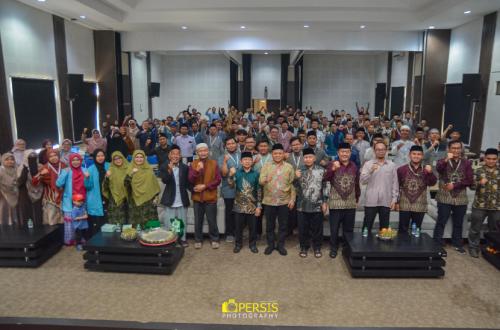
BANDUNG — The Hisbah Council of the Central Leadership of Persatuan Islam (PP Persis), in collaboration with the PP Persis Cadre Education and Training Agency (Badiklat Kader), held an Usul al-Fiqh course at the Balai Besar Penjaminan Mutu Pendidikan (BBPMP) building in Lembang from 22 to 24 October 2026. The event is part of efforts to strengthen scholarly traditions and prepare religious scholars capable of addressing the community’s concerns on the basis of the Qur’an and Sunnah.
The chair of the PP Persis Hisbah Council, KH Zae Nandang, said the course was one response to the perception that Persis did not value scholars because it sought to determine rulings directly from the Qur’an and Sunnah. He said this perception was mistaken, as Persis valued scholars’ contributions to the development of Islamic scholarship.
“We greatly value the major contributions of the scholars. We are grateful to them because the knowledge they have passed down is a tool that enables us to achieve our aims,” he said.
He stressed that cadres with the capacity for ijtihad—the independent interpretation of Islamic law—would always be needed. The community’s concerns continue to evolve, requiring religious answers that are scientifically defensible and consistent with the guidance of Islamic law.
“We will always need cadres capable of ijtihad. Issues keep emerging, and there must be answers that reassure the community. Such answers are those that derive from Allah,” Zae Nandang said.
On the process of deriving rulings, he also highlighted the importance of understanding the authenticity of hadith and the basis of the arguments used. He said Persis considers the use of sahih or hasan hadith in the process of determining rulings. Cadres therefore need to master usul al-fiqh so they can understand evidence, assess the strength of arguments and reach sound legal conclusions.
“We must understand why sahih or hasan hadith are used and how that evidence is made the basis for determining a ruling,” he said.
Zae Nandang added that the Hisbah Council was open to criticism and differing opinions, provided they were presented through the proper scholarly channels. If someone disagreed with a ruling, he said, the matter should first be discussed within the council before being shared more widely.
“If there is an opinion that differs from the Hisbah Council’s, please discuss it first. If the evidence is strong, the council will not hesitate to revise a ruling it has made,” he said.
On the status of the council’s rulings, he said decisions adopted after deliberation become jam’iyyah resolutions and must be followed by Persis members. This mechanism, he said, was important for maintaining organisational order and ensuring that differences of opinion were handled through discussion and scholarly argument.
“Hisbah Council findings that have become jam’iyyah resolutions must be followed by all members. Differences of opinion should be resolved through the established mechanisms,” he said.
Meanwhile, the course’s organising chair, Drs H Wahyu As, said the event stemmed from concerns and hopes about the continuity of religious-scholar training within Persis. He questioned whether the organisation had developed a robust system for preparing cadres to meet the challenges facing Islam in the second century of its struggle.
“This concern is not intended to cast doubt on the organisation. It comes from love for Persis and the desire to ensure that responsibility for developing scholars never ceases,” he said.
Wahyu said Persis had a long history of purifying religious beliefs, education and preaching. That tradition, he said, could not be preserved merely by recounting the past; it had to be maintained, developed and passed on through a planned cadre-development system. “Scholarly tradition cannot simply be talked about. It must be maintained, developed and reproduced through a system that is sustained,” he said.
He said the challenges in cadre development within the organisation included strengthening structure and continuity between institutions. Educational and cadre-development initiatives therefore needed to be brought together in an integrated ecosystem, with Badiklat Kader playing an important role in establishing planned and measurable training.
“The organisation’s future is determined not only by how much it grows, but also by how effectively we prepare scholars to guide its struggle,” Wahyu said.
Wahyu further stressed that usul al-fiqh should not be regarded merely as a theoretical discipline. It is an important methodology for understanding how rulings are derived from evidence, giving religious scholars a solid basis for addressing new issues. Through the course, the PP Persis Hisbah Council and Badiklat Kader hope to sustain the tradition of ijtihad and develop a generation of scholars with deep religious understanding, measurable scholarly ability and readiness to serve the community.
Source: jawawa.id (https://jawawa.id/newsitem/persis-hisbah-council-seeks-to-develop-mujtahid-scholars-through-usul-al-fiqh-course-1792673520)
Originally published by Republika (https://news.republika.co.id/berita/tnb5x9490/dewan-hisbah-persis-dorong-lahirnya-kader-mujtahid-melalui-daurah-ushul-fiqih), translated from Indonesian