
Persian Gulf poisoned by 60-square-kilometre oil spill
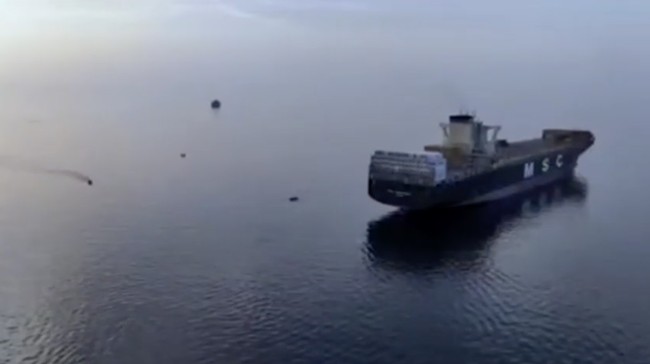
Jakarta, CNBC Indonesia - The Middle East conflict between Iran, the United States (US), and Israel has not only disrupted crude oil and commodity distribution but also impacted the environment, with oil spills occurring due to the war.
Oil spills in the Gulf region have occurred before during the 1991 Gulf War, when Iraqi forces occupying Kuwait deliberately opened oil tanker valves, terminals, and refineries, releasing millions of barrels of crude into the Gulf.
This was done to prevent US-led amphibious landings. Saddam Hussein, the Iraqi dictator, then ordered his troops to set fire to hundreds of nearby oil wells.
A US official stated, ‘If Hell had a national park, it would look like these fires.’
It took six months for international firefighters to extinguish the flames. Over 700km of Saudi Arabian coastline was covered in crude oil. Cleanup took decades and cost over $500 million at the time. Some ecological damage along the coast proved permanent.
However, the current Gulf War could worsen the region’s waters. On 6 May, a large oil spill west of Kharg Island, a major Iranian crude oil export terminal, was visible from space.
Satellite imagery showed the spill spreading across approximately 60 square kilometres of surrounding sea. The extent of damage is not yet clear, but initial estimates range from 3,000 to nearly 90,000 barrels. This is a small fraction of the 6-10 million barrels spilled into the Gulf in 1991.
However, these spills and others recently have raised concerns that the war could cause disasters, making cleanup far more difficult and worsening economic damage already caused by the conflict.
Such damage can occur in various ways, starting with attacks on Kharg Island, which has the most obvious potential to cause a massive, devastating oil spill. Its oil infrastructure can hold around 30 million barrels.
The US has attacked military installations on the island, and US President Donald Trump has repeatedly threatened to destroy Kharg’s oil infrastructure.
Tankers are the next risk. So far, no heavy-loaded tankers have been hit. However, on 26 May, the Greek ‘supertanker’ Olympic Life, capable of carrying 2 million barrels of crude oil, reported an ‘external explosion’ while sailing off the coast of Oman.
The cause of the explosion is unclear. On the same day, Iran vowed to retaliate against US airstrikes. A disaster was averted. Despite an unknown amount of fuel leakage, Olympic Life continued sailing (it is unclear how much cargo it was carrying). However, the Persian Gulf is filled with vulnerable ships.
In early May, Amin Nasser, head of Saudi Aramco, the Saudi oil producer, estimated that over 600 ships were trapped and unable to leave the Strait of Hormuz.
It is not only tankers that pose a danger. Iran’s drone carrier Shahid Bagheri was attacked early in the conflict. The ship has been continuously dumping heavy fuel oil into surrounding waters since the attack. The US claims to have sunk at least 160 Iranian naval vessels during the war. Each of these ships could become a pollution source.
A serious oil spill in the strait would be far harder to manage than usual. Under international maritime law, when an oil spill occurs, nearby ships, port authorities, and coastal nations are expected to help contain the spill and assist the crew. Then, the affected ship’s insurance company pays for cleanup.
However, third parties are increasingly wary of offering help in active war zones. At the start of the war, a salvage tug handling a damaged ship was itself hit, killing at least four crew members.
Diplomatic solutions are also harder to achieve. With ongoing hostilities, managing the international coordination needed for a major incident is more difficult.
Theoretically, diplomatic channels remain open between regional countries. But Saudi Arabia and Iran are unlikely to collaborate on any joint efforts until a lasting peace deal is reached. All sides fear that offers to cooperate may be made in bad faith, leaving them vulnerable to further attacks.
The closure of the strait adds further complications. Iran has long evaded sanctions using shadow fleets — ships that hide their identity or ownership.
The use of such vessels has increased. Shadow fleet operators were the largest group crossing the strait between 2 and 9 March, according to Windward, a maritime monitoring firm, and their numbers continue to grow as the conflict persists.
This makes oil spill cleanup more difficult. Official ships and salvage companies risk being accused of violating sanctions if they are deemed to be ‘assisting or colluding’ with shadow vessels.
‘Most consider this risk so serious they are almost afraid to do the right thing by cleaning up pollution,’ said David Smith of McGill Partners, quoted from The Economist on 30 May 2026.
Shadow vessels are often old and poorly maintained, making them more likely to leak if struck or grounded and because they cannot be identified and tida