
Perry Warjiyo: BI Goes All Out to Defend Rupiah Amid Global Pressures
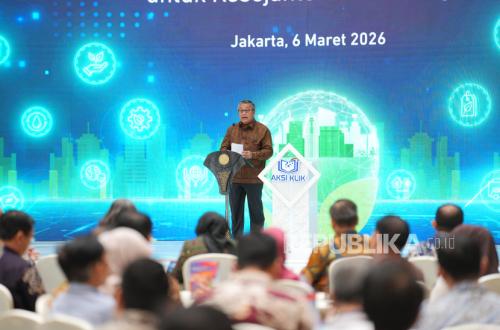
REPUBLIKA.CO.ID, JAKARTA – Bank Indonesia Governor Perry Warjiyo has emphasised the central bank’s serious commitment to maintaining the rupiah’s exchange rate stability amid various challenges from global geopolitical and geo-economic uncertainties. He stressed that the seven strategic steps being pursued under the instructions of Indonesian President Prabowo Subianto represent an all-out effort. “This is not business as usual. Those seven steps are all-out measures!” Perry stated during a press conference of the Financial System Stability Committee (KSSK) II for 2026 at the BI Complex in Jakarta on Thursday (7/6/2026). For instance, he mentioned that intervention steps, including Non-Deliverable Forward (NDF) transactions in overseas markets as well as spot and Domestic Non-Deliverable Forward (DNDF) transactions in the domestic market, are being carried out on a large scale. As a result, these intensive efforts have led to a decline in Indonesia’s foreign exchange reserves (cadev) as of March 2026. “Foreign exchange reserves did drop last month (March 2026) to US$148.2 billion, but US$148.2 billion is more than sufficient. We assess the needs for interventions. Remember! We accumulate foreign exchange reserves during periods of large inflows, which is why we use them during lean times, when outflows are substantial,” he explained. Furthermore, he continued, the interventions are not limited to domestic markets or cash transactions. Perry described these intervention steps as occurring around the world and around the clock. In overseas/off-shore NDF markets, they are conducted in Hong Kong, Singapore, London, and New York. “That’s not business as usual. That’s all out,” he asserted firmly. Regarding the policy of utilising SRBI instruments to attract foreign funds (capital inflow), Perry explained that this step serves as a strategy to balance the capital outflows occurring in SBNs and shares. According to his records, SRBI inflows year-to-date have reached Rp78.1 trillion. Meanwhile, shares have recorded outflows of Rp38.6 trillion, and SBN—although inflows have occurred in recent weeks—have recorded year-to-date outflows of Rp11.7 trillion.