
Perpusnas-UIN Ar-Raniry restore 130 flood-affected ancient manuscripts
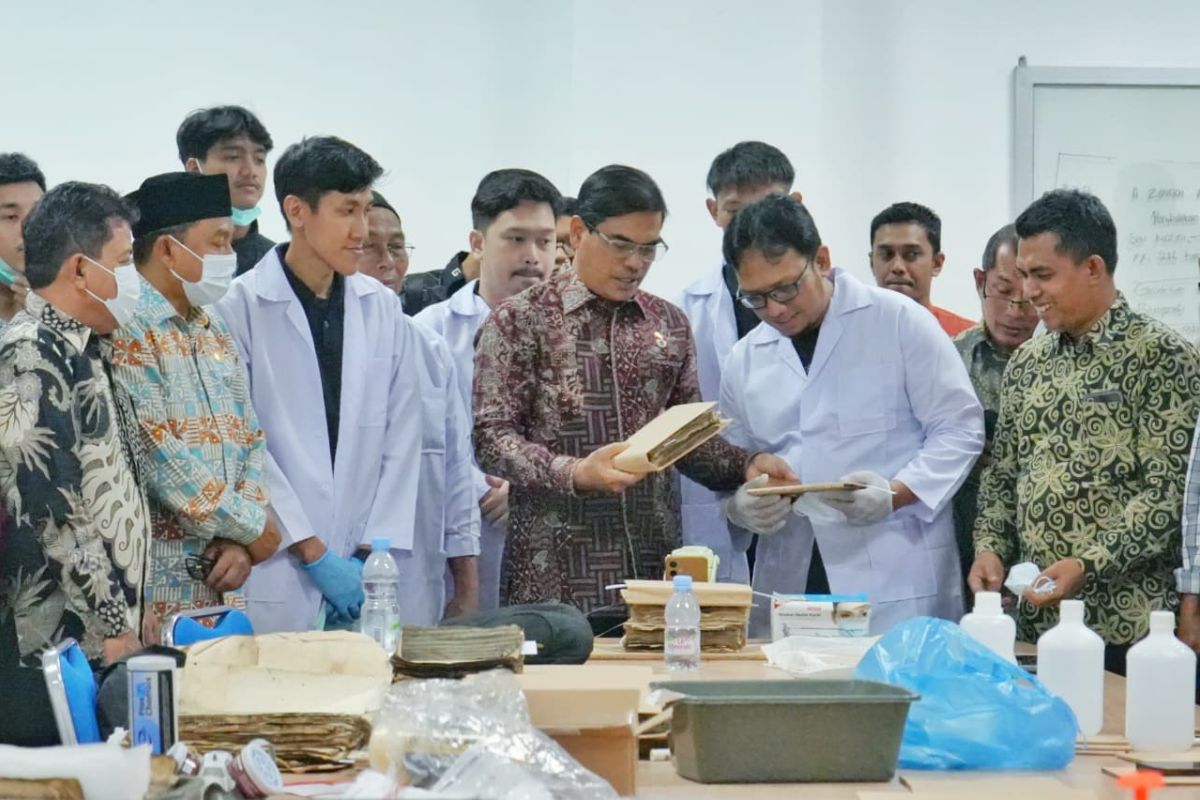
Banda Aceh (ANTARA) – The National Library of Indonesia (Perpusnas), in collaboration with UIN Ar-Raniry Banda Aceh and the Masyarakat Pernaskahan Nusantara (Manassa) Aceh Commission, has restored 130 flood-affected Aceh manuscripts. ‘The restoration of these ancient manuscripts is being carried out for collections belonging to communities in Pidie Jaya and Aceh Utara that were flood-affected at the end of November 2025,’ said Prof. Mujiburrahman, Rector of UIN Ar-Raniry, in Banda Aceh on Thursday. The remarks were made as he inspected preservation and restoration activities at the Faculty of Adab and Humanities, UIN Ar-Raniry Banda Aceh, from 19 to 23 May 2026, involving five conservators from Perpusnas Jakarta. Mujiburrahman explained that the effort to safeguard manuscripts in Aceh has been underway since the rehabilitation and reconstruction following the post-tsunami period, through cooperation with Tokyo University of Foreign Studies (TUFS) in Japan, the University of Leipzig in Germany, the Aceh Government, and the Center for Studies on Education and Society (PKPM) Aceh. In addition to restoration and preservation, the campus also aims to develop a database of Aceh manuscripts as a centre for the study of Aceh and Nusantara ancient manuscripts. ‘The campus is prepared to build a database of ancient manuscripts as a centre for the study of manuscript in Aceh and Nusantara,’ he said. Prof. Mujiburrahman hopes the preservation programme of ancient manuscripts in Aceh can be carried out sustainably, given the high historical and civilisational value of Acehnese manuscripts. Meanwhile, Imam Supangat, head of the National Library RI Conservation Team, said the conservation process begins with identifying the level of damage to the manuscripts. He noted that the manuscripts are then sorted according to repair methods before data collection and treatment. He added that some manuscripts were damaged by high humidity, triggering mould and causing pages to stick together. During the activity, manuscripts were first dried in a drying chamber, and any holes in the sheets would be patched, while manuscripts with high acidity would be neutralised. Then, for loose leaves, they are re-stitched before being given covers and storage boxes. ‘After the entire restoration process is completed, the manuscripts will be returned to their owners,’ he said.