
Perhutani Urges Compliance with Cooperation Agreements to Safeguard Forest Utilisation Governance
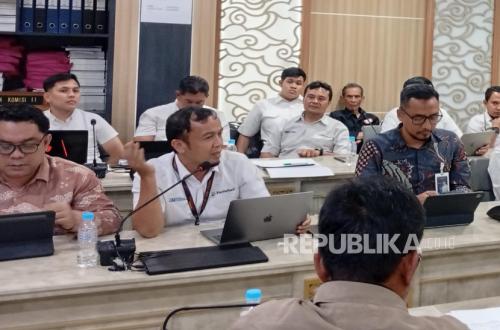
Perhutani West Java Deputy Regional Division Head Komarudin has stressed the importance of compliance with cooperation agreements (PKS) in the utilisation of forest areas. He made the remarks during a hearing (RDP) of Commission II of the West Java Regional House of Representatives (DPRD) together with Perhutani, Palawi, and the Binamitra Cooperative.
Komarudin said that every forest area utilisation cooperation begins with socialisation and joint discussion among the parties. Indeed, every clause in the PKS is discussed in detail so that all parties understand their rights and obligations.
“Every time we process a cooperation agreement, we bring both parties together. Then we discuss it article by article, word by word,” Komarudin said during the hearing at the West Java DPRD building on Wednesday (26/8/2026).
According to him, the discussion covers the title, location, object of cooperation, and the rights and obligations of each party. Once agreed and signed, the PKS has binding legal force.
For this reason, Perhutani is highlighting implementation in the field where activities are deemed inconsistent with the agreement. Komarudin noted that in the matter under discussion, the area stipulated in the PKS was around 5.5 hectares, but its utilisation turned out to have expanded.
“The problem arises when they acknowledge agreement, understand the PKS and sign it legally, it is binding. In the field, from 5.5 hectares it turned out to have expanded,” he said.
Komarudin added that Ministry of Forestry regulations concerning forest area utilisation must also serve as a guideline. Perhutani has a periodic monitoring mechanism to ensure that cooperation implementation proceeds according to the rules.
Supervision is carried out through daily, weekly and monthly monitoring. However, limited personnel mean officers cannot be on site at all times.
If problems are found, Komarudin said, Perhutani also does not immediately take parties deemed to be in violation to court. There are a number of stages to be followed, ranging from warnings, discussions and summonses to mutual agreement.
He expressed hope that all parties would prioritise transparency and resolve issues in accordance with the provisions that have been agreed.
Komarudin also highlighted business activities in forest areas that are seen to be growing. He cited the presence of a number of tenants and cafes in the Tangkuban Perahu-Cikole area that are crowded with visitors.
“This is utilising forest areas. Our concern is that this should be state revenue through us,” he said.
According to Komarudin, the revenue-sharing scheme in the cooperation actually gives a larger portion to partners. The partner’s share, he said, can reach 75 to 85 percent, while Perhutani’s portion is smaller.
“The proportion sharing is larger for the partner. Some get 80 percent, some 75, some 85. Ours is actually the smaller one. What is wrong with being transparent and following the rules,” he said.