
Perhumas Warns of Disinformation and Deepfake Risks in the AI Era
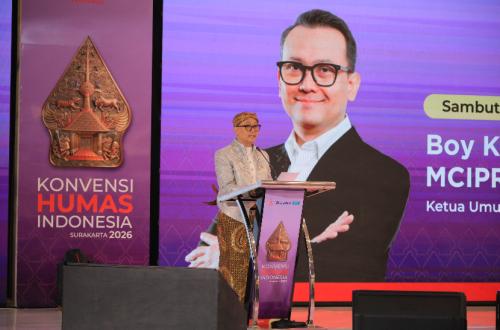
JAKARTA — Advances in artificial intelligence (AI) are increasing the risk of disinformation, deepfakes and the manipulation of digital information. The situation requires public relations practitioners to verify information more carefully, maintain accuracy and ensure that technology is used in accordance with communications ethics.
Boy Kelana, chairman of the Indonesian Public Relations Association (Perhumas), said AI has made it easier to produce and distribute information. However, technological advances have also made it possible to create and spread misleading content more quickly.
“Artificial intelligence has created extraordinary opportunities for human civilisation. At the same time, however, AI has increased our ability to create disinformation, deepfakes, manipulate perceptions and produce fake news on a scale and at a speed that were previously difficult to imagine,” Boy said as he opened the Indonesian Public Relations Convention in Solo, Central Java, on Saturday (17 October 2026).
According to Boy, advances in communications technology have not always been matched by improvements in the public’s ability to understand information. Wider access has instead brought the challenge of distinguishing facts from opinions and manipulated content.
Digital algorithms can also enable information to reach millions of people in a short time. However, the speed of distribution cannot be taken as a measure of the information’s truth or quality.
“An algorithm can make a narrative reach millions of people in a matter of seconds. But algorithms cannot always distinguish what is true, fair or responsible,” Boy said.
Boy said this situation has made the role of public relations practitioners more complex. Beyond conveying information, they need to understand context, identify communications risks and provide the public with accurate explanations.
The use of AI in communications work also requires discipline in verifying information and protecting data confidentiality. Every item published needs to be checked to ensure it meets standards of accuracy and ethics.
Boy said technology can help make work more efficient, but communications decisions still require human judgement. Critical thinking, emotional intelligence and empathy are essential skills in responding to technological change.
“We need intellectual intelligence, but also emotional intelligence. We need data and technology, but also empathy and wisdom. We must understand local issues without losing a global perspective,” Boy said.
Meanwhile, Deputy Minister of Communication and Digital Nezar Patria said AI has also changed how the public obtains information about an organisation’s policies, performance and reputation. People can now use AI-powered search tools without accessing official sources directly.
This change means organisations need to ensure that the information they publish is accurate and credible. The availability of trustworthy data is important because it may be reused through AI-based services.
“The strength of public relations today really lies in how we produce trusted data. But today, the public no longer accesses data directly from companies, agencies and institutions that work with public relations; instead, it does so through artificial intelligence,” Nezar said during his keynote address at the convention.
Nezar explained that the challenge in public communications is no longer limited to widening access to information. Its quality and depth must also be considered so the public receives explanations that can be held to account.
“Our greatest challenge today is no longer access, but depth. Using AI alone is not enough; what matters is the capability and wisdom to use it,” Nezar said.
According to Nezar, AI should be treated as a tool to support communications work, not as a replacement for human reasoning and responsibility. Its use still requires transparency, ethics and accountability, particularly when information is communicated to the public.
Through the 2026 Indonesian Public Relations Convention, Perhumas emphasised the importance of practitioners’ ability to respond to developments in communications technology. Information verification, data management and ethical practice are essential to maintaining public trust amid the growing use of AI.
Source: jawawa.id (https://jawawa.id/newsitem/perhumas-warns-of-disinformation-and-deepfake-risks-in-the-ai-era-1792227033)
Originally published by Republika (https://news.republika.co.id/berita/tn1k0g416/perhumas-ingatkan-risiko-disinformasi-dan-deepfake-di-era-ai), translated from Indonesian