
PERADI SAI Urges Corporate Legal Certainty Under New Criminal Code Amid Criminalisation Concerns
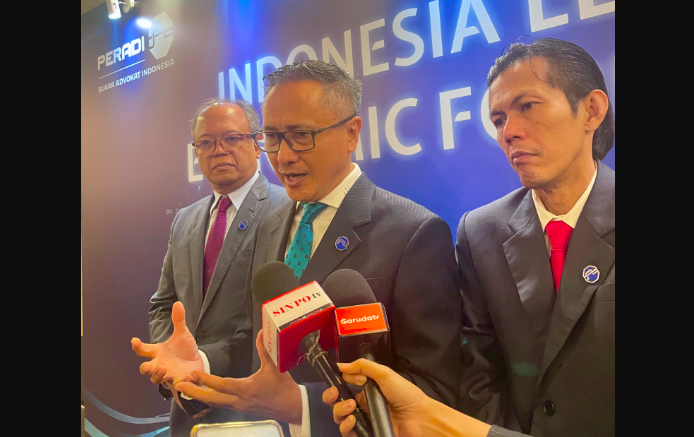
The Indonesian Advocates Association (PERADI SAI) believes the expansion of corporate criminal liability in the new National Criminal Code (KUHP) should not be viewed as a threat to the business world. Instead, the new rules are seen as a way to encourage companies to implement better governance, transparency, and legal compliance. PERADI SAI Secretary General Patra M. Zen stated that one of the fundamental changes in the new KUHP is the application of corporate criminal liability to all criminal acts, no longer limited to specific offences such as corruption, environmental crimes, and money laundering. “Previously, corporate crime was only for specific offences. Now, corporate liability applies to all criminal acts,” Patra said at the Indonesia Legal and Economic Forum (ILEF) 2026 in Jakarta on Thursday. Despite the broader scope, he stressed that the business community should not see this as a threat. “We don’t see this as a threat. Instead, we need a common understanding so we can support the government’s programme,” he said. Patra noted that several aspects still need to be discussed to ensure proportional implementation, including the theory of corporate criminal liability to be used in law enforcement practice. “There are three theories of criminal liability. One requires proof of fault first, there is strict liability where fault does not need to be proven, and there is vicarious liability. We still need to hear the views of investigators, public prosecutors, and judges on these matters,” he said. At the same forum, PERADI SAI Chairman Harry Ponto emphasised that the main spirit of the corporate criminal provisions in the new KUHP is to create order and accountability in company management. He said companies can no longer shirk responsibility by simply blaming subordinates when legal violations occur that could have been prevented through adequate supervision. “The spirit of the new KUHP is to create order. No more using the old paradigm of ‘it wasn’t me, it was my staff’, when perhaps the supervision was not proper or there was omission,” Harry said. He cited examples such as waste disposal or other operational violations that often relate to weak supervision and prevention systems. “If a violation like waste disposal occurs, why did it happen? Because it wasn’t prevented and there wasn’t proper training. So, we want to be better going forward. No more hiding,” he stated. Harry stressed that the ultimate goal of the corporate criminal provisions is not to hinder business activity, but to create a healthier and more integrity-filled business climate. “This encourages companies to be healthier, more orderly, and more law-abiding,” he said. He also noted that many business actors have questions regarding the implementation of the new KUHP, which has been in effect for only one semester. The ILEF forum was held to bring together the perspectives of law enforcement and business actors to prevent differing interpretations. Harry also highlighted the importance of legal certainty for business actors when making discretionary business decisions, ensuring that such judgements are not criminalised as long as there is no criminal intent. Daniel Ginting, Chair of the ILEF 2026, echoed the sentiment, stating that a common understanding between business actors and law enforcement is key to ensuring the new rules do not create uncertainty. He said the first six months of the KUHP’s implementation is a crucial moment to evaluate and align perceptions, providing a space to discuss additional points with both private and state-owned enterprises.