
Peradi SAI: National Criminal Code and Criminal Procedure Code Require Lawyers to Update Their Practice
Jakarta (ANTARA) – The Indonesian Advocates Association – Indonesian Advocates’ Voice (Peradi SAI) has stressed that the entry into force of the national Criminal Code (KUHP) and Criminal Procedure Code (KUHAP) requires lawyers to update their practices.
Speaking at a legal training seminar in Jakarta on Friday, Peradi SAI National Leadership Council (DPN) Chair Harry Ponto said Indonesia’s criminal procedure law now treats victims as subjects whose rights must be restored, rather than merely as witnesses.
“Peradi SAI lawyers must be at the forefront of this change, both when assisting victims and when defending defendants,” Harry said, according to a written statement.
Peradi SAI DPN Secretary-General Patra Zen outlined lawyers’ roles at every stage, from providing legal education to victims and preparing applications to assisting them in court and pursuing enforcement.
He also explained the routes for seeking restitution: during the investigation stage through the Witness and Victim Protection Agency (LPSK), by joining a claim to the criminal proceedings, or through an application after a judgment has become legally final.
Patra cited examples of rulings that had granted restitution, including costs for psychological recovery for child victims. He stressed that restitution is enforceable: if an offender fails to pay, their assets can be seized and auctioned by prosecutors.
Professor Diding Rahmat, a criminal law professor at the Marshal Suryadarma University (Unsurya), said the national criminal law framework no longer asks only how long an offender should be imprisoned, but also whether the victim has been restored.
Restitution is charged to the offender, while compensation is borne by the state. Diding also pointed to areas where regulations are not yet aligned, including whether restitution can be imposed on third parties, who is eligible to receive compensation, and differing methods for calculating time limits under the KUHAP and the Witness and Victim Protection Law.
“Success is not measured by the wording of the ruling, but by the recovery that victims actually receive. Ubi jus, ibi remedium: where there is a right, there is a remedy,” Professor Diding said.
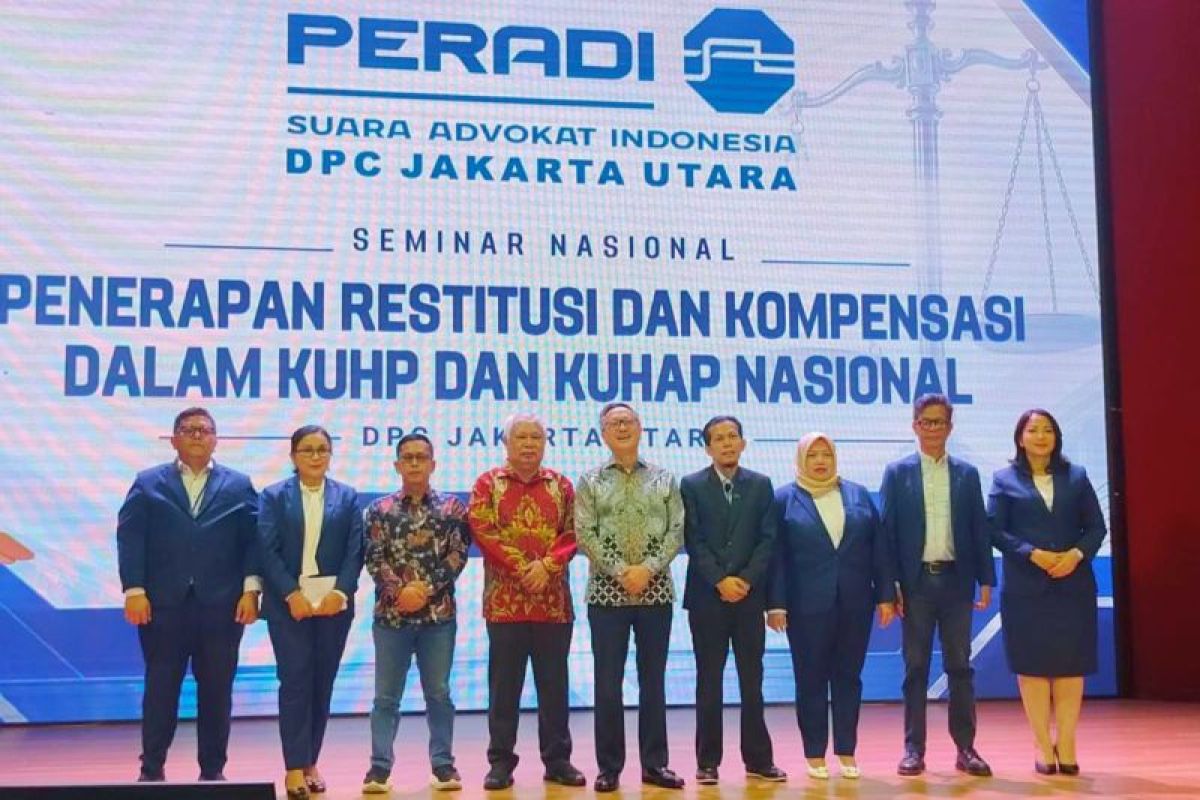
The seminar, entitled “The Application of Restitution and Compensation under the National Criminal Code and Criminal Procedure Code”, was organised by the North Jakarta branch of Peradi SAI.
It discussed the shift in the national criminal justice paradigm from merely punishing offenders towards restoring victims’ rights, as well as lawyers’ strategic role in ensuring that recovery is achieved in practice.
North Jakarta Peradi SAI branch chair Sri Astuti said the seminar was part of the branch’s commitment to continually improving its members’ professional skills.
She said North Jakarta sees a high volume of cases and that many victims are unaware of their right to compensation.
“We want every lawyer in this branch not only to understand the rules, but also to be skilled at advocating for them in practice,” Sri Astuti said.