
People's Schools: Realising Equitable Education
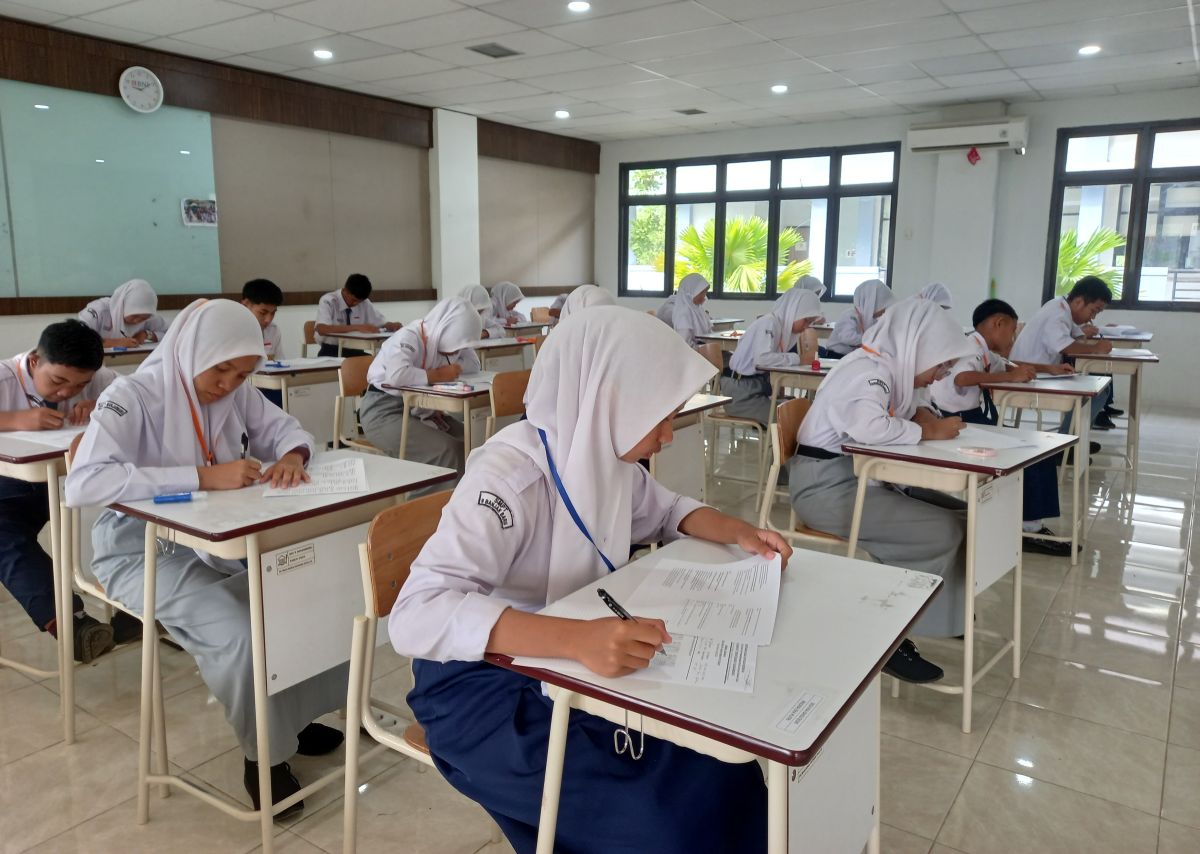
The atmosphere in a pioneer Sekolah Rakyat (SR) classroom at the Banjarmasin Centre for Social Welfare Education and Training (BBPPKS) in Banjarbaru was quiet that morning as 125 junior and senior high school students sat for their end-of-year promotion exams for the 2025/2026 academic year. The students appeared confident in answering the exam questions, while teachers and education staff conducted strict supervision to ensure the exams proceeded in an orderly and smooth manner.
Anna Maggefirah, 16, a Year 10 student from Banjarbaru, said she and her classmates had long prepared for the exams by attending extra tutoring sessions. “Alhamdulillah, the exam went smoothly and I am confident I can get good grades. My friends and I have been preparing for a long time, including attending additional tutoring,” said an optimistic Anna.
Anna is one of 75 students who received the opportunity to continue their education at the pioneer SR high school, temporarily located at the BBPPKS Banjarmasin. A further 50 students are pursuing junior high school education there. After completing her studies at MTS Umul Quran, Anna initially did not intend to continue her schooling due to her family’s difficult economic conditions. She is an orphan; her father died when she was young, and her mother, Siti Mursidah, works only as a masseuse with an irregular income far from sufficient. They fall into the Decile 1 pre-prosperous category, a group classified as very poor.
“I feel very fortunate to have the opportunity to attend a People’s School. Hopefully, I can realise my ambition to become an archaeologist because I love history,” said Anna. A similar story was shared by Zainah, 13, a Year 7 student from Kotabangun, Astambul District, Banjar Regency. Born into a pre-prosperous family far from the city, her hopes had once diminished. Now, with the modern education and facilities at the People’s School, the academically outstanding Zainah has regained the courage to dream of achieving her ambition to become a policewoman.
The People’s School programme is considered an effort to realise equitable education for all Indonesian citizens. “Although they come from underprivileged families or are marginalised, the talents and academic abilities of most of them are quite good. Of course, they need encouragement, which is the task of the teachers and educators at this People’s School,” said Diah Hasna Nabilla, a teacher at the pioneer SR at BBPPKS Banjarmasin. A graduate of the State University of Solo (UNS) with a degree in English Literature, she felt compelled to help marginalised children achieve their goals.
Education is seen as a key to cutting the chain of poverty. “Education is the main key to breaking the cycle of poverty. Through increased access to knowledge and skills, education creates better job opportunities and promotes community economic independence,” said Assistant I for Public Welfare, Galuh Tantri Narindra. Data records show there are still 64,000 school dropouts in South Kalimantan, the majority of whom come from pre-prosperous families.
Echoing this, the Head of BBPPKS Banjarmasin, Yadi Muchtar, said the programme focusing on educational services for the poor and those with limited access to education provides new opportunities and hope regarding citizens’ right to education. “There has been a big change in the students, both socially and academically. Those who were once shy and insecure are now more confident and brave enough to appear in public. Many of them excel in their lessons and achieve. This is very positive, especially when we talk about hopes for Golden Indonesia 2045.”
The Sekolah Rakyat is a priority government programme, run through the Ministry of Social Affairs, providing free boarding school education targeted at children from pre-prosperous families (Decile 1 and 2) and school dropouts. The permanent schools are being built in three areas: Banjarbaru City, Barito Kuala Regency, and Tanah Bumbu. Each school will accommodate 270 students, bringing the total to 810 students for the 2026/2027 academic year.