
Pentagon Clears Shotgun- and Grenade Launcher-Armed Drone, Signalling a New Era in Close-Range Air Warfare?
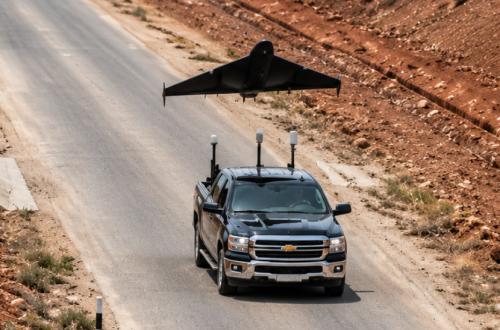
JAKARTA — The Pentagon has opened the way for the US military to use drones armed with shotguns and grenade launchers. The Cerberus MI, developed by Skyborne Technologies, has been added to the government-cleared list of unmanned aircraft systems. The move marks a technological development as relatively small aircraft are designed to carry direct-fire weapons and be used repeatedly.
Skyborne Technologies announced on Monday (26 October 2026) that the Cerberus MI had officially been added to the US Department of Defense’s Blue UAS Cleared List. Its inclusion allows US military units to procure and operate the drone platform without seeking a special exemption from existing unmanned aircraft procurement rules.
Business Insider reported on Tuesday (27 October 2026) that the Cerberus MI is among the latest developments in the race to build armed drones. Unlike kamikaze drones, which destroy themselves along with their targets, this aircraft is designed to fire its weapons, return to its operator, be reloaded and fly again on another mission.
The Pentagon’s decision does not mean the Cerberus MI has been used in combat or that all its weapons capabilities have been declared operationally ready. Blue UAS clearance primarily concerns a platform’s eligibility for procurement and use under government security and compliance requirements; deployment and the use of weapons in military operations remain subject to separate authorities and rules.
Nevertheless, the development signals an important shift in the direction of unmanned aircraft technology. While small drones have often been used for reconnaissance, to carry explosives or as one-way attack vehicles, the Cerberus MI offers a different approach, combining flight capability, sensors, artificial intelligence and weapons that can be used repeatedly.
Carrying a shotgun and a 40mm grenade launcher
The Cerberus MI is classified by the US military as a Group 2 small unmanned aircraft system. Skyborne says the drone weighs about 18 kilograms in the configuration announced, allowing personnel to carry and deploy it without large aircraft-launch facilities.
The drone was designed from the outset to carry direct-fire weapons, rather than being a commercial drone later modified with added weaponry. One design consideration was keeping the aircraft stable when a weapon is fired, as recoil could disrupt the control and position of a relatively light aircraft.
Skyborne offers two main weapon options, which can be fitted separately. The first is CHAOS, a 12-gauge shotgun designed for mounting on an unmanned system. The second is HAVOC, a low-velocity 40mm grenade launcher.
Both systems are designed to use widely recognised military-standard ammunition. The company says using ammunition already available in defence supply chains could simplify logistical support compared with developing entirely new, specialised ammunition.
According to the company, the Cerberus MI can fly for about 35 minutes while carrying weapons. Skyborne also says the system can support firing at ranges of more than 300 metres through the integration of sensors and fire-control equipment.
The 300-metre figure, however, is a capability claimed by the developer, not evidence that the drone can destroy every type of target at that range. Effectiveness will depend on the ammunition, the target’s characteristics, flight conditions and testing results that have not yet been fully disclosed.
The shotgun and grenade launcher give the Cerberus MI two distinct weapon capabilities. A shotgun could be used in a close-range counter-targeting role, while the grenade launcher broadens the drone’s potential use against targets suited to that type of ammunition.
The two weapons should not, however, be assumed to be equally effective across all missions. For example, engaging other drones in the air would require different testing from firing at ground targets.
Artificial intelligence assists with target acquisition
In addition to carrying weapons, the Cerberus MI is equipped with software called EXITUS AI. Skyborne developed the technology to help operators identify targets, combine sensor information and calculate firing solutions when the aircraft is in a suitable position.
The system uses electro-optical and infrared sensors, as well as a laser rangefinder. Data from the different sensors are processed together to help operators understand a target’s position and characteristics without relying entirely on direct visual observation.
Skyborne says the artificial intelligence in the Cerberus MI does not mean that decisions to fire are handed entirely to a computer. The company says the system uses a human-in-the-loop approach, with a person remaining involved in decisions about weapon use.
This distinction matters as the development of autonomous combat aircraft raises questions about how responsibility is divided between operators and machines. A system that helps identify or track a target is not automatically the same as one authorised to select and attack targets without human approval.
For the Cerberus MI, the AI functions described by the company are primarily intended to support observation and the calculation of firing solutions. So far, no independent testing report has comprehensively demonstrated the system’s accuracy across all battlefield conditions.
Such limitations matter because combat environments pose challenges that differ from technology demonstrations. Targets may move unpredictably, communications may be disrupted, and visibility can change because of weather, smoke or electronic interference.
For that reason, the success of artificial intelligence cannot be judged solely by its ability to detect objects. A system must also distinguish between objects that may lawfully be attacked and other objects or activity that must not be targeted under the law and military rules of engagement.
Source: jawawa.id (https://jawawa.id/newsitem/pentagon-clears-shotgun-and-grenade-launcher-armed-drone-signalling-a-new-era-in-close-range-air-warfare-1793163193)
Originally published by Republika (https://news.republika.co.id/berita/tnlm08451/pentagon-restui-drone-bersenjata-shotgun-dan-peluncur-granat-era-baru-perang-udara-jarak-dekat), translated from Indonesian