
Penggalaman Village Farmers Learn to Overcome Flood-Prone Land and Make Fertiliser from Weeds
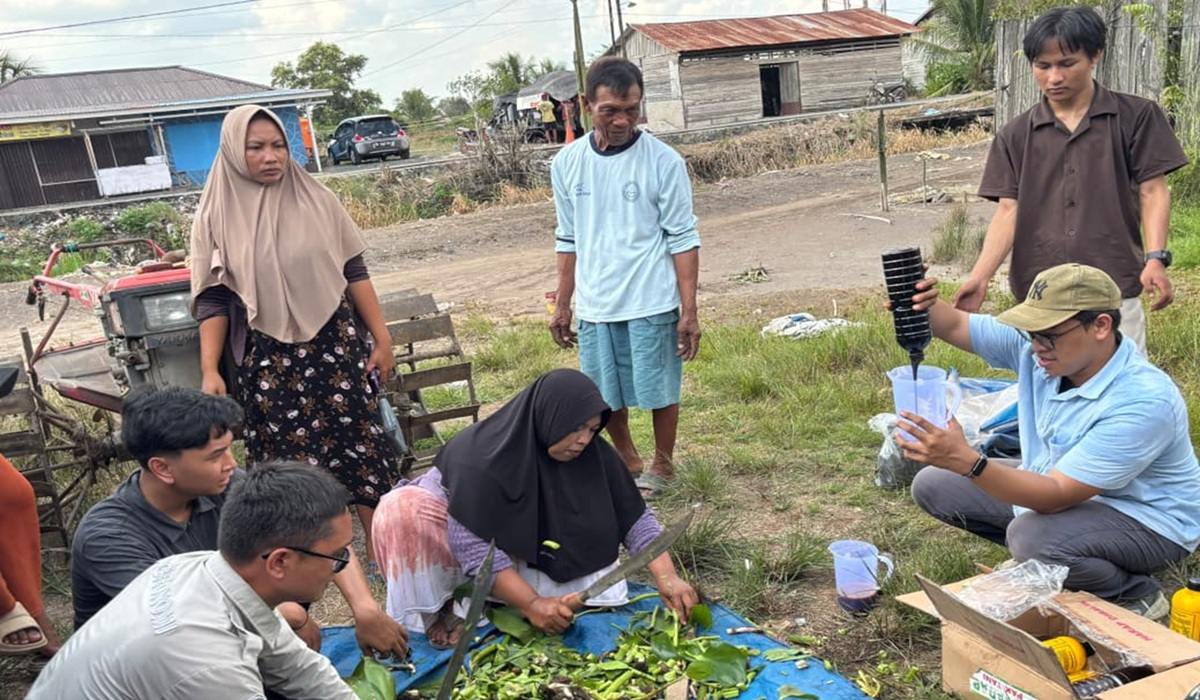
Yards in Penggalaman Village, Martapura Barat District, Banjar Regency, are frequently affected by flooding during the rainy season. The flood-prone geographical conditions often hamper residents’ farming activities as crops die from being submerged in water.
In response to this challenge, a community service team from Lambung Mangkurat University (ULM) has provided a solution through training on the utilisation of flood-prone land and the processing of weed waste. The activity focused on vertical farming techniques and the use of water hyacinth, which is abundant in the local swamp areas.
The programme was funded by the Directorate of Research and Community Service, Directorate General of Research and Development, Ministry of Higher Education, Science and Technology. It is part of the Community Service Programme under the Community-Based Empowerment Scheme for the 2026 fiscal year.
The team leader, Hayatun Izma, explained that the choice of vertical farming techniques was based on the village’s flood-prone land conditions. Together with team members Nazhipah Isnani and Gani Jawak, they introduced a tiered planting system.
“Vertical farming was chosen because it does not require a large flat area. Plants are grown in containers stacked upwards, so the roots are not submerged even when the ground below is flooded,” Izma explained on Saturday (15/8/2026).
She added that Penggalaman Village has significant land potential. Through this training, residents are expected to be able to utilise their home yards to grow productive plants, particularly family medicinal plants (TOGA).
In addition to the flooding problem, the ULM team highlighted the water hyacinth population that thrives in residential areas and rice fields. Until now, the aquatic plant has been regarded merely as a nuisance weed that is simply discarded.
The lecturers educated residents that water hyacinth is rich in nutrients and can be processed into liquid organic fertiliser. “Fertiliser made from water hyacinth is excellent for medicinal plants because it is nutrient-rich and environmentally friendly. Its use also helps clean the environment of weeds,” said Izma.
These benefits were felt directly by Anah, one of the training participants. She admitted that she had only just learned that planting could be done without direct contact with flood-prone soil. “All this time I planted directly in the yard and the plants died when it flooded. I also usually threw away water hyacinth; it never occurred to me that it could be used as fertiliser,” she said.
The head of the Bahagia Farmers Group, Mua’lim, welcomed the initiative. According to him, this kind of training is new for his members and provides hope that village land will no longer be left idle during the rainy season.
“Hopefully in the future our village can be more productive and the land will not be abandoned because of flooding,” Mua’lim said.
As a follow-up measure, the ULM lecturer team plans to provide ongoing assistance. They will monitor the development of medicinal plants that have been planted on the vertical farming racks belonging to the Bahagia Farmers Group to ensure that the programme provides permanent economic and environmental benefits for the residents of Penggalaman Village.
Source: jawawa.id (https://jawawa.id/newsitem/penggalaman-village-farmers-learn-to-overcome-flood-prone-land-and-make-fertiliser-from-weeds-1787147466)
Originally published by Media Indonesia (https://mediaindonesia.com/nusantara/923717/petani-desa-penggalaman-belajar-atasi-lahan-rawan-banjir-dan-buat-pupuk-dari-gulma), translated from Indonesian