
Pedestrians must be prioritised when 'pelican crossing' light is green
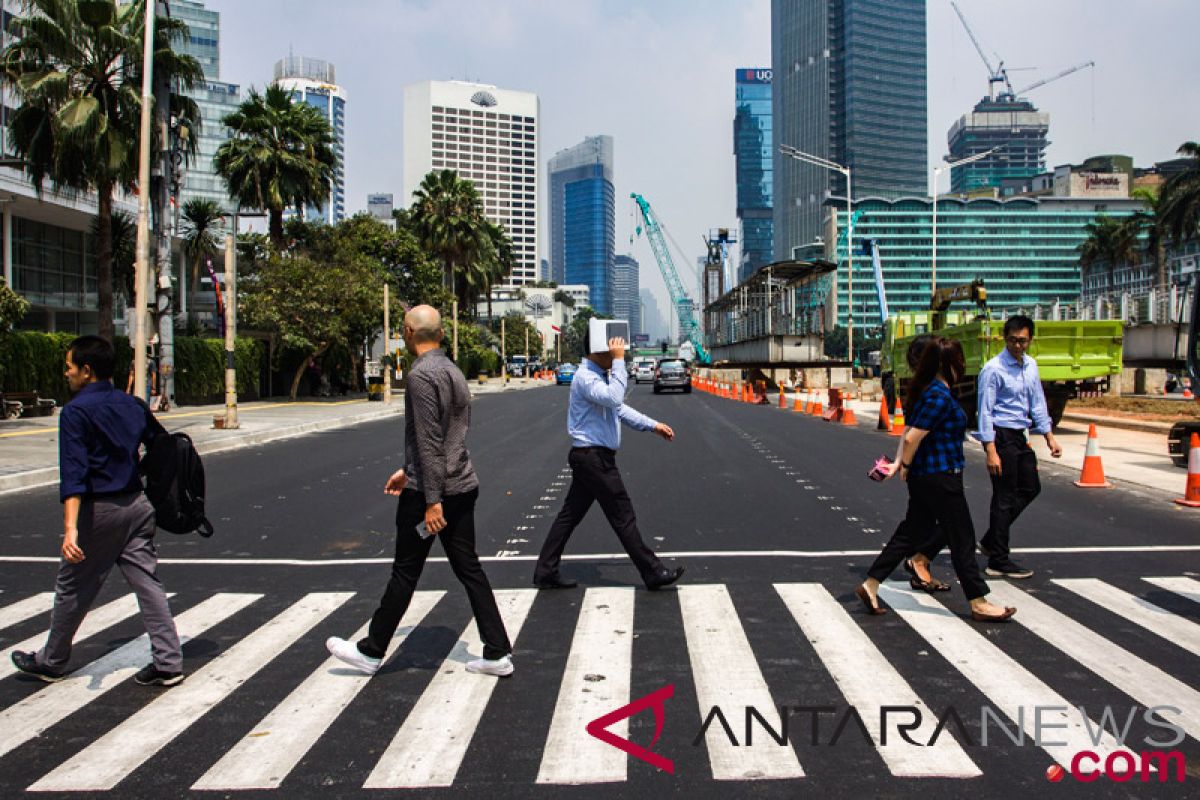
Jakarta (ANTARA) – The Transportation Office (Dishub) of DKI Jakarta Province has affirmed that pedestrians are road users who must be prioritised when the lights at a pedestrian crossing equipped with traffic signals (pelican crossing) turn green.
Under those conditions, all vehicles are obliged to stop behind the stop line until the crossing process is complete.
“When the crossing light turns green, vehicles must stop and give priority to pedestrians who are crossing,” said Head of the DKI Jakarta Transportation Office Budi Awaluddin in an official statement received in Jakarta on Saturday.
Budi issued the clarification in response to a viral incident in which a vehicle allegedly ran a red light at the pelican crossing at Bundaran HI, Central Jakarta, on Thursday (23 July).
A pelican crossing is a road safety facility designed to reduce the potential for traffic accidents. Therefore, every road user must comply with the applicable traffic signal devices (APILL).
The pelican crossing system works using a controller that manages the crossing cycle. Pedestrians must first press the crossing button, then wait until the green light comes on.
Budi said the Bundaran HI pelican crossing is a facility with high activity because it connects directly to the Bundaran HI MRT Station and a Transjakarta bus stop, and is located in an area of offices, hotels, and shopping centres.
According to him, the timing settings at the Bundaran HI pelican crossing have been adjusted to the traffic characteristics of the location. At certain hours, the waiting time ranges from 40 to 50 seconds, while the crossing time is set at 20 seconds.
These durations refer to Decree of the Director General of Land Transportation Number 43 of 1997, taking into account various aspects, including pedestrian walking speed, the width of road being crossed, the number of pedestrians in each cycle, and the effective width of the zebra crossing.
The calculation also accommodates the needs of vulnerable groups, including the elderly, persons with disabilities, children, and road users carrying goods.
Nevertheless, Dishub DKI continues to evaluate the timing settings of the pelican crossing whenever pedestrian volumes increase or traffic conditions on the ground change.
“The duration of the pelican crossing is not fixed. Evaluations can be carried out periodically by looking at needs in the field, especially during peak hours,” Budi explained.