
Peak of the Rainy Season Forecast to Last Three Months
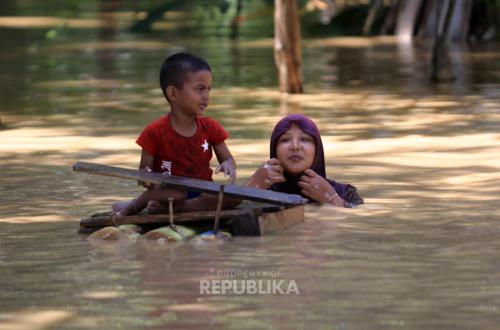
JAKARTA — The Meteorology, Climatology and Geophysics Agency (BMKG) is preparing measures to address potential hydrometeorological disasters during the 2026 rainy season. BMKG head Teuku Faisal Fathani said climate change was increasing the risk of extreme weather, which needed to be anticipated.
“Although, in theory, Indonesia is not a country that experiences tropical cyclones as severe as those in Japan, for example, or the Philippines, climate change means we still have to anticipate these extreme events. We will all work to control and anticipate their effects so that the impact on the wider public is minimised,” Faisal said, according to a BMKG statement on Tuesday (10 November 2026).
Faisal made the remarks after attending a limited meeting on natural-disaster preparedness with President Prabowo Subianto at the State Palace in Jakarta on Monday (9 November 2026). He said most parts of Indonesia would enter the rainy season in November and December 2026.
However, this year’s rainy season began around 20 to 30 days later than usual. The peak is forecast to last three months, from December 2026 to February 2027, with rainfall generally expected to be within the normal range.
“That means rainfall will be in line with the climatological average for the past 30 years, but its duration will be shorter, so we need to anticipate wet hydrometeorological disasters — floods and landslides caused by extreme rainfall,” Faisal said.
To support preparedness among the government and the public, BMKG provides early warnings of potential hazards on its website, bmkg.go.id/peringatan-dini. These cover the risk of extreme rainfall, tropical cyclones, tidal flooding, poor air quality, earthquakes and tsunamis.
For rainfall, BMKG issues short-term nowcasts at subdistrict level for the next three to six hours. The information identifies areas under alert, standby and warning status.
The agency also provides daily forecasts for up to seven days ahead, dekadal forecasts for up to ten days, and monthly information. The data can be used to identify areas that may be affected by hydrometeorological disasters.
The information forms the basis for coordination between BMKG and the National Disaster Mitigation Agency (BNPB) to identify areas and periods at risk of extreme rainfall, flooding and landslides. Faisal said mapping areas at risk was necessary to determine preventive measures.
“The information will be translated into action. Our teams are currently identifying which subdistricts will experience extreme rainfall, and where and when flooding and landslides may occur. This will allow us to take preventive measures,” Faisal said.
According to Faisal, mitigating hydrometeorological disasters also requires spatial planning, infrastructure preparedness and coordination across agencies. BMKG is supporting risk-reduction efforts through weather-modification operations (OMC) conducted with BNPB.
Faisal said OMC could be carried out when a provincial government declares an emergency-alert status. Under this arrangement, BNPB conducts the operation, with technical supervision from BMKG.
OMC uses an approach tailored to atmospheric conditions and the needs of the target area, particularly to reduce the risk of extreme rainfall in disaster-prone locations. BMKG is also continuing to monitor the potential for tropical cyclones towards the end of 2026 and the beginning of 2027.
Faisal said tropical cyclones towards the end of this year were more likely to form in the Northern Hemisphere. In early 2027, cyclone activity was expected to be dominated by the Southern Hemisphere, south of the equator.
BMKG is also providing meteorological information to the Ministry of Home Affairs, which chairs the Task Force for Accelerating Post-Disaster Rehabilitation and Reconstruction (Satgas PRRP) in three provinces. The information is also being shared with BNPB and the Ministry of Public Works to support coordination on disaster response and risk preparedness during the rainy season.
“Every day, even every hour, BMKG continues to support the Ministry of Home Affairs as chair of the Satgas PRRP for accelerating post-disaster rehabilitation and reconstruction in those three provinces. This information is also being shared with BNPB and the Ministry of Public Works so we can all prepare for the rainy season with better readiness,” Faisal said.
Home Affairs Minister Tito Karnavian said President Prabowo Subianto had instructed officials to prepare for the possibility of extreme rainfall. One measure requested was to conduct OMC in an effort to make rain fall in safer areas, including over waters, thereby reducing disaster risks in vulnerable locations.
“The President has also ordered the head of BNPB, the defence minister, the TNI commander and the national police chief to put all emergency equipment and facilities on standby, such as tents and ready-to-eat food, to prepare for the worst-case scenario in the weather conditions forecast by BMKG,” Tito said.
Source: jawawa.id (https://jawawa.id/newsitem/peak-of-the-rainy-season-forecast-to-last-three-months-1794300655)
Originally published by Republika (https://esgnow.republika.co.id/berita/to9zy2416/puncak-musim-hujan-diprediksi-berlangsung-tiga-bulan), translated from Indonesian